
This is your morning Open Thread. Pour your favorite beverage and review the past and comment on the future.
Find the past “On This Day in History” here.
September 21 is the 264th day of the year (265th in leap years) in the Gregorian calendar. There are 101 days remaining until the end of the year.
On this day in 1780, during the American Revolution, American General Benedict Arnold meets with British Major John Andre to discuss handing over West Point to the British, in return for the promise of a large sum of money and a high position in the British army. The plot was foiled and Arnold, a former American hero, became synonymous with the word “traitor.”
Born in Connecticut, he was a merchant operating ships on the Atlantic Ocean when the war broke out in 1775. After joining the growing army outside Boston, he distinguished himself through acts of cunning and bravery. His actions included the Capture of Fort Ticonderoga in 1775, successful defensive and delaying tactics despite losing the Battle of Valcour Island on Lake Champlain in 1776, the Battle of Ridgefield, Connecticut (after which he was promoted to major general), operations in relief of the Siege of Fort Stanwix, and key actions during the pivotal Battles of Saratoga in 1777, in which he suffered leg injuries that ended his combat career for several years.
In spite of his successes, Arnold was passed over for promotion by the Continental Congress while other officers claimed credit for some of his accomplishments. Adversaries in military and political circles brought charges of corruption or other malfeasance, but he was acquitted in most formal inquiries. Congress investigated his accounts, and found that he owed it money after he had spent much of his own money on the war effort. Frustrated and bitter, Arnold decided to change sides in 1779, and opened secret negotiations with the British. In July 1780, he sought and obtained command of West Point in order to surrender it to the British. Arnold’s scheme was exposed when American forces captured British Major John André carrying papers that revealed the plot. Upon learning of André’s capture, Arnold fled down the Hudson River to the British sloop-of-war Vulture, narrowly avoiding capture by the forces of George Washington, who had been alerted to the plot.
Arnold received a commission as a brigadier general in the British Army, an annual pension of £360, and a lump sum of over £6,000. He led British forces on raids in Virginia, and against New London and Groton, Connecticut, before the war effectively ended with the American victory at Yorktown. In the winter of 1782, Arnold moved to London with his second wife, Margaret “Peggy” Shippen Arnold. He was well received by King George III and the Tories but frowned upon by the Whigs. In 1787, he entered into mercantile business with his sons Richard and Henry in Saint John, New Brunswick, but returned to London to settle permanently in 1791, where he died ten years later.

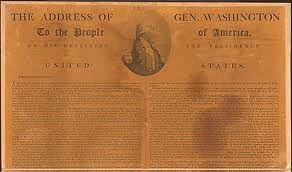 Originally published in David Claypoole’s American Daily Advertiser on September 19, 1796 under the title “The Address of General Washington To The People of The United States on his declining of the Presidency of the
 The building would take nearly a century to complete, as architects came and went, the British set fire to it and it was called into use during the Civil War. Today, the Capitol building, with its famous cast-iron dome and important collection of American art, is part of the Capitol Complex, which includes six Congressional office buildings and three Library of Congress buildings, all developed in the 19th and 20th centuries.
 On September 25, 1789, the first Congress of the United States adopted 12 amendments to the U.S. Constitution–the Bill of Rights–and sent them to the states for ratification. Ten of these amendments were ratified in 1791. In November 1789, North Carolina became the 12th state to ratify the U.S. Constitution. Rhode Island, which opposed federal control of currency and was critical of compromise on the issue of slavery, resisted ratifying the Constitution until the U.S. government threatened to sever commercial relations with the state. On May 29, 1790, Rhode Island voted by two votes to ratify the document, and the last of the original 13 colonies joined the United States. Today, the U.S. Constitution is the oldest written constitution in operation in the world.

Recent Comments