Tag: Open Thread

On This Day In History October 8

This is your morning Open Thread. Pour your favorite beverage and review the past and comment on the future.

Find the past “On This Day in History” here.

October 8 is the 281st day of the year (282nd in leap years) in the Gregorian calendar. There are 84 days remaining until the end of the year.


On this day in 1871, flames spark in the Chicago barn of Patrick and Catherine O’Leary, igniting a 2-day blaze that kills between 200 and 300 people, destroys 17,450 buildings,leaves 100,000 homeless and causes an estimated $200 million (in 1871 dollars; $3 billion in 2007 dollars) in damages.

The Great Chicago Fire was a conflagration  that burned from Sunday, October 8, to early Tuesday, October 10, 1871, killing hundreds and destroying about 4 square miles (10 km2) in Chicago, Illinois. Though the fire was one of the largest U.S.  disasters of the 19th century, the rebuilding that began almost immediately spurred Chicago’s development into one of the most populous and economically important American cities.

On the municipal flag of Chicago, the second star commemorates the fire. To this day the exact cause and origin of the fire remain a mystery.

The fire started at about 9 p.m. on Sunday, October 8, in or around a small shed that bordered the alley behind 137 DeKoven Street.[3]  The traditional account of the origin of the fire is that it was started by a cow kicking over a lantern in the barn owned by Patrick and Catherine O’Leary. Michael Ahern, the Chicago Republican reporter who created the cow story, admitted in 1893 that he had made it up because he thought it would make colorful copy.

The fire’s spread was aided by the city’s overuse of wood for building, a drought prior to the fire, and strong winds from the southwest that carried flying embers toward the heart of the city. The city also made fatal errors by not reacting soon enough and citizens were apparently unconcerned when it began. The firefighters were also exhausted from fighting a fire that happened the day before.

After the fire

Once the fire had ended, the smoldering remains were still too hot for a survey of the damage to be completed for days. Eventually it was determined that the fire destroyed an area about four miles (6 km) long and averaging 3/4 mile (1 km) wide, encompassing more than 2,000 acres (8 km²). Destroyed were more than 73 miles (120 km) of roads, 120 miles (190 km) of sidewalk, 2,000 lampposts, 17,500 buildings, and $222 million in property-about a third of the city’s valuation. Of the 300,000 inhabitants, 90,000 were left homeless. Between two and three million books were destroyed from private library collections. The fire was said by The Chicago Daily Tribune to have been so fierce that it surpassed the damage done by Napoleon’s siege of Moscow in 1812. Remarkably, some buildings did survive the fire, such as the then-new Chicago Water Tower, which remains today as an unofficial memorial to the fire’s destructive power. It was one of just five public buildings and one ordinary bungalow spared by the flames within the disaster zone. The O’Leary home and Holy Family Church, the Roman Catholic congregation of the O’Leary family, were both saved by shifts in the wind direction that kept them outside the burnt district.
Punting the Pundits

“Punting the Pundits” is an Open Thread. It is a selection of editorials and opinions from around the news medium and the internet blogs. The intent is to provide a forum for your reactions and opinions, not just to the opinions presented, but to what ever you find important.

Thanks to ek hornbeck, click on the link and you can access all the past “Punting thea Pundits”.

Follow us on Twitter @StarsHollowGzt

Paul Krugman: The Boehner Bunglers

The federal government is shut down, we’re about to hit the debt ceiling (with disastrous economic consequences), and no resolution is in sight. How did this happen?

The main answer, which only the most pathologically “balanced” reporting can deny, is the radicalization of the Republican Party. As Thomas Mann and Norman Ornstein put it last year in their book, “It’s Even Worse Than It Looks,” the G.O.P. has become “an insurgent outlier – ideologically extreme; contemptuous of the inherited social and economic policy regime; scornful of compromise; unpersuaded by conventional understanding of facts, evidence and science; and dismissive of the legitimacy of its political opposition.”

But there’s one more important piece of the story. Conservative leaders are indeed ideologically extreme, but they’re also deeply incompetent. So much so, in fact, that the Dunning-Kruger effect – the truly incompetent can’t even recognize their own incompetence – reigns supreme.

Richard (RJ) Eskow: Republicans Discover Government, Promptly Convene ‘Imperial Congress’

Picture a lone Republican running through the darkened hallways of power, paraphrasing Soylent Green‘s climactic line as he shouts the news to his peers:

“It’s people! The Federal government is people!”

That insight seemed to strike Hill Republicans last week, if only briefly: Our government is made up of people helping other people. But don’t count on seeing a new era of conciliation or a new embrace of democratic processes. Instead Republicans seemed to renew their commitment to the principle that only one branch of government — their branch — should control it.

Call it the Imperial Congress, and this week it tried to invent a new form of governance.

Michael Smerconish: What Do Socialists Think of Obamacare?

You know who should be angry about Obamacare? Real socialists. The tea party opponents of the Affordable Care Act promised them a government incursion that the new law does not deliver.

Think back to the rallies of 2009 and 2010. All those signs mocking President Obama with the word socialist emblazoned upon them were as common as Gadsden (“Don’t Tread on Me”) flags. But the health-care exchanges that launched Tuesday bear no resemblance to what Merriam-Webster defines as “a way of organizing a society in which major industries are owned and controlled by the government rather than by individual people and companies.”

And actual socialists have noticed.

E. J. Dionne Jr.: The Tea Party’s Last Stand

If the nation is lucky, this October will mark the beginning of the end of the tea party.

It is suffering from extreme miscalculation and a foolish misreading of its opponents’ intentions. This, in turn, has created a moment of enlightenment, an opening to see things that were once missed.

Many Republicans, of course, saw the disaster coming in advance of the shutdown. But they were terrified to take on a movement that is fortified by money, energy and the backing of a bloviating brigade of talk-show hosts. The assumption was that the tea party had become invincible inside the GOP.

Robert Kuttner: What if Obamacare Is Popular?

Public opinion seems to be moving against the Republicans. The question is no longer whether they will continue their suicidal gambit but when they will cave and on what terms.

Weirdly, by threatening to shut the government unless Obama killed the Affordable Care act, they got the opposite of what they sought. The rest of the government is closed, and Obamacare is open for business.

And, while Republicans and movement conservatives have spent the better part of a year demonizing Obama’s health reform, the more people become familiar with it, the more people will appreciate it — leaving the Republican alarmism with no clothes.

Michael Winship: Playing Chicken with Food Safety

The other day there was this guy in a chicken suit on Pennsylvania Avenue protesting outside the White House. Silly, but the reason the chicken and other demonstrators had crossed the avenue was to deliver a petition of more than half a million names, speaking out against new rules the US Department of Agriculture wants to put into effect – bad rules that would transfer much of the work inspecting pork and chicken and turkey meat from trained government inspectors to the processing companies themselves. Talk about putting the fox in the henhouse! [..]

Add to this the controversy over growth-enhancing drugs and hormones, the danger of genetically modified foods, the cruelty of big business factory farms: how can measures like these sound like good ideas to anyone other than those who would put profits above public health? It’s called “runaway capitalism,” and the time has come to stop this free market fundamentalism gone amok.

It’s enough to make you sick.

On This Day In History October 7

This is your morning Open Thread. Pour your favorite beverage and review the past and comment on the future.

Find the past “On This Day in History” here.

October 7 is the 280th day of the year (281st in leap years) in the Gregorian calendar. There are 85 days remaining until the end of the year.

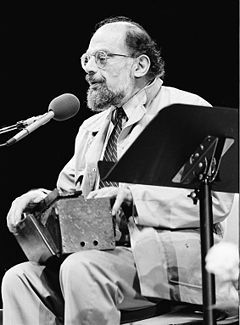
On this day in 1955, Beat poet, Allen Ginsberg reads his poem “Howl” at a poetry reading at Six Gallery in San Francisco.

Irwin Allen Ginsberg (June 3, 1926 – April 5, 1997) was an American poet who vigorously opposed militarism, materialism and sexual repression. In the 1950s, Ginsberg was a leading figure of the Beat Generation, an anarchic group of young men and women who joined poetry, song, sex, wine and illicit drugs with passionate political ideas that championed personal freedoms. Ginsberg’s epic poem Howl, in which he celebrates his fellow “angel-headed hipsters” and excoriates what he saw as the destructive forces of capitalism and conformity in the United States, is one of the classic poems of the Beat Generation  The poem, dedicated to writer Carl Solomon, has a memorable opening:

I saw the best minds of my generation destroyed by

madness, starving hysterical naked,

dragging themselves through the negro streets at dawn

looking for an angry fix…

In October 1955, Ginsberg and five other unknown poets gave a free reading at an experimental art gallery in San Francisco. Ginsberg’s Howl electrified the audience. According to fellow poet Michael McClure, it was clear “that a barrier had been broken, that a human voice and body had been hurled against the harsh wall of America and its supporting armies and navies and academies and institutions and ownership systems and power support bases.” In 1957, Howl attracted widespread publicity when it became the subject of an obscenity trial in which a San Francisco prosecutor argued it contained “filthy, vulgar, obscene, and disgusting language.” The poem seemed especially outrageous in 1950s America because it depicted both heterosexual and homosexual sex at a time when sodomy laws made homosexual acts a crime in every U.S. state. Howl reflected Ginsberg’s own bisexuality and his homosexual relationships with a number of men, including Peter Orlovsky, his lifelong partner. Judge Clayton W. Horn ruled that Howl was not obscene, adding, “Would there be any freedom of press or speech if one must reduce his vocabulary to vapid innocuous euphemisms?”

In Howl and in his other poetry, Ginsberg drew inspiration from the epic, free verse style of the 19th century American poet Walt Whitman. Both wrote passionately about the promise (and betrayal) of American democracy; the central importance of erotic experience; and the spiritual quest for the truth of everyday existence. J. D. McClatchy, editor of the Yale Review called Ginsberg “the best-known American poet of his generation, as much a social force as a literary phenomenon.” McClatchy added that Ginsberg, like Whitman, “was a bard in the old manner – outsized, darkly prophetic, part exuberance, part prayer, part rant. His work is finally a history of our era’s psyche, with all its contradictory urges.”

Ginsberg was a practicing Buddhist who studied Eastern religious disciplines extensively. One of his most influential teachers was the Tibetan Buddhist, the Venerable Chögyam Trungpa, founder of the Naropa Institute, now Naropa University at Boulder, Colorado. At Trungpa’s urging, Ginsberg and poet Anne Waldman started a poetry school there in 1974 which they called the “Jack Kerouac School of Disembodied Poetics”. In spite of his attraction to Eastern religions, the journalist Jane Kramer argues that Ginsberg, like Whitman, adhered to an “American brand of mysticism” that was, in her words, “rooted in humanism and in a romantic and visionary ideal of harmony among men.” Ginsberg’s political activism was consistent with his religious beliefs. He took part in decades of non-violent political protest against everything from the Vietnam War to the War on Drugs. The literary critic, Helen Vendler, described Ginsberg as “tirelessly persistent in protesting censorship, imperial politics, and persecution of the powerless.” His achievements as a writer as well as his notoriety as an activist gained him honors from established institutions. Ginsberg’s book of poems, The Fall of America, won the National Book Award for poetry in 1974. Other honors included the National Arts Club gold medal and his induction into the American Academy and Institute of Arts and Letters, both in 1979. In 1995, Ginsberg won a Pulitzer Prize for his book, Cosmopolitan Greetings: Poems 1986-1992.

Rant of the Week: Lewis Black – Barilla Pasta

Back in Black – Barilla Pasta

Pasta giant Barilla won’t portray a gay family for its commercials, but Lewis Black isn’t buying the whole family values argument.

On This Day In History October 6

This is your morning Open Thread. Pour your favorite beverage and review the past and comment on the future.

Find the past “On This Day in History” here.

October 6 is the 279th day of the year (280th in leap years) in the Gregorian calendar. There are 86 days remaining until the end of the year.

On this day in 1927. The Jazz Singer makes its debut in New York City.

The first feature-length motion picture with synchronized dialogue sequences, its release heralded the commercial ascendance of the “talkies” and the decline of the silent film era. Produced by Warner Bros. with its Vitaphone sound-on-disc system, the movie stars Al Jolson, who performs six songs. Directed by Alan Crosland, it is based on a play by Samson Raphaelson.

The story begins with young Jakie Rabinowitz defying the traditions of his devout Jewish family by singing popular tunes in a beer hall. Punished by his father, a cantor, Jakie runs away from home. Some years later, now calling himself Jack Robin, he has become a talented jazz singer. He attempts to build a career as an entertainer, but his professional ambitions ultimately come into conflict with the demands of his home and heritage.

The premiere was set for October 6, 1927, at Warner Bros.’ flagship theater in New York City. The choice of date was pure show business-the following day was Yom Kippur, the Jewish holiday around which much of the movie’s plot revolves.  The buildup to the premiere was tense. Besides Warner Bros.’ precarious financial position, the physical presentation of the film itself was remarkably complex:


Each of Jolson’s musical numbers was mounted on a separate reel with a separate accompanying sound disc. Even though the film was only eighty-nine minutes long…there were fifteen reels and fifteen discs to manage, and the projectionist had to be able to thread the film and cue up the Vitaphone records very quickly. The least stumble, hesitation, or human error would result in public and financial humiliation for the company.

None of the Warner brothers were able to attend: Sam Warner-among them, the strongest advocate for Vitaphone-had died the previous day of pneumonia, and the surviving brothers had returned to California for his funeral.

According to Doris Warner, who was in attendance, about halfway through the film she began to feel that something exceptional was taking place. Jolson’s “Wait a minute” line had prompted a loud, positive response from the audience. Applause followed each of his songs. Excitement built, and when Jolson and Eugenie Besserer began their dialogue scene, “the audience became hysterical.”  After the show, the audience turned into a “milling, battling, mob”, in one journalist’s description, chanting “Jolson, Jolson, Jolson!” Among those who reviewed the film, the critic who foresaw most clearly what it presaged for the future of cinema was Life magazine’s Robert Sherwood. He described the spoken dialogue scene between Jolson and Besserer as “fraught with tremendous significance…. I for one suddenly realized that the end of the silent drama is in sight”.

Critical reaction was generally, though far from universally, positive. New York Times critic Mordaunt Hall, reviewing the film’s premiere, declared that


not since the first presentation of Vitaphone features, more than a year ago [i.e., Don Juan], has anything like the ovation been heard in a motion-picture theatre…. The Vitaphoned songs and some dialogue have been introduced most adroitly. This in itself is an ambitious move, for in the expression of song the Vitaphone vitalizes the production enormously. The dialogue is not so effective, for it does not always catch the nuances of speech or inflections of the voice so that one is not aware of the mechanical features.

Variety called it “[u]ndoubtedly the best thing Vitaphone has ever put on the screen…[with] abundant power and appeal.” Richard Watts, Jr. of the New York Herald Tribune called it a “a pleasantly sentimental orgy dealing with a struggle between religion and art…. [T]his is not essentially a motion picture, but rather a chance to capture for comparative immortality the sight and sound of a great performer.” The Exhibitors Herald’s take was virtually identical: “scarcely a motion picture. It should be more properly labeled an enlarged Vitaphone record of Al Jolson in half a dozen songs.” The film received favorable reviews in both the Jewish press and in African American newspapers such as the Baltimore Afro-American, the New York Amsterdam News, and the Pittsburgh Courier. The headline of the Los Angeles Times review told a somewhat different story: “‘Jazz Singer’ Scores a Hit-Vitaphone and Al Jolson Responsible, Picture Itself Second Rate.” Photoplay dismissed Jolson as “no movie actor. Without his Broadway reputation he wouldn’t rate as a minor player.”

Punting the Pundits: Sunday Preview Edition

Punting the Punditsis an Open Thread. It is a selection of editorials and opinions from around the news medium and the internet blogs. The intent is to provide a forum for your reactions and opinions, not just to the opinions presented, but to what ever you find important.

Thanks to ek hornbeck, click on the link and you can access all the past “Punting the Pundits”.

Follow us on Twitter @StarsHollowGzt

The Sunday Talking Heads:

Up with Steve Kornacki: Guests had not yet been posted.

This Week with George Stephanopolis: The guests on ” This Week” are  House Speaker John Boehner (R-OH); Sen. Charles Schumer (D-NY); and Rep. Mick Mulvaney (R-SC).

THe guests for the roundtable debates on all the week’s politics are: with ABC News’ Jonathan Karl and Cokie Roberts; Wall Street Journal editorial page editor Paul Gigot; Starfish Media Group CEO Soledad O’Brien; and former Lead Auto Adviser and Counselor to the Treasury Secretary Steven Rattner.

Face the Nation with Bob Schieffer: Mr. Schieffer’s guests are Treasury Secretary Jacob Lew; Sen. John Cornyn (R-TX); and Israeli Prime Minister Benjamin Netanyahu.

Joining him for a panel discussion are PBS’ Gwen Ifill; The Washington Post‘s Dana Milbank; POLITICO‘s Jim VandeHei; and CBS News Political Director John Dickerson.

Meet the Press with David Gregory: The guests on this week’s MTP are Treasury Secretary Jack Lew and Sen. Rand Paul (R-KY).

Guests for the panel discussion are Chair of the Congressional Black Caucus Rep. Marcia Fudge (D-OH); Republican strategist Mike Murphy; Host of NPR’s Morning Edition, Steve Inskeep; and editor of the National Review, Rich Lowry.

State of the Union with Candy Crowley: Ms. Crowley’a guests are Treasury Secretary Jack Lew; and Sen. Ted Cruz (R-TX).

Joining her for a panel discussion are Rep. Donna Edwards, Rep. Steve King, CNN crossfire host Stephanie Cutter and CNN Political Commentator Ross Douthat.

Health and Fitness News

Welcome to the Health and Fitness NewsWelcome to the Stars Hollow Health and Fitness News weekly diary. It will publish on Saturday afternoon and be open for discussion about health related issues including diet, exercise, health and health care issues, as well as, tips on what you can do when there is a medical emergency. Also an opportunity to share and exchange your favorite healthy recipes.

Questions are encouraged and I will answer to the best of my ability. If I can’t, I will try to steer you in the right direction. Naturally, I cannot give individual medical advice for personal health issues. I can give you information about medical conditions and the current treatments available.

You can now find past Health and Fitness News diaries here and on the right hand side of the Front Page.

Follow us on Twitter @StarsHollowGzt

Pasta Dishes With Vegetables as Stars

Perciatelli With Baby Broccoli, Tomatoes and Anchovies photo 30recipehealth-articleLarge_zps89eb58a7.jpg

It’s been a busy week for me and whenever my schedule is tight I veer toward pasta. In some of this week’s Recipes for Health you will be able to prepare the vegetable accompaniment in the time it takes to heat the water and cook the pasta: the same water is used to blanch vegetables in the dish. I made one dish with perciatelli, baby broccoli and tomatoes and blanched the baby broccoli in the water that I then used for the pasta, and when I made orecchiette with pesto and green and yellow string beans, I just threw the beans into the pot with the pasta halfway through the pasta’s cooking time.

~Martha Rose Shulman~

Perciatelli With Baby Broccoli, Tomatoes and Anchovies

This Southern Italian pasta is inspired by a dish that calls for the light green cauliflower used in Sicily.

Orecchiette With Basil and Pistachio Pesto and Green and Yellow Beans

Cut the beans into small lengths so that everything is bite-size.

Farfalle With Roasted Peppers, Peas, Feta and Yogurt

This dish is inspired by Greek and Turkish ways with pasta and yogurt.

Whole Wheat Penne or Fusilli With Tomatoes, Shell Beans and Feta

Shell beans are a rare treat, soft and velvety, to be savored during their short season.

Lasagna With Pistou and Mushrooms

There will be a day when the weather suddenly cools and my basil plants and those at your farmers’ market stop thriving, but that day hasn’t come yet.

Punting the Pundits

“Punting the Pundits” is an Open Thread. It is a selection of editorials and opinions from around the news medium and the internet blogs. The intent is to provide a forum for your reactions and opinions, not just to the opinions presented, but to what ever you find important.

Thanks to ek hornbeck, click on the link and you can access all the past “Punting thea Pundits”.

Follow us on Twitter @StarsHollowGzt

New York Times Editorial Board: Now Republicans Want a ‘Dialogue’

Republicans are now simply flailing. Because they lack any plausible explanation for their irresponsible conduct in creating and prolonging the government shutdown, they are inventing new demands by the hour.

“Defund Obamacare!” they cried at the beginning, stating their condition for reopening the government. Then they moved to delaying health care reform, delaying the individual mandate and repealing one of the health care law’s taxes. Then they started talking about another grand bargain on the budget, tax reform and entitlement cuts. When nothing worked, they simplified their ransom note, saying President Obama and the Democrats had to sit down with them and negotiate something, or anything.

Charles M. Blow: A Terrible, Tragic Game

Speaker John Boehner barked Friday about the government shutdown: “This isn’t some damn game.” Speaker John Boehner barked Friday about the government shutdown: “This isn’t some damn game.”

The House leader was responding to an anonymous “senior administration official” who was quoted in a Wall Street Journal article, saying: “We are winning. … It doesn’t really matter to us’ how long the shutdown lasts ‘because what matters is the end result.’ ” [..]

That said, the speaker is wrong once again. This unfortunately is a game. It’s a game that he allowed himself to be pushed into playing and one he can find no easy way out of. It’s a game in which he thought the president would blink. But President Obama is staring straight ahead, wide-eyed like a long-haul trucker at 3 in the morning. This is a game in which the speaker cared more about keeping his job than about keeping the American government running, the people who work for it and those who depend on it.

It is most definitely a game, a terrible, tragic game that House Republicans are playing in the People’s House.

Gail Collins: Frankenstein Goes to Congress

Our question for today is: Why don’t the Republicans just throw in the towel? Really, this is not going well for anybody.  

Lots of reasons. There’s Senator Ted Cruz of Texas, the General Patton of the government shutdown. And people like the Republican in the House who said he and his colleagues “have to get something out of this. And I don’t know what that even is.” Also, Ted Cruz. [..]

But here’s my long-term theory. Over the past few years, Republicans have terrified their most fervent followers about Obamacare in order to disguise the fact that they no longer knew what to say about their old bête noir, entitlements. Now they can’t turn the temperature down.

Joe Nocera: A Fracking Rorschach Test

A few weeks ago, a group of scientists led by David T. Allen of the University of Texas published an important, peer-reviewed paper in the Proceedings of the National Academy of Sciences. The subject was our old friend hydraulic fracturing – a k a fracking – that infamous process that allows companies to drill for natural gas trapped in shale formations deep below the earth’s surface.

Thanks to the fracking boom, America is on the verge of overtaking Russia as the world’s largest producer of oil and gas, as The Wall Street Journal pointed out a few days ago. Supporters of fracking (like me) tend to focus on the economic and foreign policy blessings that come with being able to supply so much more of our energy needs in-house, as it were. Critics, however, fear that fracking could have grave environmental consequences. And they worry that the abundance of natural gas will keep America hooked on fossil fuels.

Ralph Nader: Giant Pentagon Budget Is Unauditable Year After Year

The federal government is currently in a state of shutdown thanks to a small faction of extremist Republicans who vehemently bellow that the Affordable Care Act (ACA) will have a catastrophic economic effect on our country. These members of Congress are so irrational about the ACA that they have caused the furlough of nearly 800,000 federal workers — some of whom handle vitally important tasks such as safety inspections, monitoring our food supply and detecting epidemic outbreaks. Congress, however, has failed to address the worst excesses in the federal budget — the bloated, highly wasteful military budget. More than half of federal discretionary spending now goes to the military budget. Many more taxpayer dollars are devoted to the Department of Defense than to the critical needs of our citizenry, including the flawed Obamacare which should be replaced with single payer — full Medicare for all.

Unfortunately, curbing the worst excesses of an out-of-control military industrial complex is not a front burner issue for the 40 or so Tea Party Republicans currently stomping their feet in Congress about health care reform. Instead, Senator Ted Cruz (R-TX), who has recently emerged as the de-facto leader of the opposition to Obamacare, has accused his opponents in Congress of “holding the military hostage” by not giving in to the demands of the extremists in his party.

Mark Weisbrot: President Obama’s Defeats May Turn Out to Be More Important Than His Likely Victory Over Republicans

Looking past the shutdown and budget battle, the big picture is that America’s four decade-long drift to the right is decisively over

If we step back a moment from the government shutdown – an assault on millions of federal workers and people who need the services of the national government at this time – and the Republicans’ over-hyped and largely empty threat to trigger a default on the national public debt, there are more significant recent political developments that will continue long after this damaging political theater is over.

President Obama was twice defeated last month on matters of national and international importance, by grassroots opposition and resistance from within his own party. The first was over his planned bombing of Syria; the second was over his attempt to appoint Larry Summers as chair of the Federal Reserve.

On This Day In History October 5

This is your morning Open Thread. Pour your favorite beverage and review the past and comment on the future.

Find the past “On This Day in History” here.

October 5 is the 278th day of the year (279th in leap years) in the Gregorian calendar. There are 87 days remaining until the end of the year.

On this day in 1877, Chief Joseph of the Nez Perce Indians surrenders to U.S. General Nelson A. Miles in the Bear Paw mountains of Montana, declaring,

“Hear me, my chiefs: My heart is sick and sad. From where the sun now stands, I will fight no more forever.”

Chief Joseph (March 3, 1840 – September 21, 1904) was the chief of the Wal-lam-wat-kain (Wallowa) band of Nez Perce during General Oliver O. Howard‘s attempt to forcibly remove his band and the other “non-treaty” Nez Perce to a reservation in Idaho. For his principled resistance to the removal, he became renowned as a humanitarian and peacemaker.

Joseph the Younger succeeded his father as chief in 1871. Before his death, the latter counseled his son:

“My son, my body is returning to my mother earth, and my spirit is going very soon to see the Great Spirit Chief. When I am gone, think of your country. You are the chief of these people. They look to you to guide them. Always remember that your father never sold his country. You must stop your ears whenever you are asked to sign a treaty selling your home. A few years more and white men will be all around you. They have their eyes on this land. My son, never forget my dying words. This country holds your father’s body. Never sell the bones of your father and your mother.”

Chief Joseph commented “I clasped my father’s hand and promised to do as he asked. A man who would not defend his father’s grave is worse than a wild animal.”

The non-treaty Nez Perce suffered many injustices at the hands of settlers and prospectors, but out of fear of reprisal from the militarily superior Americans, Joseph never allowed any violence against them, instead making many concessions to them in hopes of securing peace.

In 1873, Chief Joseph negotiated with the federal government to ensure his people could stay on their land in the Wallowa Valley. But in 1877, the government reversed its policy, and Army General Oliver Howard threatened to attack if the Wallowa band did not relocate to the Idaho Reservation with the other Nez Perce. Chief Joseph reluctantly agreed.

Before the outbreak of hostilities, General Howard held a council to try to convince Joseph and his people to relocate. Joseph finished his address to the General, which focused on human equality, by expressing his “[disbelief that] the Great Spirit Chief gave one kind of men the right to tell another kind of men what they must do.”

Howard reacted angrily, interpreting the statement as a challenge to his authority. When Chief Too-hul-hul-sote protested, he was jailed for five days.

The day following the council, Joseph, White Bird, and Chief Looking Glass all accompanied General Howard to look at different areas. Howard offered them a plot of land that was inhabited by Whites and Indians, promising to clear them out. Joseph and his chieftains refused, adhering to their tribal tradition of not taking what did not belong to them.

Unable to find any suitable uninhabited land on the reservation, Howard informed Joseph that his people had thirty days to collect their livestock and move to the reservation. Joseph pleaded for more time, but Howard told him that he would consider their presence in the Wallowa Valley beyond the thirty-day mark an act of war.

Returning home, Joseph called a council among his people. At the council, he spoke on behalf of peace, preferring to abandon his father’s grave over war. Too-hul-hul-sote, insulted by his incarceration, advocated war.

The Wallowa band began making preparations for the long journey, meeting first with other bands at Rocky Canyon. At this council too, many leaders urged war, while Joseph argued in favor of peace.

While the council was underway, a young man whose father had been killed rode up and announced that he and several other young men had already killed four white men, an act sure to initiate war.

Still hoping to avoid further bloodshed, Joseph and other Nez Perce chiefs began leading his people north toward Canada.

With 2,000 U.S. soldiers in pursuit, Joseph and other Nez Perce chiefs led 800 Nez Perce toward their friends the Crows, but when the Crows betrayed them and joined the United States army for money, the Nez Perce went towards freedom at the Canadian border. For over three months, the Nez Perce outmaneuvered and battled their pursuers traveling 1,600 miles (2,570 km) across Oregon, Washington, Idaho, Wyoming, and Montana. General Howard, leading the opposing cavalry, was impressed with the skill with which the Nez Perce fought, using advance and rear guards, skirmish lines, and field fortifications. Finally, after a devastating five-day battle during freezing weather conditions with no food or blankets, Chief Joseph formally surrendered to General Nelson Appleton Miles on October 5, 1877 in the Bear Paw Mountains of the Montana Territory, less than 40 miles (60 km) south of Canada in a place close to the present-day Chinook in Blaine County. The battle is remembered in popular history by the words attributed to Chief Joseph at the formal surrender:

“Tell General Howard I know his heart. What he told me before, I have it in my heart. I am tired of fighting. Our chiefs are killed; Looking Glass is dead, Too-hul-hul-sote is dead. The old men are all dead. It is the young men who say yes or no. He who led on the young men is dead. It is cold, and we have no blankets; the little children are freezing to death. My people, some of them, have run away to the hills, and have no blankets, no food. No one knows where they are-perhaps freezing to death. I want to have time to look for my children, and see how many of them I can find. Maybe I shall find them among the dead. Hear me, my chiefs! I am tired; my heart is sick and sad. From where the sun now stands, I will fight no more forever.”

Punting the Pundits

“Punting the Pundits” is an Open Thread. It is a selection of editorials and opinions from around the news medium and the internet blogs. The intent is to provide a forum for your reactions and opinions, not just to the opinions presented, but to what ever you find important.

Thanks to ek hornbeck, click on the link and you can access all the past “Punting thea Pundits”.

Follow us on Twitter @StarsHollowGzt

Paul Krugman: Reform Turns Real

At this point, the crisis in American governance has taken on a life of its own. Some Republicans are now saying openly that they want concessions in return for reopening the government and avoiding default, not because they have any specific policy goals in mind, but simply because they don’t want to feel “disrespected.” And no endgame is in sight.

But this confrontation did start with a real issue: Republican efforts to stop Obamacare from going into effect. It’s long been clear that the great fear of the Republican Party was not that health reform would fail, but that it would succeed. And developments since Tuesday, when the exchanges on which individuals will buy health insurance opened for business, strongly suggest that their worst fears will indeed be realized: This thing is going to work.

New York Times Editorial Board; A Population Betrayed

It is outrageous that millions of the poorest people in the country will be denied health insurance because of decisions made mostly by Republican governors and legislators. These people will neither qualify for their state’s Medicaid program for the poor nor for subsidized coverage on new insurance exchanges that are being established in every state by the health care reform law.

Their plight is a result of the Supreme Court’s decision last year that struck down the reform law’s mandatory expansion of Medicaid and made expansion optional. Every state in the Deep South except Arkansas has rejected expansion, as have Republican-led states elsewhere. These 26 states would rather turn down incredibly generous federal funds that would finance 100 percent of the expansion costs for three years and at least 90 percent thereafter than offer a helping hand to their most vulnerable residents.

Richard (RJ) Eskow: The GOP’s Shutdown Tab: One Billion Dollars and Counting

Forty million dollars an hour. A third of a billion every day. $1.6 billion every week. That’s a conservative estimate of the money Republicans are wasting by keeping the federal government closed down. And if pundits like Sean Hannity have their way, they’ll run up a much larger tab before this is all over.

But then, if there’s one thing Republicans know how to do it’s run a tab.

The bill has already come to roughly $1 billion as of today (Thursday), and it grows larger every moment the government stays shut down. Republicans in Congress recently voted to cut $4 billion per year from programs that feed the needy. In two and a half weeks they’ll have wasted more than that on their shutdown.

George Zorncik: Congressional Liberals Mobilize to Keep Social Insurance Out of Shutdown Talks

We’ve seen this movie before: Republicans force a showdown in Congress over funding the government, the debt ceiling or, in the present case, both. Then a “grand bargain” is proposed to solve the impasse-one that includes serious reductions to social insurance programs.

That’s just how the GOP would like the current drama to play out. Wednesday, National Review‘s Robert Costa reported that House Speaker John Boehner and Representative Paul Ryan are rallying nervous Republicans by telling them that while Obamacare may not end up getting defunded, GOP leadership is cooking up another big budget deal that includes cuts to the safety net so cherished by many conservative members. “It’s the return of the grand bargain,” one member told Costa. “Ryan is selling this to everybody; he’s getting back to his sweet spot,” said another.

In particular, Costa mentioned Chained CPI as one component of the emerging proposal. This, you may recall, is a cut to Social Security benefits dressed up as a ostensibly “more accurate” recalibration of the formula used to adjust benefits to inflation. (It’s not.)

Amy Jones: The Forgotten War

Will the U.S. still be meddling in Afghanistan 30 years from now?  If history is any guide, the answer is yes.  And if history is any guide,  three decades from now most Americans will have only the haziest idea why.

Since the 1950s, the U.S. has been trying to mold that remote land to its own desires, first through an aid “war” in the midst of the Cold War with the Soviet Union; then, starting as the 1970s ended, an increasingly bitter and brutally hot proxy war with the Soviets meant to pay them back for supporting America’s enemies during the war in Vietnam.  One bad war leads to another.

Ralph Nader: Congressional “Mad Dogs” Render the Powerful Powerless

SHUTDOWN – blared the Washington Post headline. None of the powers-that-be could stop a small faction of Republicans in the House of Representatives from shutting down many federal government operations starting on October 1.

Suddenly the powerful Business Roundtable and U.S. Chamber of Commerce are powerless, along with two hundred corporate trade associations, who see Uncle Sam as their big customer. Suddenly, the Republican dominated National Governors Association, together with Mitt Romney, the Party’s presidential nominee in 2013, are powerless. Also powerless so far are the allegedly sovereign people, who want uninterrupted safety inspections, enforcement of labor and environmental laws, children’s nutrition and educational programs (like Head Start), student loan processing, veterans benefits, detection of epidemics, access to national parks, and inspections of nuclear power plants.

Load more