
This is your morning Open Thread. Pour your favorite beverage and review the past and comment on the future.
Find the past “On This Day in History” here.
November 18 is the 322nd day of the year (323rd in leap years) in the Gregorian calendar. There are 43 days remaining until the end of the year.
On this day in 1883, the Railraods create the first time zones At exactly noon on this day, American and Canadian railroads begin using four continental time zones to end the confusion of dealing with thousands of local times. The bold move was emblematic of the power shared by the railroad companies.
The need for continental time zones stemmed directly from the problems of moving passengers and freight over the thousands of miles of rail line that covered North America by the 1880s. Since human beings had first begun keeping track of time, they set their clocks to the local movement of the sun. Even as late as the 1880s, most towns in the U.S. had their own local time, generally based on “high noon,” or the time when the sun was at its highest point in the sky. As railroads began to shrink the travel time between cities from days or months to mere hours, however, these local times became a scheduling nightmare. Railroad timetables in major cities listed dozens of different arrival and departure times for the same train, each linked to a different local time zone.
Timekeeping on the American railroads in the mid 19th century was somewhat confused. Each railroad used its own standard time, usually based on the local time of its headquarters or most important terminus, and the railroad’s train schedules were published using its own time. Some major railroad junctions served by several different railroads had a separate clock for each railroad, each showing a different time; the main station in Pittsburgh, Pennsylvania, for example, kept six different times.
Charles F. Dowd proposed a system of one-hour standard time zones for American railroads about 1863, although he published nothing on the matter at that time and did not consult railroad officials until 1869. In 1870, he proposed four ideal time zones (having north-south borders), the first centered on Washington, D.C., but by 1872 the first was centered 75 W of Greenwich, with geographic borders (for example, sections of the Appalachian Mountains). Dowd’s system was never accepted by American railroads. Instead, U.S. and Canadian railroads implemented a version proposed by William F. Allen, the editor of the Traveler’s Official Railway Guide. The borders of its time zones ran through railroad stations, often in major cities. For example, the border between its Eastern and Central time zones ran through Detroit, Buffalo, Pittsburgh, Atlanta, and Charleston. It was inaugurated on Sunday, November 18, 1883, also called “The Day of Two Noons”, when each railroad station clock was reset as standard-time noon was reached within each time zone. The zones were named Intercolonial, Eastern, Central, Mountain, and Pacific. Within one year, 85% of all cities with populations over 10,000, about 200 cities, were using standard time. A notable exception was Detroit (which is about half-way between the meridians of eastern time and central time), which kept local time until 1900, then tried Central Standard Time, local mean time, and Eastern Standard Time before a May 1915 ordinance settled on EST and was ratified by popular vote in August 1916. The confusion of times came to an end when Standard zone time was formally adopted by the U.S. Congress on March 19, 1918, in the Standard Time Act.
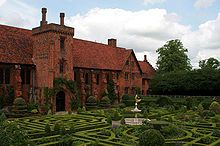

 Did the young Austrian nun named Maria really take to the hills surrounding Salzburg to sing spontaneously of her love of music? Did she comfort herself with thoughts of copper kettles, and did she swoon to her future husband’s song about an alpine flower while the creeping menace of Nazism spread across central Europe? No, the real-life Maria von Trapp did none of those things. She was indeed a former nun, and she did indeed marry Count Georg von Trapp and become stepmother to his large brood of children, but nearly all of the particulars she related in her 1949 book, The Story of the Trapp Family Singers, were ignored by the creators of the Broadway musical her memoir inspired. And while the liberties taken by the show’s writers, Howard Lindsay and Russel Crouse, and by its composer and lyricist, Richard Rodgers and Oscar Hammerstein II, caused some consternation to the real Maria von Trapp and to her stepchildren, according to many later reports, those liberties made The Sound of Music a smash success from the very night of its Broadway opening on this day in 1959.
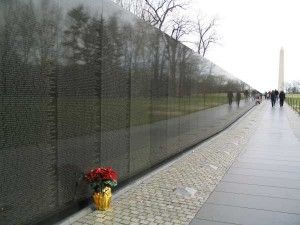
 Inscribed on the walls with the Optima typeface are the names of servicemen who were either confirmed to be KIA (Killed in Action) or remained classified as MIA (Missing in Action) when the walls were constructed in 1982. They are listed in chronological order, starting at the apex on panel 1E in 1959 (although it was later discovered that the first casualties were military advisers who were killed by artillery fire in 1957), moving day by day to the end of the eastern wall at panel 70E, which ends on May 25, 1968, starting again at panel 70W at the end of the western wall which completes the list for May 25, 1968, and returning to the apex at panel 1W in 1975. Symbolically, this is described as a “wound that is closed and healing.” Information about rank, unit, and decorations are not given. The wall listed 58,159 names when it was completed in 1993; as of June 2010, there are 58,267 names, including 8 women. Approximately 1,200 of these are listed as missing (MIAs, POWs, and others), denoted with a cross; the confirmed dead are marked with a diamond. If the missing return alive, the cross is circumscribed by a circle (although this has never occurred as of March 2009); if their death is confirmed, a diamond is superimposed over the cross. According to the Vietnam Veterans Memorial Fund, “there is no definitive answer to exactly how many, but there could be as many as 38 names of personnel who survived, but through clerical errors, were added to the list of fatalities provided by the Department of Defense.” Directories are located on nearby podiums so that visitors may locate specific names.

 SS Edmund Fitzgerald (nicknamed “Mighty Fitz,” “The Fitz,” or “The Big Fitz”) was an American Great Lakes freighter launched on June 8, 1958. At the time of its launching, it was one of the first boats to be at or near maximum “St Lawrence Seaway Size” which was 730 feet (220 m) long and 75 feet (23 m) wide. From its launching in 1958 until 1971 the Fitzgerald continued to be one of the largest boats on the Great Lakes.
 On this day in 1872, fire rips through Boston.
Recent Comments