
This is your morning Open Thread. Pour your favorite beverage and review the past and comment on the future.
Find the past “On This Day in History” here.
November 19 is the 323rd day of the year (324th in leap years) in the Gregorian calendar. There are 42 days remaining until the end of the year.
On this day in 1863, President Abraham Lincoln delivers Gettysburg Address.
On November 19, 1863, at the dedication of a military cemetery at Gettysburg, Pennsylvania, during the American Civil War, President Abraham Lincoln delivers one of the most memorable speeches in American history. In just 272 words, Lincoln brilliantly and movingly reminded a war-weary public why the Union had to fight, and win, the Civil War.
The Battle of Gettysburg, fought some four months earlier, was the single bloodiest battle of the Civil War. Over the course of three days, more than 45,000 men were killed, injured, captured or went missing. The battle also proved to be the turning point of the war: General Robert E. Lee’s defeat and retreat from Gettysburg marked the last Confederate invasion of Northern territory and the beginning of the Southern army’s ultimate decline.
Charged by Pennsylvania’s governor, Andrew Curtin, to care for the Gettysburg dead, an attorney named David Wills bought 17 acres of pasture to turn into a cemetery for the more than 7,500 who fell in battle. Wills invited Edward Everett, one of the most famous orators of the day, to deliver a speech at the cemetery’s dedication. Almost as an afterthought, Wills also sent a letter to Lincoln-just two weeks before the ceremony-requesting “a few appropriate remarks” to consecrate the grounds.
Four score and seven years ago our fathers brought forth on this continent a new nation, conceived in liberty, and dedicated to the proposition that all men are created equal.
Now we are engaged in a great civil war, testing whether that nation, or any nation, so conceived and so dedicated, can long endure. We are met on a great battle-field of that war. We have come to dedicate a portion of that field, as a final resting place for those who here gave their lives that that nation might live. It is altogether fitting and proper that we should do this.
But, in a larger sense, we can not dedicate, we can not consecrate, we can not hallow this ground. The brave men, living and dead, who struggled here, have consecrated it, far above our poor power to add or detract. The world will little note, nor long remember what we say here, but it can never forget what they did here. It is for us the living, rather, to be dedicated here to the unfinished work which they who fought here have thus far so nobly advanced. It is rather for us to be here dedicated to the great task remaining before us-that from these honored dead we take increased devotion to that cause for which they gave the last full measure of devotion-that we here highly resolve that these dead shall not have died in vain-that this nation, under God, shall have a new birth of freedom-and that government of the people, by the people, for the people, shall not perish from the earth.
 On this day in 1883,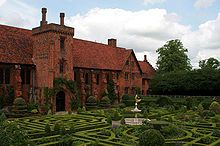

 Did the young Austrian nun named Maria really take to the hills surrounding Salzburg to sing spontaneously of her love of music? Did she comfort herself with thoughts of copper kettles, and did she swoon to her future husband’s song about an alpine flower while the creeping menace of Nazism spread across central Europe? No, the real-life Maria von Trapp did none of those things. She was indeed a former nun, and she did indeed marry Count Georg von Trapp and become stepmother to his large brood of children, but nearly all of the particulars she related in her 1949 book, The Story of the Trapp Family Singers, were ignored by the creators of the Broadway musical her memoir inspired. And while the liberties taken by the show’s writers, Howard Lindsay and Russel Crouse, and by its composer and lyricist, Richard Rodgers and Oscar Hammerstein II, caused some consternation to the real Maria von Trapp and to her stepchildren, according to many later reports, those liberties made The Sound of Music a smash success from the very night of its Broadway opening on this day in 1959.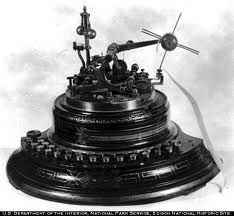
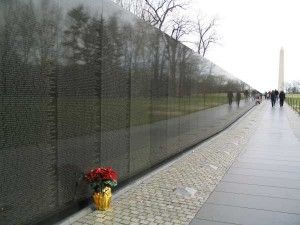
 Inscribed on the walls with the Optima typeface are the names of servicemen who were either confirmed to be KIA (Killed in Action) or remained classified as MIA (Missing in Action) when the walls were constructed in 1982. They are listed in chronological order, starting at the apex on panel 1E in 1959 (although it was later discovered that the first casualties were military advisers who were killed by artillery fire in 1957), moving day by day to the end of the eastern wall at panel 70E, which ends on May 25, 1968, starting again at panel 70W at the end of the western wall which completes the list for May 25, 1968, and returning to the apex at panel 1W in 1975. Symbolically, this is described as a “wound that is closed and healing.” Information about rank, unit, and decorations are not given. The wall listed 58,159 names when it was completed in 1993; as of June 2010, there are 58,267 names, including 8 women. Approximately 1,200 of these are listed as missing (MIAs, POWs, and others), denoted with a cross; the confirmed dead are marked with a diamond. If the missing return alive, the cross is circumscribed by a circle (although this has never occurred as of March 2009); if their death is confirmed, a diamond is superimposed over the cross. According to the Vietnam Veterans Memorial Fund, “there is no definitive answer to exactly how many, but there could be as many as 38 names of personnel who survived, but through clerical errors, were added to the list of fatalities provided by the Department of Defense.” Directories are located on nearby podiums so that visitors may locate specific names.

 SS Edmund Fitzgerald (nicknamed “Mighty Fitz,” “The Fitz,” or “The Big Fitz”) was an American Great Lakes freighter launched on June 8, 1958. At the time of its launching, it was one of the first boats to be at or near maximum “St Lawrence Seaway Size” which was 730 feet (220 m) long and 75 feet (23 m) wide. From its launching in 1958 until 1971 the Fitzgerald continued to be one of the largest boats on the Great Lakes.
Recent Comments