
This is your morning Open Thread. Pour your favorite beverage and review the past and comment on the future.
Find the past “On This Day in History” here.
September 29 is the 272nd day of the year (273rd in leap years) in the Gregorian calendar. There are 93 days remaining until the end of the year.
On this day in 1547, Miguel de Cervantes, author of Don Quixote, is born this day near Madrid.
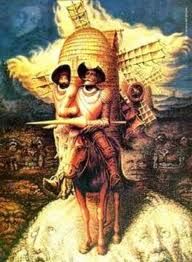
Cervantes led an adventurous life and achieved much popular success, but he nevertheless struggled financially throughout his life. Little is know about his childhood, except that he was a favorite student of Madrid humanist Juan Lopez, and that his father was an apothecary.
In 1569, Cervantes was living in Rome and working for a future cardinal. Shortly thereafter, he enlisted in the Spanish fleet to fight against the Turks. At the Battle of Lepanto in 1571, he took three bullets and suffered permanent damage to his left hand. Later, he was stationed at Palermo and Naples. On the way home to Madrid in 1575, he and his brother Roderigo were captured by Barbary pirates and held captive in Algiers. Cervantes was ransomed after five years of captivity and returned to Madrid, where he began writing. Although his records indicate he wrote 20 to 30 plays, only two survive. In 1585, he published a romance. During this time, he married a woman 18 years younger than he was and had an illegitimate daughter, whom he raised in his household. He worked as a tax collector and as a requisitioner of supplies for the navy, but was jailed for irregularities in his accounting. Some historians believe he formulated the idea for Don Quixote while in jail.
In 1604, he received the license to publish Don Quixote. Although the book began as a satire of chivalric epics, it was far more complex than a simple satire. The book blended traditional genres to create a sad portrait of a penniless man striving to live by the ideals of the past. The book was a huge success and brought Cervantes literary respect and position, but did not generate much money. He wrote dramas and short stories until a phony sequel, penned by another writer, prompted him to write Don Quixote, Part II in 1615.
Cervantes died in Madrid on April 23, 1616. In honor of the date on which both Miguel de Cervantes and William Shakespeare died, UNESCO established April 23 as the International Day of the Book. (Shakespeare and Cervantes, however, did not actually die on the same day, as the April 23 date for Shakespeare is Julian calendar (Old Style) and the April 23 date for Cervantes is Gregorian calendar (New Style) as those were the calendars in effect in England and in Spain, respectively, at that time. The Gregorian calendar was then ten days ahead of the Julian.)

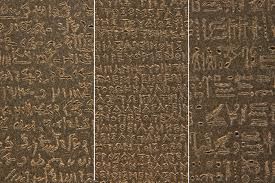 Thomas Young was one of the first to attempt decipherment of the Egyptian hieroglyphs, basing his own work on the investigations of Swedish diplomat Akerblad, who built up a demotic alphabet of 29 letters (15 turned out to be correct) and translated all personal names and other words in the Demotic part of the Rosetta Stone in 1802. Akerblad however, wrongly believed that demotic was entirely phonetic or alphabetic. Young thought the same, and by 1814 he had completely translated the enchorial (which Champollion labeled Demotic as it is called today) text of the Rosetta Stone (he had a list with 86 demotic words). Young then studied the hieroglyphic alphabet and made some progress but failed to recognise that demotic and hieroglyphic texts were paraphrases and not simple translations. In 1823 he published an Account of the Recent Discoveries in Hieroglyphic Literature and Egyptian Antiquities. Some of Young’s conclusions appeared in the famous article Egypt he wrote for the 1818 edition of the Encyclopædia Britannica.
 The first Congress of the United States approves 12 amendments to the U.S. Constitution, and sends them to the states for ratification. The amendments, known as the Bill of Rights, were designed to protect the basic rights of U.S. citizens, guaranteeing the freedom of speech, press, assembly, and exercise of religion; the right to fair legal procedure and to bear arms; and that powers not delegated to the federal government were reserved for the states and the people.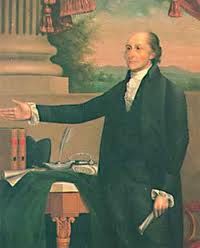
 . . . . Andre Malraux, the French minister of culture, commissioned him to design a new ceiling for the Paris Opera after seeing Chagall’s work in Daphnis et Chloe. Working with a surface of 560 square meters, Chagall divided the ceiling into color zones that he filled with landscapes and figures representing the luminaries of opera and ballet. The ceiling was unveiled on September 23, 1964, during a performance of the same Daphnis et Chloe. As usual, a few detractors condemned Chagall’s work as overly primitive, but this criticism was drowned out in the general acclaim for the work. In 1966, as a gift to the city that had sheltered him during World War II, he painted two vast murals for New York’s Metropolitan Opera House (1966).
 When the Civil War broke out in 1861, shortly after Lincoln’s inauguration as America’s 16th president, he maintained that the war was about restoring the Union and not about slavery. He avoided issuing an anti-slavery proclamation immediately, despite the urgings of abolitionists and radical Republicans, as well as his personal belief that slavery was morally repugnant. Instead, Lincoln chose to move cautiously until he could gain wide support from the public for such a measure.
Recent Comments