Punting the Pundits

“Punting the Pundits” is an Open Thread. It is a selection of editorials and opinions from around the news medium and the internet blogs. The intent is to provide a forum for your reactions and opinions, not just to the opinions presented, but to what ever you find important.

Thanks to ek hornbeck, click on the link and you can access all the past “Punting the Pundits”.

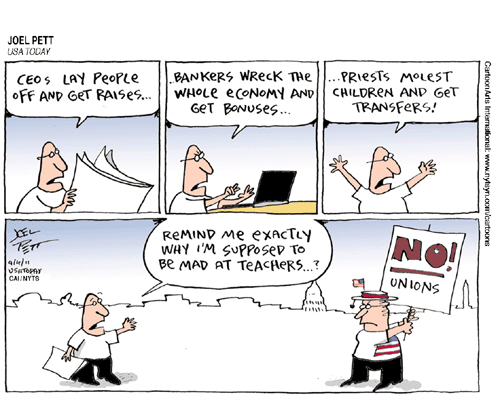
Robert Reich: Why the Republican War on Workers Rights Undermines the American Economy

The battle has resumed in Wisconsin. The state supreme court has allowed Governor Scott Walker to strip bargaining rights from state workers. . . . .

This war on workers’ rights is an assault on the middle class, and it is undermining the American economy.

The American economy can’t get out of neutral until American workers have more money in their pockets to buy what they produce. And unions are the best way to give them the bargaining power to get better pay.

Robert Dreyfuss: Reality Check: Budget Cuts Inevitable at the Department of Defense

There’s an inevitability to the coming decline of U.S. power and influence worldwide, as the American economy shrinks relative to the economic power of other countries, as America’s allies in places like Egypt strike out on their own, and as the size of the US military declines because the United States can no longer afford to spend upwards of $700 billion on defense.

Still, there are those who believe that the United States must maintain, and even increase its spending at the Pentagon, even as more and more Republicans are prepared to throw the military under the bus to save money. Take, for instance, Fred Hiatt of the Washington Post, who pens an op-ed in today’s paper entitled: “What’s happened to America’s leadership role?” Hiatt, a reliable hawk who’s helped steer the Post into indefensibly pro-defense positions, including support for the wars in Afghanistan and Libya, accuses President Obama of surrendering the US leadership role by refusing to take the lead in battling Libya’s Muammar Qaddafi and by backing a modest drawdown in Afghanistan:

John Nichols: Bernie Sanders to Obama: ‘Do Not Yield to Outrageous Republican Demands’ on Taxes, Cuts, Deficit Policy

Bernie Sanders went to the floor of the Senate last December to deliver the most important congressional address of 2010, a nine-hour long, filibuster-style condemnation of economic policies that favored the rich while burdening working Americans. The independent senator from Vermont electrified the nation with a call for economic justice that challenged Obama administration compromises with Republicans on issues of tax policy and declared: “There is a war going on in this country, and I am not referring to the wars in Iraq or Afghanistan. I am talking about a war being waged by some of the wealthiest and most powerful people in this country against the working families of the United States of America, against the disappearing and shrinking middle class of our country.”

Now, as Republicans pressure the president to embrace an approach to deficit reduction that will further widen the gap between rich and working Americans-with tax breaks for the wealthy and the slashing of benefits for the what remains of the middle class-Sanders is preparing to return to the Senate floor Monday for another epic challenge to the failed economic policies of Wall Street and its political amen corner.

Geoffrey R. Stone:Our Untransparent President

AS a longtime supporter and colleague of Barack Obama at the University of Chicago, as well as an informal adviser to his 2008 campaign, I had high hopes that he would restore the balance between government secrecy and government transparency that had been lost under George W. Bush, and that he would follow through on his promise, as a candidate, to promote openness and public accountability in government policy making.

It has not quite worked out that way. While Mr. Obama has taken certain steps, notably early in his administration, to scale back some of the Bush-era excesses, in other respects he has shown a disappointing willingness to continue in his predecessor’s footsteps.

New York Times Editorial: Gay Marriage: A Milestone

New York State has made a powerful and principled choice by giving all couples the right to wed and enjoy the legal rights of marriage. It is a proud moment for New Yorkers, thousands of whom took to the streets on Sunday to celebrate this step forward. But this moment does not erase the bigotry against gays and lesbians enshrined in the federal Defense of Marriage Act, which denies federal recognition of same-sex marriages and allows any state to refuse to recognize another state’s unions.

Though there was unnecessary secrecy in the negotiations, Gov. Andrew Cuomo made a determined effort to achieve marriage equality in New York. He shares credit with the four Republican state senators who bucked their party and threats from conservatives to do what they knew was right. State Senators James Alesi, Roy McDonald, Mark Grisanti and Stephen Saland, all from upstate districts, deserve the support of their communities. They showed the kind of strength that is extremely hard to find in today’s politics.

Joe Conason: The Ruinous Rant of John McCain

The decline of the Grand Old Party into an angry mob is gaining momentum, with crackpot rage displacing common sense on every major issue from public finance to marriage rights.

An ominous signal of this transformation emanated last week from John McCain, who has been a sometime voice of rationality on such sensitive partisan matters as torture, climate change and immigration. Now he, too, has descended into demagoguery by falsely claiming that illegal immigrants are behind the spread of destructive wildfires in Arizona.

On This Day In History June 27

This is your morning Open Thread. Pour your favorite beverage and review the past and comment on the future.

Find the past “On This Day in History” here.

Click on images to enlarge.

June 27 is the 178th day of the year (179th in leap years) in the Gregorian calendar. There are 187 days remaining until the end of the year.

On this day in 1950, Truman orders U.S. forces to Korea.

On June 27, 1950, President Harry S. Truman announces that he is ordering U.S. air and naval forces to South Korea to aid the democratic nation in repulsing an invasion by communist North Korea. The United States was undertaking the major military operation, he explained, to enforce a United Nations resolution calling for an end to hostilities, and to stem the spread of communism in Asia. In addition to ordering U.S. forces to Korea, Truman also deployed the U.S. 7th Fleet to Formosa (Taiwan) to guard against invasion by communist China and ordered an acceleration of military aid to French forces fighting communist guerrillas in Vietnam.

Factors in US intervention

The Truman Administration was caught at a crossroads. Before the invasion, Korea was not included in the strategic Asian Defense Perimeter outlined by Secretary of State Acheson. Military strategists were more concerned with the security of Europe against the Soviet Union than East Asia. At the same time, the Administration was worried that a war in Korea could quickly widen into another world war should the Chinese or Soviets decide to get involved as well.

One facet of the changing attitude toward Korea and whether to get involved was Japan. Especially after the fall of China to the Communists, “…Japan itself increasingly appeared as the major East Asian prize to be protected”. US East Asian experts saw Japan as the critical counterweight to the Soviet Union and China in the region. While there was no United States policy that dealt with South Korea directly as a national interest, its proximity to Japan pushed South Korea to the fore. “The recognition that the security of Japan required a non-hostile Korea led directly to President Truman’s decision to intervene… The essential point… is that the American response to the North Korean attack stemmed from considerations of US policy toward Japan.” The United States wanted to shore up Japan to make it a viable counterweight against the Soviet Union and China, and Korea was seen as integral to that end.

The other important part of committing to intervention lay in speculation about Soviet action in the event that the United States intervene. The Truman administration was fretful that a war in Korea was a diversionary assault that would escalate to a general war in Europe once the US committed in Korea. At the same time, “[t]here was no suggestion from anyone that the United Nations or the United States could back away from (the conflict)”. In Truman’s mind, this aggression, if left unchecked, would start a chain reaction that would destroy the United Nations and give the go ahead to further Communist aggression elsewhere. Korea was where a stand had to be made, the difficult part was how. The UN Security council approved the use of force to help the South Koreans and the US immediately began using air and naval forces in the area to that end. The Administration still refrained from committing on the ground because some advisors believed the North Koreans could be stopped by air and naval power alone. Also, it was still uncertain if this was a clever ploy by the Soviet Union to catch the US unawares or just a test of US resolve. The decision to commit ground troops and to intervene eventually became viable when a communiqué was received on June 27 from the Soviet Union that alluded it would not move against US forces in Korea. “This opened the way for the sending of American ground forces, for it now seemed less likely that a general war-with Korea as a preliminary diversion-was imminent”. With the Soviet Union’s tacit agreement that this would not cause an escalation, the United States now could intervene with confidence that other commitments would not be jeopardized.

 1743 – War of the Austrian Succession: Battle of Dettingen: On the battlefield in Bavaria, George II personally leads troops into battle. The last time that a British monarch would command troops in the field.

1759 – General James Wolfe begins the siege of Quebec.

1806 – British forces take Buenos Aires during the first British invasions of the Rio de la Plata.

1844 – Joseph Smith, Jr., founder of the Latter Day Saint movement, and his brother Hyrum Smith, are murdered by a mob at the Carthage, Illinois jail.

1895 – The inaugural run of the Baltimore and Ohio Railroad’s Royal Blue from Washington, D.C., to New York, New York, the first U.S. passenger train to use electric locomotives.

1898 – The first solo circumnavigation of the globe is completed by Joshua Slocum from Briar Island, Nova Scotia.

1899 – A. E. J. Collins scores 628 runs not out, the highest-ever recorded score in cricket.

1905 – Battleship Potemkin uprising: sailors start a mutiny aboard the Battleship Potemkin, denouncing the crimes of autocracy, demanding liberty and an end to war.

1923 – Capt. Lowell H. Smith and Lt. John P. Richter perform the first ever aerial refueling in a DH-4B biplane

1927 – Prime Minister of Japan Tanaka Giichi leads a conference to discuss Japan’s plans for China; later, a document detailing these plans, the “Tanaka Memorial” is leaked, although it is now considered a forgery.

1941 – Romanian governmental forces, allies of Nazi Germany, launch one of the most violent pogroms in Jewish history in the city of Iasi, (Romania), resulting in the murder of at least 13,266 Jews.

1941 – German troops capture the city of Bialystok during Operation Barbarossa.

1946 – In the Canadian Citizenship Act, the Parliament of Canada establishes the definition of Canadian citizenship.

1950 – The United States decides to send troops to fight in the Korean War.

1954 – The world’s first nuclear power station opens in Obninsk, near Moscow.

1954 – The 1954 FIFA World Cup quarterfinal match between Hungary and Brazil, highly anticipated to be exciting, instead turns violent, with three players ejected and further fighting continuing after the game.

1967 – The world’s first ATM is installed in Enfield Town, England, United Kingdom.

1971 – After only three years in business, rock promoter Bill Graham closes the Fillmore East in New York, New York, the “Church of Rock and Roll”.

1973 – The President of Uruguay Juan Maria Bordaberry dissolves Parliament and establishes a dictatorship.

1974 – U.S. president Richard Nixon visits the Soviet Union.

1976 – Air France Flight 139 (Tel Aviv-Athens-Paris) is hijacked en route to Paris by the PLO and redirected to Entebbe, Uganda.

1977 – France grants independence to Djibouti.

1981 – The Central Committee of the Communist Party of China issues its “Resolution on Certain Questions in the History of Our Party Since the Founding of the People’s Republic of China”, laying the blame for the Cultural Revolution on Mao Zedong.

1982 – Space Shuttle Columbia launched from the Kennedy Space Center on the final research and development flight mission, STS-4.

1989 – The current international treaty defending indigenous peoples, ILO 169 convention, is adopted.

1991 – Slovenia, after declaring independence two days before is invaded by Yugoslav troops, tanks, and aircraft starting the Ten-Day War.

2007 – The Brazilian Military Police invades the favelas of Complexo do Alemao in an episode which is remembered as the Complexo do Alemao massacre.

2008 – In a highly-scrutizined election President of Zimbabwe Robert Mugabe is re-elected in a landslide after his opponent Morgan Tsvangirai had withdrawn a week earlier, citing violence against his party’s supporters.

Holidays and observances

   *Armed Forces Day, formerly Veterans’ Day (United Kingdom)

   *Canadian Multiculturalism Day (Canada)

   *Christian Feast Day:

       * Crescens, one of the Seventy Disciples

       * Cyril of Alexandria (Coptic Church, Roman Catholic Church, and Lutheran Church)

       * Ladislaus I of Hungary

       * Our Lady of Perpetual Help

       * June 27 (Eastern Orthodox liturgics)

   * Independence Day, celebrates the independence of Djibouti from France in 1977

   * Mixed Race Day (Brazil)

   * National HIV Testing Day (United States)

   * Seven Sleepers Day or Siebenschläfertag (Germany)

Six In The Morning

Europe Stifles Drivers in Favor of Alternatives


By ELISABETH ROSENTHAL

Published: June 26, 2011


ZURICH – While American cities are synchronizing green lights to improve traffic flow and offering apps to help drivers find parking, many European cities are doing the opposite: creating environments openly hostile to cars. The methods vary, but the mission is clear – to make car use expensive and just plain miserable enough to tilt drivers toward more environmentally friendly modes of transportation.

Cities including Vienna to Munich and Copenhagen have closed vast swaths of streets to car traffic. Barcelona and Paris have had car lanes eroded by popular bike-sharing programs. Drivers in London and Stockholm pay hefty congestion charges just for entering the heart of the city. And over the past two years, dozens of German cities have joined a national network of “environmental zones” where only cars with low carbon dioxide emissions may enter.


Monday’s Headlines:

Philip Morris sues over Australian plans to ban logos from cigarette packets

Khmer Rouge trial begins despite ‘political pressure’

Libya: Fierce fighting south-west of Tripoli

Eternal triangle fuels Uganda tension

Women’s World Cup kicks off in Germany

Philip Morris sues over Australian plans to ban logos from cigarette packets

Australian government plans to replace tobacco companies’ branding with grisly images of the consequences of smoking

Associated Press

guardian.co.uk, Monday 27 June 2011  


The tobacco giant Philip Morris has launched legal action against the Australian government over the country’s plans to strip company logos from cigarette packages and replace them with grisly images of cancerous mouths, sickly children and bulging, blinded eyes.

The government believes the rules will make the packages less attractive to smokers and turn Australia into the world’s toughest country on tobacco advertising. Several cigarette makers have threatened lawsuits, arguing the move illegally diminishes the value of their trademarks. Philip Morris is the first to file a claim for compensation.

Khmer Rouge trial begins despite ‘political pressure’

Genocide tribunal for four men in charge when 1.8 million Cambodians died may reveal awkward truths about role of West

By Andrew Buncombe, Asia Correspondent Monday, 27 June 2011

The four most senior former members of the Khmer Rouge regime still alive will go on trial today at a genocide tribunal that has been shaken by allegations that it has buckled under political interference. It is expected the hearing will highlight uncomfortable details about the role of nations such as the US, China and the UK in supporting the Maoist-inspired rebels and even creating the circumstances in which they swept to power.

The trial in Phnom Penh will see four ageing former rebel leaders brought before the court where they will face charges of genocide, war crimes, crimes against humanity and murder.

Libya: Fierce fighting south-west of Tripoli

Rebel forces in Libya have clashed with troops loyal to Col Muammar Gaddafi about 80km (50 miles) south-west of the capital, Tripoli.

The BBC 27 June 2011  

A rebel spokesman in the Nafusa mountains said there had been heavy fighting on the outskirts of the strategic town of Bir al-Ghanam.

The rebels told the BBC they were making a push for Tripoli.

Meanwhile the International Criminal Court is to decide whether to issue an arrest warrant for Col Gaddafi.

A decision by a three-judge panel is expected at 1100 GMT. The ICC’s chief prosecutor has also requested arrest warrants for Col Gaddafi’s son, Saif al-Islam, and the head of Libyan intelligence, Abdullah Senussi

Eternal triangle fuels Uganda tension


Josh Kron, Kampala June 27, 2011  

WITH mass protests rocking the Arab world, riots and violent arrests in Uganda in the past few months have gone largely unnoticed.

The unrest has been driven by rising food and fuel prices, but it has found its focus in two men – President Yoweri Museveni and his main opponent, Kizza Besigye – once close friends and comrades in arms.

Once Mr Museveni’s doctor, Dr Besigye may know Uganda’s ruler of 25 years – and how to get under his skin – better than any politician.

Women’s World Cup kicks off in Germany

Organizers hope the Women’s World Cup soccer tournament will increase interest in the sport, but more than half of Germans questioned in a recent poll could not name a single player on the national team.

By Michael Steininger, Correspondent  

When host country Germany faces Canada tonight in the second match of the 2011 Women’s World Cup, they’ll be playing in front of a sold-out crowd of 70,000 at Berlin’s Olympic stadium.

World soccer’s governing body FIFA and Germany’s national soccer associations hope that the sixth edition of the tournament will boost the popularity of a sport that is constantly – and often unfavorably – compared to the men’s version.

Sixteen teams compete over a course of four weeks. Reigning champion Germany and the US, both two-time winners of the cup, are favorites to win the trophy again, but there are a number of other contenders.

Pique the Geek 20110626: Sulfur

Sulfur is one of the few chemical elements found in its pure state in nature.  Consequently, it was known and used by the ancients.  Many of those uses are still employed to this day, so it is a good thing that sulfur is rather common, at least locally.  Historically, sulfur was mined near volcanic activity and thermal springs where it often occurs.  In a few third world countries that is still a source of income for a significant number of people.

As the use of sulfur (mostly as sulfuric acid) increased in the 19th century, mining sulfur near volcanic regions could not keep up with demand, so new sources had to be developed.  It was known that vast amounts of sulfur occur in association with salt domes in and near the Gulf of Mexico, but there was no way to mine it due to water and shifting sand.  Thus, in 1894 a brilliant process was devised by German-American engineer Herman Frasch to solve the problem.

In the Frasch Process, three concentric pipes are sunk to the sulfur deposit.  Superheated water is then pumped betwixt the outermost pipe and the next one.  Sulfur melts at 115 C, so water under pressure can be heated to high enough a temperature to melt it.  However, sulfur is more dense than water so water pressure alone will not move it up the pipe.  To solve that, compressed air is pumped down the innermost pipe which whips the sulfur to a froth.  This is less dense than water, so the sulfur in pushed to the surface.  When the air/sulfur/water mixture reaches atmospheric pressure, the water flashes to vapor, forcefully ejecting the sulfur from the pipe.  The pipe is designed to send the sulfur to a collection area.  Many tons per day can be extracted by this method.

These days, very sulfur is produced this way.  The last Frasch plant in the United States closed in 2000.  Sulfur now is almost exclusively produced as a byproduct from the desulfurization of oil and gas before using it as fuel.  Because of the large amount of energy to heat the water that is required for the Frasch process, byproduct sulfur is cheaper, and besides the sulfur must be removed from the fuels anyway to avoid acid rain, formerly a serious problem in North America.

Sulfur, symbol S, atomic number (Z) = 16, is extremely common.  It is produced in the cores of massive stars by the alpha process, fusing silicon and helium to sulfur-32, the most common isotope.  Stable isotopes of masses 33, 34, and 36 also exist, as well as many artificial, radioactive ones.  Sulfur is just below oxygen in the periodic table, making it a chalcogen.  Since it is just below oxygen, one would expect it to have properties similar to oxygen.  To some extent that is the case, but there are significant differences as well.

Obviously, sulfur is a solid rather than a gas.  That can be explained to some extent by its higher Z.  Also, sulfur exists mainly as eight membered rings, so sulfur molecules are much heavier than the diatomic oxygen molecule.  That is most of the reason that oxygen and sulfur have melting points that are over 300 C different.  Sulfur DOES form compounds that are analogous to oxides where a sulfur atom extracts two electrons from another element, often a metal, to form sulfides.  Some of the most important ores of many metals are sulfides, such as sphalerite, zinc sulfide, and galena, lead sulfide.

However, sulfur has a much more complex chemistry than does oxygen, because it is a third row element.  This gets into quantum mechanics, but essentially sulfur can do something that oxygen can not, and that is form more than two chemical bonds.  This is because sulfur, like all third row elements, has d orbitals where second row elements do not.  This means that sulfur can form up to six bonds per atom, opening the way to lots of interesting things.  In addition, sulfur is much less electronegative than is oxygen, so it can both receive electrons (an oxidizing agent) and donate electrons (a reducing agent).  Except when combining with fluorine, the most electronegative element, oxygen typically is only an oxidizing agent.

Sulfur is everywhere.  It is critical in biochemistry, being a component of at least two common amino acids, the building blocks of proteins.  This is very important, because the tertiary structure (the three dimensional shape after folding) of proteins is largely determined by disulfide bridges where two sulfur atoms on different amino acids (in many cases amino acids that are far apart in the chain) combine, thus “tacking” the skeleton into shape.  Keratin, the protein of nails and hair, is particularly rich in sulfur containing amino acids, making keratin very tough.  This is also why burning hair smells quite different than burning meat, since meat is relatively poorer in sulfur containing amino acids.

Thus, sulfur is an essential nutrient for both plants and animals.  Do not worry about getting enough in your diet, because if you get enough protein to survive, you most likely gets all of the sulfur that you need.  However, some agricultural land is becoming deficient in sulfur, particularly in places like Europe where agriculture has been practiced for millenia.  When this occurs, it is easily replaced with fertilizers that contain sulfur, and they are relatively cheap.  Calcium sulfate is generally used since it is more readily absorbed by plants than is elemental sulfur.  It can also be mined, so does not require synthesis.  We shall get back to this material later.  Studies show that sulfur is needed by plants in amounts similar to phosphorous, so it is indeed important.

Several vitamins also contain sulfur, so it is a critical competent of materials in addition to proteins.  Many drugs have sulfur in them, including penicillin.  A sulfur containing compound, allicin, gives garlic its characteristic smell.  Many sulfur compounds have characteristic odors  such as hydrogen sulfide (the smell of rotten eggs), sulfur dioxide (the choking gas given off when sulfur burns), butyl thiol (skunk oil, also added in trace amounts to natural gas as a warning agent, since natural gas itself in odorless), and others too numerous to mention.

In addition to nutritional uses, there are thousands of industrial and consumer uses for sulfur, usually as sulfur compounds but sometimes the element itself.  You have probably seen sulfur at the drug store (usually called “flowers of sulfur”), and it is used as a dusting powder and is fairly effective for athlete’s foot.  The sulfur combines with perspiration to form low levels of sulfurous acid which is a mild antiseptic.  Since antiquity sulfur has been burnt to produce sulfur dioxide to bleach and preserved dried fruit.  Also for hundreds of years compounds of sulfurous acid, called sulfites, have been used to keep wine from going off due to bacterial action.  Some people have a rather severe allergic reaction to sulfites, so by law all wine that has been treated with them has to carry a “contains sulfites” label.

An interesting use for elemental sulfur is in forensic work.  Shoeprints, when in soil, are often preserved using plaster of Paris, actually calcium sulfate!  However, shoeprints in snow are instantly destroyed using plaster.  Sulfur is melted and used instead.  Even though the temperature is higher than plaster, the heat capacity of sulfur is very much lower than the heat capacity of the water in the plaster, so a light treatment with molten sulfur does not destroy the print.

By far the largest use of sulfur is to produce sulfuric acid, probably the most important industrial chemical after water.  There is hardly an industrial process that does not involve this material in a direct or an indirect way.  The battery in your car (unless you have a Leaf or a hybrid) contains sulfuric acid both as the electrolyte and as a reactant in the electricity producing chemical system.  The importance of sulfuric acid to modern life can not be overemphasized.  There are a couple of reasons that this material is so important.

First, it is the cheapest strong acid, being made from sulfur, water, and air.  The modern production method is to burn sulfur to sulfur dioxide, then using a catalyst, further oxidizing it to sulfur trioxide (some of that interesting chemistry because of those d orbitals), then combining the SO3 with water, H2O to form sulfuric acid, H2SO4.  In this way sulfuric acid can be obtained in a high state of purity and in high concentration.

Second, sulfuric acid has a very high boiling point, higher than any of the other common acids.  This allows it to be used to produce those other acids, since it does not boil over into the receiver.  To make hydrochloric acid, for example, salt (sodium chloride) is treated with sulfuric acid and heat, and the anhydride  (meaning literally “without water”) hydrogen chloride, HCl, if formed.  This is dissolved in water to form hydrochloric acid.  If you have a pool, you have probably used muriatic acid, which is just an obsolete name for hydrochloric acid.

Sulfuric acid used to be called “The Old Grey Mare of Industry” because of its multitude of uses, in comparison with the farm animal that was at the time the chief source of power on the family farm.  Although farming is not done with horses so much these days, sulfuric acid is more important than ever.  Unless some special properties are required, sulfuric acid is the acid of choice for most chemical processes because of its low cost and high purity.

There are lots of other sulfur compounds that are important, and you use or touch them every day.  Drywall (the so called Sheet Rock, which is a brand name) is merely plaster of Paris that is mixed with water and placed into molds lined with heavy paper, then allowed to harden.  Enormous quantities of these sheets are used in commercial and residential construction.  It is inexpensive compared to many other wall coverings, easy to work with (I am quite good at handing drywall), durable (unless you have a habit of hitting walls with your fist), and, extremely importantly, fireproof (there is not enough paper to sustain combustion).  Plaster is also often used to line fire resistant filing cabinets, not only because it is an excellent insulator, but also gives off water vapor when heated, thus soaking up energy and reducing the intensity of a fire.

Another extremely large use of sulfur is in the production of synthetic detergents.  Soap does not contain a significant amount of sulfur (except as impurities in the starting materials) and is made from vegetable or animal fat and either sodium or potassium hydroxide.  Now, only alkali metal soaps are water soluble.  When soap is used in areas where the water is hard (containing iron, calcium, magnesium or a combination of them as dissolved salts), those metal ions replace the sodium or potassium, causing the soap to precipitate.  This is the famous bathtub ring and soap scum.  

There are a couple of ways to combat this phenomenon.  One is to add materials that preferentially react with those ions and prevent them from reacting with the soap.  Probably the most effective of these are the phosphates, but they have some significant environmental concerns because they are not removed at the sewerage treatment stage, so can enter waterways where they act as nutrients, getting algal growth out of whack, causing a “bloom” that then dies and, while rotting, deplete oxygen from water, killing fish.  Borax and carbonates are also used (without the negative environmental effects), but are not nearly as effective as phosphates.

Another approach is to soften the water, exchanging the offensive ions with sodium.  This is done with ion exchange resins which contain sodium and preferentially attract the other ions and release sodium ones.  However, this technology is not that cheap and requires periodic recharging with salt to remove the other ions.  Here in the Bluegrass, where the water is extremely hard due to calcium (making it ideal for making Bourbon whiskey, by the way) many people have water softeners.  As an aside, do not believe all of the hype that you see on the TeeVee (particularly on the Fox “News” Channel) about that electronic gizmo that is supposed to “soften” your water whilst leaving in the “good” minerals.  I shall do a piece on that soon.

A completely different approach is to use something other than soap.  Here is where sulfur comes into play.  There is a class of sulfur compounds called alkylbenzenesulfonates that are affected by hard water much less than is soap.  This is not to say that they are completely immune, but just much less affected.  Looking at my bottle of Clairol Herbal Essences shampoo (dishwashing detergent is very similar), the two main ingredients after water are sodium laureth sulfate and sodium lauryl sulfate, both of this class of compounds.  Laundry detergent usually also contains some water softening agents as well, because fabric is more difficult to clean than what little hair that I have or dishes.

Back when these agents were first introduced, there was a huge problem with mountains of foam after sewerage treatment.  It turns out that these first generation detergents were not biodegradable, but the modern ones are and the sewerage treatment plants now break them down to simpler, nontoxic molecules that do not form suds.

Another large use for sulfur to to make rubber usable.  This process is called vulcanization since heat is involved and the Roman god Vulcan was associated with heat and with sulfur.  Natural rubber is not an extremely useful substance in its raw form.  It oxidizes readily, gets gummy in hot weather and stiff in cold weather.  As a matter of fact, about the only thing that it was good for was removing pencil marks, hence the name “rubber”.  However, when treated with elemental sulfur (other agents are also used in modern practice), and heated, something remarkable happens.  Remember the disulfide bridge in proteins?  The same thing happens with rubber, the sulfur forming those same kinds of bonds betwixt the long chain rubber molecules, making the entire structure more stable.  Depending on how much sulfur is added, very soft rubbers, like crepe shoe soles up to very hard rubbers (like Ebonite, as hard and stiff as oak) can be made.  Carbon black also improves the chemical and mechanical properties of rubber, making it tougher.  The tire industry uses large amounts of both carbon black and sulfur to make modern, long wearing, low rolling resistance automobile tires.  Now you know why tires are typically black.

That is about enough for tonight.  I hope that you have a greater appreciation of sulfur than before.  It really is quite a remarkable element, due largely to those d orbitals!

Well, you have done it again!  You have wasted many more perfectly good einsteins of photons reading this smelly piece.  And even though Eric Cantor stops acting like a second grader, taking his ball and leaving, when he reads me say it, I always learn much more than I could ever possibly hope to teach by writing this series.  Thus, please keep those comments, questions, corrections, and other feedback coming.  Tips and recs are also much appreciated.  I shall stay around tonight as long as comments warrant, and shall return tomorrow after Keith’s show (I really like being able to say that again!) for Review Time.  Remember, no science or technology subject is off topic here.

Warmest regards,

Doc

The Abbreviated Evening Edition

Due to playing in the mud (don’t ask, trust me it’s messy), the Evening Edition will brought to you by c’est moi.

Greek rebel lawmakers may block austerity: deputy PM

ATHENS (Reuters) – Greece’s deputy prime minister warned on Sunday that rebel lawmakers may block some reforms sought by international lenders, though parliament will probably back an overall austerity package this week to avert national bankruptcy.

Adding to Socialist Prime Minister George Papandreou’s dire problems, the conservative opposition rejected appeals from the government and senior European Union politicians to vote in favor of the five-year plan.

Republicans firm on taxes ahead of Obama meeting

WASHINGTON (Reuters) – The Senate’s top two Republicans on Sunday stood firm against including tax increases in any deal to raise the debt limit and shrink budget deficits one day before a meeting with President Barack Obama, but said the showdown need not go down to the “11th hour.”

Obama is to meet separately with Senate Democratic and Republican leaders on Monday to try to revive negotiations that collapsed on Thursday when Republicans walked out over Democrats’ demands for tax increases.

Levees hold as Souris River crests at historic high

MINOT, North Dakota (Reuters) – The Souris River crested to historic heights in North Dakota’s fourth largest city of Minot early on Sunday, but emergency levees held providing respite to officials battling to keep areas dry.

“Probably inevitable” a country will exit euro: Soros

VIENNA (Reuters) – Billionaire investor George Soros thinks a country will eventually exit the euro zone and urged policymakers on Sunday to come up with a “plan B” that could rescue the European Union from looming economic collapse.

Yemen’s Saleh to reappear as violence grips south

RIYADH/SANAA (Reuters) – Wounded Yemeni President Ali Abdullah Saleh, not seen in public since an attack on his palace in early June, is well enough to return soon to Yemen and will make a media appearance within the next couple of days.

Gaddafi revives offer of vote to end Libya conflict

TRIPOLI (Reuters) – The Libyan government on Sunday renewed its offer to hold a vote on whether Muammar Gaddafi should stay in power, a proposal unlikely to interest his opponents but which could widen differences inside NATO.

Intelligence shift shows change in Afghan war aims

WASHINGTON – Military intelligence officers were scrambling a year ago to collect and analyze the social, economic and tribal ins and outs of each valley and hamlet in Afghanistan.

This information wasn’t the kind of secret or covert material many military intelligence specialists were used to. But it was seen as crucial to helping commanders tell the good guys from the bad, learn what Afghans really needed from their government and undermine the Taliban-led insurgency by winning hearts and minds over time.

Libyan rebels claim advances in western mountains

TRIPOLI, Libya – Rebels in Libya’s western mountains said they have advanced and are battling Moammar Gadhafi’s forces in a strategic town southwest of the capital, ramping up pressure against government troops on a second front.

Pride parade celebrates passage of gay marriage

NEW YORK – One of the world’s oldest and largest gay pride parades turned into a carnival-like celebration of same-sex marriage Sunday as hundreds of thousands of revelers rejoiced at New York’s new law giving gay couples the same marital rights as everyone else.

Nigeria: 25 killed in 3 bomb attacks in northeast

MAIDUGURI, Nigeria – Suspected members of an Islamic sect bombed three beer gardens in northeastern Nigeria, killing 25 people and wounding 12 others on Sunday, authorities said.

Police blamed the attack on a group known locally as Boko Haram, which earlier this month carried out an attack on the nations police headquarters.

Hugo Chavez’s brother talks of armed struggle

CARACAS, Venezuela – One of Venezuelan President Hugo Chavez’s brothers said Sunday that backers of the hospitalized leftist leader should not rule out armed struggle in the future, though they prefer to maintain power at the ballot box.

Wisconsin justice says court fight led to choking

MADISON, Wis. – A member of the Wisconsin Supreme Court’s liberal faction has accused a conservative justice of choking her during an argument in her office earlier this month – a charge he denied.

Syrian troops close in on Lebanon border

DAMASCUS (AFP) – Syrian troops pushed towards the Lebanese border on Sunday as they pressed a deadly crackdown in central towns on the eve of an opposition meeting in Damascus on the country’s unrest, activists said.

Kadhafi to stay out of Libya peace talks: AU panel

PRETORIA (AFP) – African leaders Sunday welcomed Moamer Kadhafi’s decision to stay out of talks to end Libya’s conflict, entering its fifth month, as fighting raged between his troops and rebels near Tripoli.

Obama’s signature: Is it real or is it autopenned?

WASHINGTON – It’s the open secret that nobody in government wants to talk about: That cherished presidential signature that’s tucked away in a scrapbook or framed for all to see might never have passed under the president’s hand.

Vettel wins sixth race of the year at European Grand Prix

VALENCIA, Spain (AP) – Red Bull driver Sebastian Vettel won his sixth race of the season at the European Grand Prix on Sunday to further strengthen his already commanding Formula One championship lead.

Vettel beat Fernando Alonso of Ferrari by 10.891 seconds for his second straight victory along Valencia’s street circuit. It was the German’s fifth win this season starting in pole and came in stifling 115-degree heat.

Germany, France win on opening day of World Cup

SINSHEIM, Germany – On a great day for women’s soccer, it was a good day for Europe’s teams.

The World Cup started Sunday with two stadiums overflowing with goodwill, color and the cheer of nearly 100,000 fans. There were also four goals, including one stunner.

Sunday Train: Making a ‘national HSR plan’ into a National Network

(10 AM – promoted by TheMomCat)

Burning the Midnight Oil for Living Energy Independence

A repeat of a post from February of this year

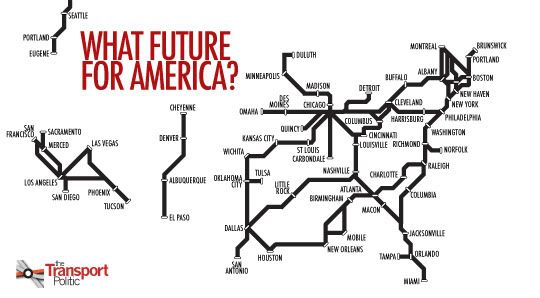
Way back before the Super Bowl, the White House had a series of exciting announcements, covered at The Transport Politic under the heading The White House Stakes Its Political Capital on a Massive Intercity Rail Plan.

That article is accompanied by the map reproduced here ~ and I stress that the map if Yonah Freemark’s work, not a map presented by the White House ~ of what a HSR system that rises to the “80% of Americans” target would look like.

And one reaction to that map is the same as the reaction to the designated DoT HSR corridors: how is that a national network? Its just bits and pieces.

How to fix this image problem, while also providing a substantial upgrade to the program, below the fold.

This is a familiar problem

The problem is even worse when people go to the Department of Transport website and take a look at the “designated HSR corridors”. Since this is an issue that comes up almost every time I post that picture, its an image problem I am used to addressing.

First, this is not a network plan, its a map of those corridors that have successfully jumped through all the hurdles to be eligible for HSR grant funding. Indeed, the reason the NEC (Northeast Corridor) is in Red instead of Green is that it has not been taken through those hurdles ~ instead its been receiving funding dedicated to Amtrak, rather than competing for what were miniscule amounts of HSR funding before the Stimulus Bill and its big bang $8b in funding.

Now that the White House has proposed basically $8b per year, split between dedicated funding to building new higher speed transport services and funding to upgrade and improve existing rail infrastructure ~ it seems reasonable that its time for the NEC to get designated. Maybe it could be split between existing corridors ~ DC to Phillie into the Southeast HSR corridors, Phillie to NYC into the Keystone Corridor, NYC to Boston into the New England HSR corridors.

Second, the target for either Rapid Passenger Rail, Regional HSR or Express HSR are trips of 500 miles or less ~ while the details depend on the efficiency of the alignment:

  • Roughly 100 to 300 miles for Rapid Passenger Rail, with maximum speeds of 110mph and transit speeds at or slightly better than Interstate Highway transit speeds
  • Roughly 100 to 400 miles for Regional HSR, with maximum speeds of 125mph, typically electrified on dedicated passenger track, but able to share existing rail right of way
  • Roughly 100 to 500 miles for Express HSR, with speeds over 125mph and maximum speeds of 220mph or more, requiring its own dedicated and all grade separated right of way

When you connect the metropolitan areas with populations to justify the investment required for Regional HSR and Express HSR, you simply do not necessarily get a coast to coast system,

So even if that “officially designated” system is bulked up by adding (1) the most promising corridors that the states have not gotten around to designating, such as Houston / Dallas, Pittsburgh / Cleveland, Detroit / Cleveland, Orlando / Jacksonville and etcetera and (2) existing state plans that build up from the “foundation” corridors that it makes sense to designate first … there will still be those gaps.

An Entirely Different National High Speed Rail network

Sunday Train readers will recognize this map, which presents proposed Steel Interstate corridors.

Steel Interstates are, primarily, High Speed FREIGHT Rail. They are intended to be electric rail corridors. They are to be provided with Positive Train Control throughout so that they can allow Rapid Freight Rail ~ 100mph single stack container trains, operated to schedule, to be able to offer faster and more reliable loading dock to loading dock times even with most containers having a short haul truck trip at both ends of the trip.

“Able to offer” is a key here ~ in curvy sections of right of way, there would be express track that would be elevated for Express freight, but with 3 inches of “unbalanced” cant allowed, that could in many cases also accommodate heavier (for example, double stack container) 60mph freight trains as well.

Much less annual funding is required per mile of Steel Interstate, since the funding is providing an interest subsidy, with the capital cost repaid by the access and user fees paid by trains using the new infrastructure ~ whether passing track or dedicated track, trains using the publicly owned express infrastructure would pay an access fee, and all trains using the publicly owned overhead electric wires would pay a user fee.

On reflection, that isn’t entirely different High Speed Rail after all

Now, from the perspective of passenger trains, if there is dedicated express track alongside the conventional heavy rail track … this is a 125mph Regional HSR corridor. It is, certainly, one that is used by and primarily paid for by freight services: but if Rapid Electric Freight can run on it at 100mph, then with suitable upgrades to level crossings, electric passenger tilt trains can run on it at 125mph.

If this is Express passing track added to conventional heavy rail track … this is a 110mph Rapid Passenger Rail corridor. Again, one primarily used and primarily paid for by freight services, but Rapid Passenger Rail nonetheless. To accommodate 100mph freight, the level crossings already have to be upgraded to Rapid Passenger Rail standard.

Except this is Rapid Passenger Rail and Regional HSR on an “Amtrak Dream” model, since this is publicly owned infrastructure designed to allow freight rail to keep to a schedule, which means, at the same time, it is designed to allow passenger rail to keep to a schedule. Buy the appropriate 110mph or 125mph trains, pay the access and user fees, and run the train.

The higher speed means that crew costs are lower per mile. The higher speed means that demand for the trips is stronger. And the higher speed means its possible to make more trips with the same trains, so the new trains serve more miles per day than the current Amtrak trains can do. And the design for path reliability ~ a design requirement for the freight market being targeted ~ means that there are fewer delays and it is possible to trim the slack that has to be built into current Amtrak schedules, while still meeting better on time service targets.

And Look What Happens when the Steel Interstate is added

Nowl, assume that there is passenger service ~ twice a day, three times a day, eight times a day … whatever the market will support ~ along the Steel Interstates. (original jpg)

NOW we got a national network.

Now, remember the $8b/yr? If we are willing to have a little patience in how rapidly we roll out the Steel Interstates, and finish them in something more like sixteen years than the six years that would be required at full commercial urgency, $2b in interest subsidy annually until the system is completed and the capital entirely refunded would be sufficient.

That suggests:

  • $4b annually for new Regional and Express HSR passenger rail track and, where required, corridors, on an 80:20 Federal:State match basis
  • $2b annually for the Steel Interstates, $500m to each Line Development Bank, leveraging a capital base of about $10b (or more) each, with user and access fees for use of completed infrastructure rolled over into further work until the designated Steel Interstate is completed.
  • $2b for Rapid Passenger Rail, complementary conventional passenger rail, common rail infrastructure improvement projects, and operating funding for launching preliminary services

Midnight Oil ~ Truganini

Rant of the Week: Stephen Colbert

Generic Republican Presidential Nominee

Jon Huntsman announces his presidential candidacy, and Stephen finds the perfect generic Republican presidential candidate.

On This Day In History June 26

This is your morning Open Thread. Pour your favorite beverage and review the past and comment on the future.

Find the past “On This Day in History” here.

Click on images to enlarge.

June 26 is the 177th day of the year (178th in leap years) in the Gregorian calendar. There are 188 days remaining until the end of the year.

On this day in 1959, St. Lawrence Seaway opened.

In a ceremony presided over by U.S. President Dwight D. Eisenhower and Queen Elizabeth II, the St. Lawrence Seaway is officially opened, creating a navigational channel from the Atlantic Ocean to all the Great Lakes. The seaway, made up of a system of canals, locks, and dredged waterways, extends a distance of nearly 2,500 miles, from the Atlantic Ocean through the Gulf of St. Lawrence to Duluth, Minnesota, on Lake Superior.

History

The Saint Lawrence Seaway was preceded by a number of other canals. In 1871, locks on the Saint Lawrence allowed transit of vessels 186 ft (57 m) long, 44 ft 6 in (13.56 m) wide, and 9 ft (2.7 m) deep. The Welland Canal at that time allowed transit of vessels 142 ft (43 m) long, 26 ft (7.9 m) wide, and 10 ft (3.0 m) deep, but was generally too small to allow passage of larger ocean-going ships.

The first proposals for a binational comprehensive deep waterway along the St. Lawrence came in the 1890s. In the following decades the idea of a power project became inseparable from the seaway – in fact, the various governments involved believed that the deeper water created by the hydro project were necessary to make the seaway channels feasible. American proposals for development up to and including the First World War met with little interest from the Canadian federal government. But the two national government submitted St. Lawrence plans, and the Wooten-Bowden Report and the International Joint Commission both recommended the project in the early 1920s. Although the Liberal Mackenzkie King was reluctant to proceed, in part of because of opposition to the project in Quebec, in 1932 the two countries inked a treaty. This failed to receive the assent of Congress. Subsequent attempts to forge an agreement in the 1930s came to naught as the Ontario government of Mitchell Hepburn, along with Quebec, got in the way. By 1941, President Roosevelt and Prime Minister King made an executive agreement to build the joint hydro and navigation works, but this too failed to receive the assent of Congress. Proposals for the seaway were met with resistance from railway and port lobbyists in the United States.

In the post-1945 years, proposals to introduce tolls still could not induce the U.S. Congress to approve the project. Growing impatient, and with Ontario desperate for hydro-electricity, Canada began to consider “going it alone.” This seized the imagination of Canadians, engendering a groundswell of St. Lawrence nationalism. Fueled by this support, the Canadian Louis St. Laurent government decided over the course of 1951 and 1952 to construct the waterway alone, combined with a hydro project (which would prove to be the joint responsibility of Ontario and New York – as a power dam would change the water levels, it required bilateral cooperation). However, the Truman and Eisenhower administrations considered it a national security threat for Canada to alone control the deep waterway, and used various means – such as delaying and stalling the Federal Power Commission license for the power aspect – until Congress in early 1954 approved an American seaway role via the Wiley act. Canada, out of concern for the ramifications of the bilateral relationship, reluctantly acquiesced.

In the United States, Dr. N.R. Danelian (who was the Director of the 13 volume St. Lawrence Seaway Survey in the U.S. Department of Navigation (1932-1963)), worked with the U.S. Secretary of State on Canadian-United States issues regarding the Seaway and worked for over 15 years on passage of the Seaway Act. He later became President of the Great Lakes St. Lawrence Association to further the interests of the Seaway development to benefit the American Heartland.

The seaway opened in 1959 and cost $638 million in Canadian dollars, $336.2 million of which was paid by the U.S. government.[1] Queen Elizabeth II and President Dwight D. Eisenhower formally opened the Seaway with a short cruise aboard Royal Yacht Britannia after addressing the crowds in St. Lambert, Quebec.

The seaway’s opening is often credited with making the Erie Canal obsolete, thus setting off the severe economic decline of several cities in Upstate New York.

 221 – Roman Emperor Elagabalus adopts his cousin Alexander Severus as his heir and receives the title of Caesar.

363 – Roman Emperor Julian is killed during the retreat from the Sassanid Empire. General Jovian is proclaimed Emperor by the troops on the battlefield.

1284 – the legendary Pied Piper leads 130 children out of Hamelin, Germany

1409 – Western Schism: the Roman Catholic church is led into a double schism as Petros Philargos is crowned Pope Alexander V after the Council of Pisa, joining Pope Gregory XII in Rome and Pope Benedict XII in Avignon.

1541 – Francisco Pizarro is assassinated in Lima by the son of his former companion and later antagonist, Diego Almagro the younger. Almagro is later caught and executed.

1718 – Tsarevich Alexei Petrovich of Russia, Peter the Great’s son, mysteriously dies after being sentenced to death by his father for plotting against him.

1723 – After a siege and bombardment by cannon, Baku surrenders to the Russians.

1848 – End of the June Days Uprising in Paris.

1857 – The first investiture of the Victoria Cross in Hyde Park, London.

1870 – The Christian holiday of Christmas is declared a federal holiday in the United States.

1907 – The 1907 Tiflis bank robbery took place in Yerevan Square, now Freedom Square, Tbilisi.

1909 – The Science Museum in London comes into existence as an independent entity.

1917 – The first U.S. troops arrive in France to fight alongside Britain, France, Italy, and Russia against Germany, and Austria-Hungary in World War I.

1918 – World War I, Western Front: Battle for Belleau Wood – Allied Forces under John J. Pershing and James Harbord defeat Imperial German Forces under Wilhelm, German Crown Prince.

1924 – American occupying forces leave the Dominican Republic.

1927 – The Cyclone roller coaster opens on Coney Island.

1934 – President Franklin D. Roosevelt signs the Federal Credit Union Act, which establishes credit unions.

1936 – Initial flight of the Focke-Wulf Fw 61, the first practical helicopter.

1940 – World War II: under the Molotov-Ribbentrop Pact, the Soviet Union presents an ultimatum to Romania requiring it to cede Bessarabia and the northern part of Bukovina.

1942 – The first flight of the Grumman F6F Hellcat.

1945 – The United Nations Charter is signed in San Francisco.

1948 – The Western allies begin an airlift to Berlin after the Soviet Union blockades West Berlin.

1948 – William Shockley files the original patent for the grown junction transistor, the first bipolar junction transistor.

1948 – Shirley Jackson’s short story The Lottery is published in The New Yorker magazine.

1952 – The Pan-Malayan Labour Party is founded in Malaya, as a union of statewise labour parties.

1953 – Lavrentiy Beria,head of MVD, is arrested by Nikita Khrushchev and other members of the Politburo.

1955 – The South African Congress Alliance adopts the Freedom Charter at the Congress of the People in Kliptown.

1959 – The Saint Lawrence Seaway opens, opening North America’s Great Lakes to ocean-going ships.

1960 – The former British Protectorate of British Somaliland gains its independence as Somaliland .

1960 – Madagascar gains its independence from France.

1973 – At Plesetsk Cosmodrome 9 people are killed in an explosion of a Cosmos 3-M rocket.

1974 – The Universal Product Code is scanned for the first time to sell a package of Wrigley’s chewing gum at the Marsh Supermarket in Troy, Ohio

1975 – Indira Gandhi establishes emergency rule in India.

1975 – Two FBI agents and a member of the American Indian Movement are killed in a shootout on the Pine Ridge Indian Reservation in South Dakota; Leonard Peltier is later convicted of the murders in a controversial trial.

1977 – The Yorkshire Ripper kills 16 year old shop assistant Jayne MacDonald in Leeds, changing public perception of the killer as she is the first victim who is not a prostitute.

1978 – Air Canada Flight 189 to Toronto overruns the runway and crashes into the Etobicoke Creek ravine. Two of 107 passengers on board perish.

1991 – Ten-Day War: the Yugoslav people’s army begins the Ten-Day War in Slovenia.

1995 – Hamad bin Khalifa al-Thani deposes his father Khalifa bin Hamad al-Thani, the Emir of Qatar, in a bloodless coup.

1996 – Irish Journalist Veronica Guerin is shot in her car while in traffic in the outskirts of Dublin

1997 – The U.S. Supreme Court rules that the Communications Decency Act violates the First Amendment to the United States Constitution.

2003 – The U.S. Supreme Court rules in Lawrence v. Texas that gender-based sodomy laws are unconstitutional.

2008 – The U.S. Supreme Court rules in District of Columbia v. Heller that the Second Amendment to the United States Constitution protects an individual right, and that the District of Columbia handgun ban is unconstitutional.

Holidays and observances

   * Army and Navy Day (Azerbaijan)

   * Christian Feast Day:

       * Anthelm of Belley

       * Hermogius

       * John and Paul

       * Josemaría Escrivá

       * Mar Abhai (Syriac Orthodox Church)

       * Vigilius of Trent

       * June 26 (Eastern Orthodox liturgics)

   * Flag Day (Romania)

   * Independence Day, celebrates the independence of Madagascar from France in 1960

   * International Day against Drug Abuse and Illicit Trafficking (International)

   * International Day in Support of Victims of Torture (International)

   * Sunthorn Phu Day (Thailand)

Keeping The Door Open To Torture

During his confirmation hearings to replace Leon Panetta as CIA director, General David Petraeus, the Nato commander in Afghanistan, told Senate Intelligence Committee that:

(Sen. Mark) Udall was clearly trying to get Petraeus to reiterate his opposition to torture – he read back several quotes Petraeus himself had given saying such techniques are immoral and when they’ve been used, they’ve “turned around and bitten us in the backside.” Udall asked, “do you see torture any differently in a CIA context than in a military context?”

But Petraeus instead pivoted to the TV-ready “ticking time bomb” scenario, and said torture might be justified if you have a “special situation” where an “individual in your hands who you know has placed a nuclear device under the Empire State Building. It goes off in 30 minutes, he has the codes to turn it off.” Then he urged legislators to consider crafting such an exception into the law:

I think that is a special case. I think there should be discussion of that by policymakers and by Congress. I think that it should be thought out ahead of time. There should be a process if indeed there is going to be something more than, again, the normal techniques employed in such a case. And again, I — I would certainly submit that that would be very helpful if that kind of debate could be held and if some resolution could be made as to what should be done in a case like that so that it is worked out ahead of time, rather than under an extraordinary sense of pressure in such a situation.

Torture is not a value that Americans have died for and it is beyond being stupid, it is illegal.

Punting the Pundits: Sunday Preview Edition

“Punting the Pundits” is an Open Thread. It is a selection of editorials and opinions from around the news medium and the internet blogs. The intent is to provide a forum for your reactions and opinions, not just to the opinions presented, but to what ever you find important.

Thanks to ek hornbeck, click on the link and you can access all the past “Punting the Pundits”.

The Sunday Talking Heads:

This Week with Christiane Amanpour: This week’s guest are Senate Minority Leader Mitch McConnell (R-KY) and House Assistant Minority Leader James Clyburn (D-SC).

On the roundtable George Will, former White House communications director Anita Dunn, Thomson Reuters’ Chrystia Freeland and ABC’s senior political correspondent Jonathan Karl discuss the debt limit. A second roundtable will examine the Afghan withdrawal wit George Will, ABC News’ senior foreign affairs correspondent Martha Raddatz and professor of international politics at Tufts University Vali Nasr.

Face the Nation with Bob Schieffer:Mr. Schieffer’s guest will be Rep. Michele Bachmann (R-MN).

The Chris Matthews Show: This Week’s Guests Norah O’Donnell, David Ignatius, The Washington Post Columnist, Michael Duffy, TIME Magazine Assistant Managing Editor and Helene Cooper The New York Times White House Correspondent who will discuss the Afghan withdrawal and the dilemma for the Tea Party if either Romney or Huntsman is nominated.

Meet the Press with David Gregory: Gusets are New Jersey Gov. Chris Christie, Armed Services Committee members Sen. Jack Reed (D-RI) and Sen. Jim Webb (D-VA).

Roundtable: Decision 2012 and more with the BBC’s Katty Kay, The NYT’s Matt Bai and David Brooks

State of the Union with Candy Crowley: Guests are Rep. Mike Rogers, the chairman of the House Intelligence Committee, House Minority Leader Nancy Pelosi, conservative Sen. Jim DeMint, Bill Burton, former deputy press secretary for President Obama, and Michael Gerson, former speechwriter for President George W. Bush..

Fareed Zakaris: GPS: A world-wide exclusive with Afghan President Hamid Karzai, PIMCO’s CEO Mohamed El-Erian and CNN senior legal analyst Jeffrey Toobin.

Now you can all go back to bed or celebrate Gay Marriage in New York

Maureen Dowd: Why Is He Bi? (Sigh)

HE was born this way.

Bi.

Not bisexual. Not even bipartisan. Just binary.

Our president likes to be on both sides at once.

In Afghanistan, he wants to go but he wants to stay. He’s surging and withdrawing simultaneously. He’s leaving fewer troops than are needed for a counterinsurgency strategy and more troops than are needed for a counterterrorism strategy – and he seems to want both strategies at the same time. Our work is done but we have to still be there. Our work isn’t done but we can go.

On Libya, President Obama wants to lead from behind. He’s engaging in hostilities against Qaddafi while telling Congress he’s not engaging in hostilities against Qaddafi.

Mark Weisbrot: European Authorities Risking Financial Contagion in Greek Showdown; Where Is the U.S. Government?

The US had better be ready for the economic shock

The European authorities are playing a dangerous game of “chicken” with Greece right now. It is overdue for US members of Congress to exercise some oversight as to what our government’s role is in this process, and how we might be preparing for a Greek debt default. Depending on how it happens, this default could have serious repercussions for the international financial system, the US economy and, indeed, the world economy.

New York Times Editorial: Whose Stimulus?

Big businesses are telling Washington that they are willing to do their bit for the economy – if the price is right. Multinational companies say they could repatriate hundreds of billions in foreign profits and pump them into domestic investment and hiring, but only if Congress and the White House agree to cut the tax rate on those profits to 5.25 percent from 35 percent. They call their plan “the next stimulus.” Sounds more like extortion.

In the last five years American businesses have kept abroad more than $1 trillion worth of foreign earnings, according to government data. An article by David Kocieniewski in The Times last week noted that Microsoft has $29 billion offshore, Google has $17 billion and Apple has $12 billion.

Robert Naiman: Kucinich: Ensure Safety of U.S. Citizens on The Audacity of Hope

In many arenas of human endeavor, there is no plausible way to convince someone through abstract argument that an endeavor that appears to be incredibly difficult is nonetheless not impossible. There’s nothing for it but to create an example.

Efforts to get Members of Congress to do anything related in any way to the basic human rights of Palestinians that is not slavishly pro-Likud is a prime example of this phenomenon. Many are convinced – not without evidence that makes their position seductive – that it is an immutable law of the universe that all Members of Congress must always express fealty to right-wing views on this topic.

Frank Bruni: To Know Us Is to Let Us Love

IN the mid-1980s, when I was in college, what concerned and frustrated my peers and me was how few states had basic statutes forbidding discrimination against gay men and lesbians: laws that merely prevented someone from being denied a job or apartment on the basis of whom he or she loved. At that point only Wisconsin and the District of Columbia provided such protection. The decade would end with just one addition, Massachusetts, to that meager list.

Same-sex marriage? I don’t recall our talking – or dreaming – much about that. We considered ourselves realists. Sometimes idealists. But never fantasists.

John Nichols: Wisconsin Governor Walker’s Chief Judicial Ally Accused of Physically Attacking Jurist Who Defended Rule of Law

Wisconsin Supreme Court Justice David Prosser, who mentored controversial Governor Scott Walker when both served as Republican legislators, has positioned himself as the primary defender of Walker’s radical anti-labor and anti-local democracy agenda on the court.

And it appears that the justice, whose unstable behavior and violent language has been highlighted in media reports, is willing to go to any length to protect Walker from legal accountability.

Justice Prosser, who retained his seat on the court only after the recount of results from an April statewide election that saw charges of fraud and political abuse aimed at the justice’s campaign, now stands accused of physically attacking a justice who disagreed with his push to make the high court an amen corner for the governor.

Load more