
Burning the Midnight Oil for Living Energy Independence
crossposted from Voices on the Square
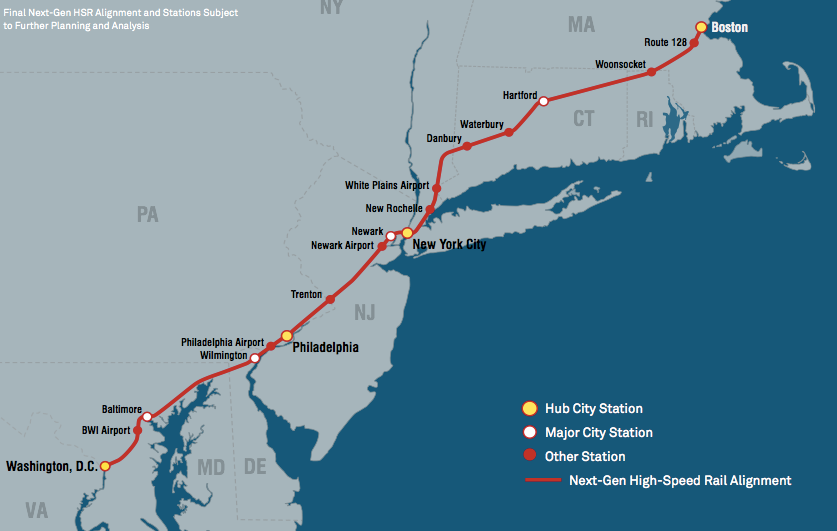 One of the transit bloggers that I enjoy reading is Alon Levy who blogs his observations on a variety of transit topics at Pedestrian Observations . Following the important California HSR funding vote in the California State Senate and the excitement leading up to it, I thought I’d like to take a look at the proposed Express HSR system for the states of the Northeast Corridor.
Of the $53b cost of the proposed San Francisco to Los Angeles Express HSR corridor seems hefty ~ and it seems even heftier when it shows the Year of Expenditure headline value of $68b ~ then the proposed Northeast Corridor states Express HSR will seem massive.
However, Alon claims:
Northeast Corridor HSR, 90% Cheaper
…
In contrast with this extravaganza, it is possible to achieve comparable travel times for about one tenth the cost. The important thing is to build the projects with the most benefit measured in travel time reduced or reliability gained per unit of cost, and also share tracks heavily with commuter rail, using timed overtakes to reduce the required amount of multi-tracking.
This sounds like an intriguing possibility … but is it realistic? Or is it wishful thinking? Follow me below the fold, and then let’s discuss it.
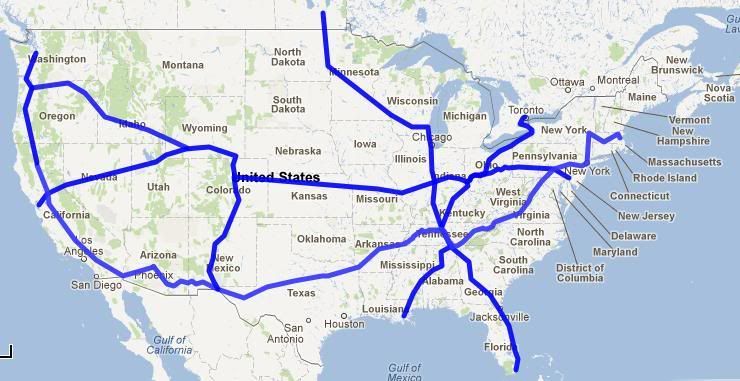 The last two weeks on the Sunday Train, I’ve been writing about the Steel Interstate.
  Express HSR is sexy. Indeed, its sexy enough that when Big Oil propagandizes against it, they have to paint it as too expensive or something that America is too incompetent to handle, since the idea of sitting in an actually comfortable rail seat, watching a movie on a laptop or snacking on a sandwich while flying along at two to three times highway speeds, “just like in France or Japan or Spain”, that’s too appealing to convince a big majority of people that it would be anything but nice to have. So they have to con people into thinking of it as an unrealistic pipe dream that the US can do what Spain has been doing for a decade, France for three decades, and Japan for half a century.
 This week’s Sunday Train is a trio of shorter topics. The first is a research development project to develop a modern steam train to run on biocoal. The target is a sustainable steam train that, as a headline grabber, will attempt to run at 130mph and break the world steam train speed record. There’s much to like about this research development project … but I am going to argue that biocoal to operate trains is not it.
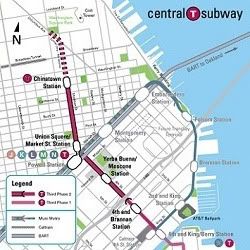 Second, SF’s MUNI transport agency is one of the ten agencies slated to split $760m in Prop1a(2008) bond funds improvements to systems interconnecting with the planned High Speed Rail system. The balance of the $950m goes to the three existing Amtrak California intercity rail services, the Capitol Corridor, the San Joaquin, and the Surfliner.
 And third, a speculative look at an alternative technology that SF MUNI might deploy that money on, that actually would connect with the HSR system at the Transbay Terminal, as well as connecting to BART, the MUNI light rail network, the existing (and proposed alternative) Caltrain terminus at 4th and King, and provide express transit service along Geary Blvd.
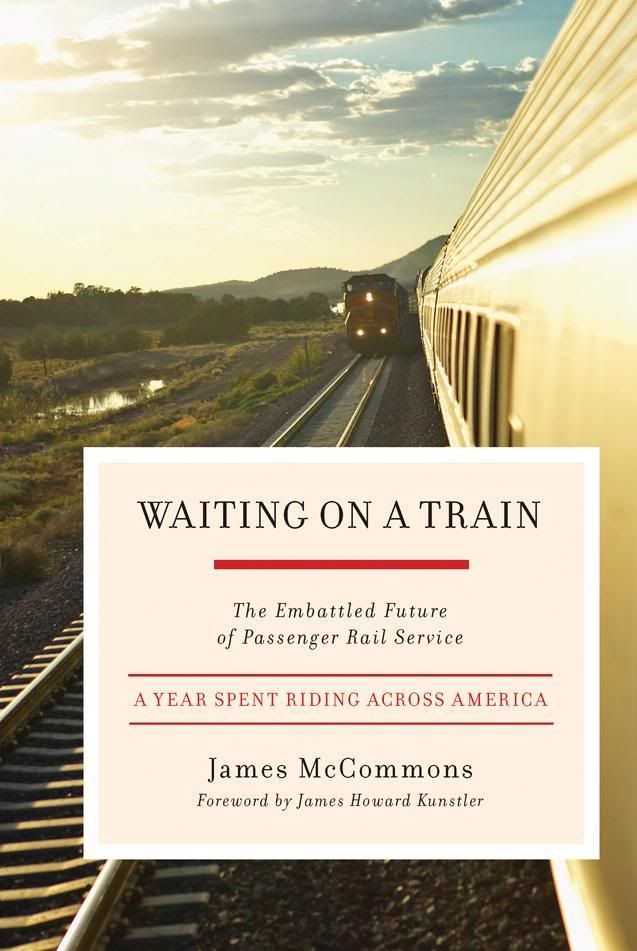 Back in the 29 Nov 2009 Sunday Train,
  The Iowa Department of Transport has just completed the Chicago to Omaha Regional Passenger Rail System Planning Study, to select its preferred alignment for a detailed Environmental Impact Report.
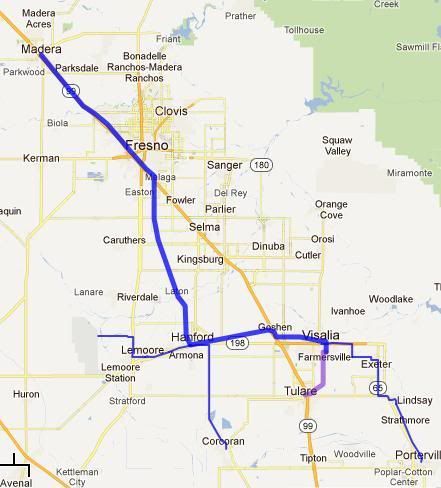 Kings County officials have been
  One element of the recent California HSR “revised” draft 2012 Business Plan (which we shall call the Other, Other Plan) involves looking to one particular means of finance in addition to general fund bond finance and Federal transport grant funding:
  I saw this story a couple of weeks ago, but between the happenings in California and some unanswered questions I had, I haven’t mentioned it yet.
Recent Comments