
This is your morning Open Thread. Pour your favorite beverage and review the past and comment on the future.
Find the past “On This Day in History” here.
September 25 is the 268th day of the year (269th in leap years) in the Gregorian calendar. There are 97 days remaining until the end of the year.
On this day in 1789, the Bill of Rights passes Congress.
The first Congress of the United States approves 12 amendments to the U.S. Constitution, and sends them to the states for ratification. The amendments, known as the Bill of Rights, were designed to protect the basic rights of U.S. citizens, guaranteeing the freedom of speech, press, assembly, and exercise of religion; the right to fair legal procedure and to bear arms; and that powers not delegated to the federal government were reserved for the states and the people.
The Bill of Rights is the name by which the first ten amendments to the United States Constitution are known. They were introduced by James Madison to the First United States Congress in 1789 as a series of articles, and came into effect on December 15, 1791, when they had been ratified by three-fourths of the States. An agreement to create the Bill of Rights helped to secure ratification of the Constitution itself. Thomas Jefferson was a supporter of the Bill of Rights.
The Bill of Rights prohibits Congress from making any law respecting any establishment of religion or prohibiting the free exercise thereof, guarantees free speech, free press, free assembly and association and the right to petition government for redress, forbids infringement of “…the right of the people to keep and bear Arms…”, and prohibits the federal government from depriving any person of life, liberty, or property, without due process of law. In federal criminal cases, it requires indictment by a grand jury for any capital or “infamous crime”, guarantees a speedy, public trial with an impartial jury composed of members of the state or judicial district in which the crime occurred, and prohibits double jeopardy. In addition, the Bill of Rights states that “the enumeration in the Constitution, of certain rights, shall not be construed to deny or disparage others retained by the people,” and reserves all powers not specifically granted to the federal government to the people or the States. Most of these restrictions were later applied to the states by a series of decisions applying the due process clause of the Fourteenth Amendment, which was ratified in 1868, after the American Civil War.
The question of including a Bill of Rights in the body of the Constitution was discussed at the Philadelphia Convention on September 12, 1787. George Mason “wished the plan [the Constitution] had been prefaced with a Bill of Rights.” Elbridge Gerry of Massachusetts “concurred in the idea & moved for a Committee to prepare a Bill of Rights.” Mr Sherman argued against a Bill of Rights stating that the “State Declarations of Rights are not repealed by this Constitution.” Mason then stated “The Laws of the U. S. are to be paramount to State Bills of Rights.” The motion was defeated with 10-Nays, 1-Absent, and No-Yeas.
Madison proposed the Bill of Rights while ideological conflict between Federalists and anti-Federalists, dating from the 1787 Philadelphia Convention, threatened the final ratification of the new national Constitution. It largely responded to the Constitution’s influential opponents, including prominent Founding Fathers, who argued that the Constitution should not be ratified because it failed to protect the fundamental principles of human liberty. The Bill was influenced by George Mason’s 1776 Virginia Declaration of Rights, the 1689 English Bill of Rights, works of the Age of Enlightenment pertaining to natural rights, and earlier English political documents such as Magna Carta (1215).
Two other articles were proposed to the States; only the last ten articles were ratified contemporaneously. They correspond to the First through Tenth Amendments to the Constitution. The proposed first Article, dealing with the number and apportionment of U.S. Representatives, never became part of the Constitution. The second Article, limiting the power of Congress to increase the salaries of its members, was ratified two centuries later as the 27th Amendment. Though they are incorporated into Madison’s document known as the “Bill of Rights”, neither article established protection of a right. For that reason, and also because the term had been applied to the first ten amendments long before the 27th Amendment was ratified, the term “Bill of Rights” in modern U.S. usage means only the ten amendments ratified in 1791.
The Bill of Rights plays a key role in American law and government, and remains a vital symbol of the freedoms and culture of the nation. One of the first fourteen copies of the Bill of Rights is on public display at the National Archives in Washington, D.C.
 . . . . Andre Malraux, the French minister of culture, commissioned him to design a new ceiling for the Paris Opera after seeing Chagall’s work in Daphnis et Chloe. Working with a surface of 560 square meters, Chagall divided the ceiling into color zones that he filled with landscapes and figures representing the luminaries of opera and ballet. The ceiling was unveiled on September 23, 1964, during a performance of the same Daphnis et Chloe. As usual, a few detractors condemned Chagall’s work as overly primitive, but this criticism was drowned out in the general acclaim for the work. In 1966, as a gift to the city that had sheltered him during World War II, he painted two vast murals for New York’s Metropolitan Opera House (1966).
 When the Civil War broke out in 1861, shortly after Lincoln’s inauguration as America’s 16th president, he maintained that the war was about restoring the Union and not about slavery. He avoided issuing an anti-slavery proclamation immediately, despite the urgings of abolitionists and radical Republicans, as well as his personal belief that slavery was morally repugnant. Instead, Lincoln chose to move cautiously until he could gain wide support from the public for such a measure.

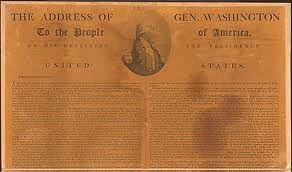 Originally published in David Claypoole’s American Daily Advertiser on September 19, 1796 under the title “The Address of General Washington To The People of The United States on his declining of the Presidency of the
 The building would take nearly a century to complete, as architects came and went, the British set fire to it and it was called into use during the Civil War. Today, the Capitol building, with its famous cast-iron dome and important collection of American art, is part of the Capitol Complex, which includes six Congressional office buildings and three Library of Congress buildings, all developed in the 19th and 20th centuries.
 On September 25, 1789, the first Congress of the United States adopted 12 amendments to the U.S. Constitution–the Bill of Rights–and sent them to the states for ratification. Ten of these amendments were ratified in 1791. In November 1789, North Carolina became the 12th state to ratify the U.S. Constitution. Rhode Island, which opposed federal control of currency and was critical of compromise on the issue of slavery, resisted ratifying the Constitution until the U.S. government threatened to sever commercial relations with the state. On May 29, 1790, Rhode Island voted by two votes to ratify the document, and the last of the original 13 colonies joined the United States. Today, the U.S. Constitution is the oldest written constitution in operation in the world.
Recent Comments