
This is your morning Open Thread. Pour your favorite beverage and review the past and comment on the future.
Find the past “On This Day in History” here.
Click on images to enlarge
August 9 is the 221st day of the year (222nd in leap years) in the Gregorian calendar. There are 144 days remaining until the end of the year.
On this day in 1974, one day after the resignation of President Richard M. Nixon, Gerald R. Ford is sworn in as president, making him the first man to assume the presidency upon his predecessor’s resignation. He was also the first non-elected vice president and non-elected president, which made his ascendance to the presidency all the more unique.
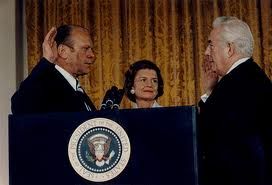
Gerald Rudolph Ford, Jr. (born Leslie Lynch King, Jr.; July 14, 1913 – December 26, 2006) was the 38th President of the United States, serving from 1974 to 1977, and the 40th Vice President of the United States serving from 1973 to 1974. As the first person appointed to the vice-presidency under the terms of the 25th Amendment, when he became President upon Richard Nixon’s resignation on August 9, 1974, he also became the only President of the United States who was elected neither President nor Vice-President.
Before ascending to the vice-presidency, Ford served nearly 25 years as Representative from Michigan’s 5th congressional district, eight of them as the Republican Minority Leader.
As President, Ford signed the Helsinki Accords, marking a move toward detente in the Cold War. With the conquest of South Vietnam by North Vietnam nine months into his presidency, US involvement in Vietnam essentially ended. Domestically, Ford presided over what was then the worst economy since the Great Depression, with growing inflation and a recession during his tenure. One of his more controversial acts was to grant a presidential pardon to President Richard Nixon for his role in the Watergate scandal. During Ford’s incumbency, foreign policy was characterized in procedural terms by the increased role Congress began to play, and by the corresponding curb on the powers of the President. In 1976, Ford narrowly defeated Ronald Reagan for the Republican nomination, but ultimately lost the presidential election to Democrat Jimmy Carter.
Following his years as president, Ford remained active in the Republican Party. After experiencing health problems and being admitted to the hospital four times in 2006, Ford died in his home on December 26, 2006. He lived longer than any other U.S. president, dying at the age of 93 years and 165 days.
 Heyerdahl and his five-person crew set sail from Callao, Peru, on the 40-square-foot Kon-Tiki on April 28, 1947. The Kon-Tiki, named for a mythical white chieftain, was made of indigenous materials and designed to resemble rafts of early South American Indians. While crossing the Pacific, the sailors encountered storms, sharks and whales, before finally washing ashore at Raroia. Heyerdahl, born in Larvik, Norway, on October 6, 1914, believed that Polynesia’s earliest inhabitants had come from South America, a theory that conflicted with popular scholarly opinion that the original settlers arrived from Asia. Even after his successful voyage, anthropologists and historians continued to discredit Heyerdahl’s belief. However, his journey captivated the public and he wrote a book about the experience that became an international bestseller and was translated into 65 languages. Heyerdahl also produced a documentary about the trip that won an Academy Award in 1951.
 Television, rock and roll and teenagers. In the late 1950s, when television and rock and roll were new and when the biggest generation in American history was just about to enter its teens, it took a bit of originality to see the potential power in this now-obvious combination. The man who saw that potential more clearly than any other was a 26-year-old native of upstate New York named
 The USS Nautilus was constructed under the direction of U.S. Navy Captain Hyman G. Rickover, a brilliant Russian-born engineer who joined the U.S. atomic program in 1946. In 1947, he was put in charge of the navy’s nuclear-propulsion program and began work on an atomic submarine. Regarded as a fanatic by his detractors, Rickover succeeded in developing and delivering the world’s first nuclear submarine years ahead of schedule. In 1952, the Nautilus’ keel was laid by President Harry S. Truman, and on January 21, 1954, first lady Mamie Eisenhower broke a bottle of champagne across its bow as it was launched into the Thames River at Groton, Connecticut. Commissioned on September 30, 1954, it first ran under nuclear power on the morning of January 17, 1955.
Recent Comments