Tag: Open Thread

The Breakfast Club (Dream a Little Dream)

Welcome to The Breakfast Club! We’re a disorganized group of rebel lefties who hang out and chat if and when we’re not too hungover  we’ve been bailed out we’re not too exhausted from last night’s (CENSORED) the caffeine kicks in. Join us every weekday morning at 9am (ET) and weekend morning at 10:30am (ET) to talk about current news and our boring lives and to make fun of LaEscapee! If we are ever running late, it’s PhilJD’s fault.

 photo 807561379_e6771a7c8e_zps7668d00e.jpg

This Day in History

Nazi police arrest Anne Frank and family; Britain declares war on Germany in World War I; Three civil rights workers found slain in Mississippi; The Bordens axed to death; Jazz great Louis Armstrong born.

Breakfast Tunes

Something to Think about over Coffee Prozac

How wonderful it is that nobody need wait a single moment before starting to improve the world.

Anne Frank

On This Day In History August 4

This is your morning Open Thread. Pour your favorite beverage and review the past and comment on the future.

Find the past “On This Day in History” here.

Click on images to enlarge

August 4 is the 216th day of the year (217th in leap years) in the Gregorian calendar. There are 149 days remaining until the end of the year.

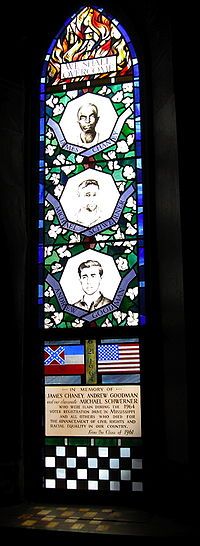
On this day in 1964, the remains of three civil rights workers whose disappearance on June 21 garnered national attention are found buried in an earthen dam near Philadelphia, Mississippi. Michael Schwerner and Andrew Goodman, both white New Yorkers, had traveled to heavily segregated Mississippi in 1964 to help organize civil rights efforts on behalf of the Congress of Racial Equality (CORE). The third man, James Chaney, was a local African American man who had joined CORE in 1963. The disappearance of the three young men led to a massive FBI investigation that was code-named MIBURN, for “Mississippi Burning.”

On Junr 20, Schwerner returned from a civil rights training session in Ohio with 21-year-old James Chaney and 20-year-old Andrew Goodman, a new recruit to CORE. The next day–June 21–the three went to investigate the burning of the church in Neshoba. While attempting to drive back to Meridian, they were stopped by Neshoba County Deputy Sheriff Cecil Price just inside the city limits of Philadelphia, the county seat. Price, a member of the KKK who had been looking out for Schwerner or other civil rights workers, threw them in the Neshoba County jail, allegedly under suspicion for church arson.

After seven hours in jail, during which the men were not allowed to make a phone call, Price released them on bail. After escorting them out of town, the deputy returned to Philadelphia to drop off an accompanying Philadelphia police officer. As soon as he was alone, he raced down the highway in pursuit of the three civil rights workers. He caught the men just inside county limits and loaded them into his car. Two other cars pulled up filled with Klansmen who had been alerted by Price of the capture of the CORE workers, and the three cars drove down an unmarked dirt road called Rock Cut Road. Schwerner, Goodman, and Chaney were shot to death and their bodies buried in an earthen dam a few miles from the Mt. Zion Methodist Church.

Punting the Pundits

“Punting the Pundits” is an Open Thread. It is a selection of editorials and opinions from around the news medium and the internet blogs. The intent is to provide a forum for your reactions and opinions, not just to the opinions presented, but to what ever you find important.

Thanks to ek hornbeck, click on the link and you can access all the past “Punting the Pundits”.

Follow us on Twitter @StarsHollowGzt

Paul Krugman: America’s Un-Greek Tragedies in Puerto Rico and Appalachia

On Friday the government of Puerto Rico announced that it was about to miss a bond payment. It claimed that for technical legal reasons this wouldn’t be a default, but that’s a distinction without a difference.

So is Puerto Rico America’s Greece? No, it isn’t, and it’s important to understand why.

Puerto Rico’s fiscal crisis is basically the byproduct of a severe economic downturn. The commonwealth’s government was slow to adjust to the worsening fundamentals, papering over the problem with borrowing. And now it has hit the wall.

What went wrong? There was a time when the island did quite well as a manufacturing center, boosted in part by a special federal tax break. But that tax break expired in 2006, and in any case changes in the world economy have worked against Puerto Rico.

Robert Kuttner: The German Menace

At the end of World War II, a bloody horror that cost 80 million lives worldwide, American leaders were determined that Germany must never again rise to massacre its neighbors. So the allies created a plan to strip Germany of its industrial might and turn it into a “pastoral” economy with a GDP well below its level of 1938.

In addition, the reparations from the previous damage created by Germany during World War I, which were levied at the Versailles peace conference but never paid, were made due and payable over ten years.

The combined cost of the reparations and the loss of its industry were deemed a fitting punishment for the Germans, who pretended not to know what was going on but were fully culpable for the rise and the grotesque atrocities of the Hitler regime.

Germany, economically crushed, never did pay back its debts but at least the Germans were taught a lesson — and Germany never again became a world power.

Oops — that’s not what happened.

Robert Reich: The Revolt Against the Ruling Class

“He can’t possibly win the nomination,” is the phrase heard most often when Washington insiders mention either Donald Trump or Bernie Sanders.

Yet as enthusiasm for the bombastic billionaire and the socialist senior continues to build within each party, the political establishment is mystified.

They don’t understand that the biggest political phenomenon in America today is a revolt against the “ruling class” of insiders that have dominated Washington for more than three decades.

In two very different ways, Trump and Sanders are agents of this revolt. I’ll explain the two ways in a moment.

Don’t confuse this for the public’s typical attraction to candidates posing as political outsiders who’ll clean up the mess, even when they’re really insiders who contributed to the mess.

What’s new is the degree of anger now focused on those who have had power over our economic and political system since the start of the 1980s.

Paul Buchheit: Great Embarrassments of an Unequal Society

America has experienced “gush-up” rather than “trickle-down.” The shame is on the adherents of unregulated free-market capitalism, who have assaulted us with the message of “winner-take-all” wealth over the common good. George Willperpetuates the neoliberal myth by quoting one of his idols, John Tamny: “Income inequality in a capitalist system is truly beautiful…it provides the incentive for creative people to gamble on new ideas..”

But in the realm of reality, there are many reasons for embarrassment:  [..]

The Greatest Embarrassment

That would be Congress itself: Allowing Americans to go without health care. Blowing off jobs bills. Ignoring infrastructure. Privatizing education and other public needs. Doing nothing about student debt. Cutting the IRS even though every hour of auditing returns $9,000 from large corporations. And on and on and on.

Terrell Jermaine Starr: Body Cams Can Capture Abuse, But Can They End Police Brutality?

The swift first-degree murder charge filed against a former University of Cincinnati police officer after his body camera captured him shooting an unarmed black man to death reflects how crucial video is in proving police misconduct.

When Ray Tensing pulled Samuel Dubose over on July 19, his body camera captured the entire stop. After Dubose was unable to produce a license and prevented Tensing from opening the driver door of his vehicle, the former cop shot him in the head. Tensing claimed he was being dragged by the car, which was proven untrue. A police report of the incident also shows officers on the scene lied about seeing Dubose’s car “dragging” Tensing. [..]

As critical as body cameras are in exposing police abuses, law enforcement experts told AlterNet that policymakers at the local and national levels need to do much more to curtail police brutality. Tensing wore a body camera, but still ended up abusing his power and shooting Dubose to death for no reason.

Reynard Loki: People Are Dying from Contaminated Food, but Obama and Congress Don’t Seem to Care

In 2010, after thousands of Americans were sickened by tainted spinach, peanut butter and eggs, Congress passed the Food Safety Modernization Act (FSMA), a sweeping reform bill that gave the Food and Drug Administration (FDA) new powers to help ensure the safety of the nation’s food system. It was the nation’s first major food policy legislation since FDR signed the Food, Drug and Cosmetic Act in 1938. But now, five years later, according to a recent POLITICO investigation, not a single one of the new rules has been implemented and the entire mission has a $276-million funding gap. So what happened?

The Breakfast Club (Keep Swinging)

Welcome to The Breakfast Club! We’re a disorganized group of rebel lefties who hang out and chat if and when we’re not too hungover  we’ve been bailed out we’re not too exhausted from last night’s (CENSORED) the caffeine kicks in. Join us every weekday morning at 9am (ET) and weekend morning at 10:30am (ET) to talk about current news and our boring lives and to make fun of LaEscapee! If we are ever running late, it’s PhilJD’s fault.

 photo 807561379_e6771a7c8e_zps7668d00e.jpg

This Day in History

Christopher Columbus sets sail; Europe slides further into World War I; A Cold War case heats up Capitol Hill; Air traffic controllers in the U.S. go on strike; NBA founded; Singer Tony Bennett born.

Breakfast Tunes

Something to Think about over Coffee Prozac

To work is to feel alive.

Tony Bennett

On This Day In History August 3

This is your morning Open Thread. Pour your favorite beverage and review the past and comment on the future.

Find the past “On This Day in History” here.

Click on images to enlarge

August 3 is the 215th day of the year (216th in leap years) in the Gregorian calendar. There are 150 days remaining until the end of the year.

On August 3, 1958, the U.S. nuclear submarine Nautilus accomplishes the first undersea voyage to the geographic North Pole. The world’s first nuclear submarine, the Nautilus  dived at Point Barrow, Alaska, and traveled nearly 1,000 miles under the Arctic ice cap to reach the top of the world. It then steamed on to Iceland, pioneering a new and shorter route from the Pacific to the Atlantic and Europe.

The USS Nautilus was constructed under the direction of U.S. Navy Captain Hyman G. Rickover, a brilliant Russian-born engineer who joined the U.S. atomic program in 1946. In 1947, he was put in charge of the navy’s nuclear-propulsion program and began work on an atomic submarine. Regarded as a fanatic by his detractors, Rickover succeeded in developing and delivering the world’s first nuclear submarine years ahead of schedule. In 1952, the Nautilus’ keel was laid by President Harry S. Truman, and on January 21, 1954, first lady Mamie Eisenhower broke a bottle of champagne across its bow as it was launched into the Thames River at Groton, Connecticut. Commissioned on September 30, 1954, it first ran under nuclear power on the morning of January 17, 1955.

USS Nautilus (SSN-571) was the world’s first operational nuclear-powered submarine. She was also the first vessel to complete a submerged transit across the North Pole.

Named for the submarine in Jules Verne’s Twenty Thousand Leagues Under the Sea, Nautilus was authorized in 1951 and launched in 1954. Because her nuclear propulsion allowed her to remain submerged for far longer than diesel-electric submarines, she broke many records in her first years of operation and was able to travel to locations previously beyond the limits of submarines. In operation, she revealed a number of limitations in her design and construction; this information was used to improve subsequent submarines.

The Nautilus was decommissioned in 1980 and designated a National Historic Landmark in 1982. She has been preserved as a museum of submarine history in New London, Connecticut, where she receives some 250,000 visitors a year.

Rant of the Week: Jon Stewart – Caliphatication

Caliphatication

On This Day In History August 2

This is your morning Open Thread. Pour a cup of your favorite morning beverage and review the past and comment on the future.

August 2 is the 214th day of the year (215th in leap years) in the Gregorian calendar. There are 151 days remaining until the end of the year.

On this day in 1776, members of Congress affix their signatures to an enlarged copy of the Declaration of Independence.

Fifty-six congressional delegates in total signed the document, including some who were not present at the vote approving the declaration. The delegates signed by state from North to South, beginning with Josiah Bartlett of New Hampshire and ending with George Walton of Georgia. John Dickinson of Pennsylvania and James Duane, Robert Livingston and John Jay of New York refused to sign. Carter Braxton of Virginia; Robert Morris of Pennsylvania; George Reed of Delaware; and Edward Rutledge of South Carolina opposed the document but signed in order to give the impression of a unanimous Congress. Five delegates were absent: Generals George Washington, John Sullivan, James Clinton and Christopher Gadsden and Virginia Governor Patrick Henry.

The United States Declaration of Independence is a statement adopted by the Continental Congress on July 4, 1776, which announced that the thirteen American colonies then at war with Great Britain were now independent states, and thus no longer a part of the British Empire. Written primarily by Thomas Jefferson, the Declaration is a formal explanation of why Congress had voted on July 2 to declare independence from Great Britain, more than a year after the outbreak of the American Revolutionary War. The birthday of the United States of America-Independence Day-is celebrated on July 4, the day the wording of the Declaration was approved by Congress.

The Declaration justified the independence of the United States by listing colonial grievances against King George III, and by asserting certain natural rights, including a right of revolution. Having served its original purpose in announcing independence, the text of the Declaration was initially ignored after the American Revolution. Its stature grew over the years, particularly the second sentence, a sweeping statement of individual human rights:

   We hold these truths to be self-evident, that all men are created equal, that they are endowed by their Creator with certain unalienable Rights, that among these are Life, Liberty and the pursuit of Happiness.

This sentence has been called “one of the best-known sentences in the English language” and “the most potent and consequential words in American history”.

After finalizing the text on July 4, Congress issued the Declaration of Independence in several forms. It was initially published as a printed broadside that was widely distributed and read to the public. The most famous version of the Declaration, a signed copy that is usually regarded as the Declaration of Independence, is on display at the National Archives in Washington, D.C. Although the wording of the Declaration was approved on July 4, the date of its signing has been disputed. Most historians have concluded that it was signed nearly a month after its adoption, on August 2, 1776, and not on July 4 as is commonly believed. The sources and interpretation of the Declaration have been the subject of much scholarly inquiry.

The famous wording of the Declaration has often been invoked to protect the rights of individuals and marginalized groups, and has come to represent for many people a moral standard for which the United States should strive. This view was greatly influenced by Abraham Lincoln, who considered the Declaration to be the foundation of his political philosophy, and who promoted the idea that the Declaration is a statement of principles through which the United States Constitution should be interpreted.

Punting the Pundits: Sunday Preview Edition

Punting the Punditsis an Open Thread. It is a selection of editorials and opinions from around the news medium and the internet blogs. The intent is to provide a forum for your reactions and opinions, not just to the opinions presented, but to what ever you find important.

Thanks to ek hornbeck, click on the link and you can access all the past “Punting the Pundits”.

Follow us on Twitter @StarsHollowGzt

The Sunday Talking Heads:

This Week with George Stephanopolis: The guests on Sunday’s “This Week” are: Donald Trump; Sen. Bernie Sanders (I-VT); former Sen. Rick Santorum (R-PA); and RNC Chair Reince Priebus.

At the roundtable are: Democratic strategist Maria Cardona; former House speaker Newt Gingrich (R-GA); Republican strategist and pollster Kristen Soltis Anderson; and ABC News’ Cokie Roberts.

Face the Nation: Host John Dickerson’s guests are: former Gov. Mike Huckabee (R-AR); and CBS News Aviation and Safety Expert Chesley “Sully” Sullenberger.

On a panel to discuss money in politics are: CBS News Correspondent Julianna Goldman; former FEC commissioner Trevor Potter; Washington Post‘s Matea Gold; and Steven Law, American Crossroads.

The guests on the political panel are: Molly Ball, The Atlantic; Ron Fournier, The National Journal; Dan Balz, The Washington Post; and Reihan Salam, The National Review.

Meet the Press with Chuck Todd: The guests on this Sunday’s “MTP” are: RNC Chair Reince Priebus; DNC Chair Debbie Wasserman Schultz; GOP presidential contender Dr. Ben Carson; and Philadelphia Police Commissioner Charles Ramsey.

At the roundtable, the guests are:  Gerald Seib, The Wall Street Journal; Kathleen Parker, The Washington Post; Helene Cooper, The New York Times; and Chris Matthews, host of MSNBC’s “Hardball.”

State of the Union with Jake Tapper: Mr. Tapper’s guests are: GOP presidential contenders Gov. Chris Christie (R-NJ) and Sen. Rand Paul (R-Ky.).

His panel guests are: Former Gov. Haley Barbour (R-MS); Brianna Keilar, CNN senior political correspondent; Jennifer J. Jacobs, Des Moines Register; and Van Jones, Rebuild the Dream.

In a tribute to the departing host of “The Daily ShowJon Stewart, Mr. Tapper speaks with Samantha Bee.

Punting the Pundits

“Punting the Pundits” is an Open Thread. It is a selection of editorials and opinions from around the news medium and the internet blogs. The intent is to provide a forum for your reactions and opinions, not just to the opinions presented, but to what ever you find important.

Thanks to ek hornbeck, click on the link and you can access all the past “Punting the Pundits”.

Follow us on Twitter @StarsHollowGzt

Chris Bostic and John Stewart: US Chamber of Commerce is in Big Tobacco’s thrall

Its political interference on behalf of the tobacco industry threatens public health measures abroad – and at home

A flurry of news articles, opinion pieces and blog posts have followed a June 30 New York Times investigation detailing how the U.S. Chamber of Commerce uses its clout to undermine public health measures that restrict tobacco use, sale and uptake, as mandated by the World Health Organization’s global tobacco treaty, the Framework Convention on Tobacco Control. While the coverage has highlighted the Chamber’s faculty for undermining tobacco control internationally, it has largely omitted the organization’s political interference in the United States on behalf of Big Tobacco.

One of the clearest ways the Chamber of Commerce has peddled the tobacco industry’s interests at home is through trade negotiations. The U.S. is on the verge of completing what would be the world’s largest trade and investment treaty, the Trans-Pacific Partnership (TPP). Many critics have opposed this deal, among the U.S. and 11 other Pacific Rim countries, over concerns about its possible effects on public health, the environment and workers’ rights. [..]

The global community is on course to curb the tobacco epidemic, in large part because of the World Health Organization’s global tobacco treaty. The U.S. Chamber of Commerce should be ashamed to do Big Tobacco’s dirty work, and governments, including ours, would be wise to reject its lobbying on any issue.

Now that the Chamber’s relationship with Big Tobacco has been exposed, the U.S. must look skeptically on the rest of the organization’s agenda. With the tobacco industry responsible for the loss of more than 6 million lives every year, there appear to be few, if any, ethical boundaries to the Chamber’s operations.

Amy Goodman and Denis Moyhihan: Cincinnati and the Murder of Samuel DuBose

A stunning indictment has been handed down in Cincinnati, focusing attention again on police killings of people of color. Hamilton County Prosecutor Joseph T. Deters announced that University of Cincinnati Police Officer Ray Tensing has been charged with murder, for the July 19 shooting death of Samuel DuBose, a 43-year-old African-American man. Tensing pulled over DuBose because he was driving a car without a front license plate. As Deter said in his news conference: “He was dealing with someone without a front license plate. This is, in the vernacular, a very chicken-crap stop.” Tensing wanted to see DuBose’s driver’s license. When DuBose said he didn’t have it, Tensing made a motion to open DuBose’s car door. Within seconds of this interaction, Tensing’s right hand swung into the video frame with a pistol. He fired a single shot into DuBose’s head, which sent the car, with DuBose dead behind the wheel, rolling down the street, where it crashed to a halt. Before Tensing’s body-camera video was released, the officer claimed that his arm had been caught in the car, and he was dragged down the street. Another officer, Phillip Kidd, reported he saw the same thing. The video clearly debunked their version. Kidd should be arrested, too. Prosecutor Deters released Officer Tensing’s body-camera video, stating, “This is without question a murder.” [..]

Cincinnati is a start for accountability and justice. Cleveland should pay attention. As the thousand people gathered there last weekend said clearly, “Black Lives Matter.”

Ellen Brown: The Greek Coup: Liquidity as a Weapon of Coercion

In the modern global banking system, all banks need a credit line with the central bank in order to be part of the payments system. Choking off that credit line was a form of blackmail the Greek government couldn’t refuse.

Former Greek finance minister Yanis Varoufakis is now being charged with treason for exploring the possibility of an alternative payment system in the event of a Greek exit from the euro. The irony of it all was underscored by Raúl Ilargi Meijer, who opined in a July 27th blog:

   The fact that these things were taken into consideration doesn’t mean Syriza was planning a coup . . . . If you want a coup, look instead at the Troika having wrestled control over Greek domestic finances. That’s a coup if you ever saw one.

   Let’s have an independent commission look into how on earth it is possible that a cabal of unelected movers and shakers gets full control over the entire financial structure of a democratically elected eurozone member government. By all means, let’s see the legal arguments for this.

So how was that coup pulled off? The answer seems to be through extortion. The European Central Bank threatened to turn off the liquidity that all banks – even solvent ones – need to maintain their day-to-day accounting balances. That threat was made good in the run-up to the Greek referendum, when the ECB did turn off the liquidity tap and Greek banks had to close their doors.

Eugene Robinson: ‘Twas the Week Before the Republican Debate

I feel like a kid the week before Christmas. There’s just one present under the tree, but it’s all a columnist could ever hope for: the first Republican debate!

How could next Thursday night in Cleveland fail to be one of the most entertaining political spectacles we’ve seen in a long time? There are, far as I can tell, 17 candidates for the GOP nomination. Nobody’s quite sure which 10 will qualify for the prime-time clash, with the rest relegated to an earlier also-rans debate. Fox News, which is organizing the festivities, says it will use an average of national polls to make the cut, but won’t say which polls.

One hopes the poor candidates at least hear the good or bad news before they arrive in Cleveland. Imagine the phone call Rick Perry’s campaign might get: “Um, has the governor’s plane landed yet? Because it turns out we need him on stage quite a bit earlier than we thought.”

Joe Conason: Which ‘Senior Official’ Smeared Hillary Clinton?

In the aftermath of that famously discredited New York Times story about a “criminal referral” regarding Hillary Clinton’s emails, a few important questions stand out, among many that remain unanswered.

Exactly who told Times reporters Michael S. Schmidt and Matt Apuzzo that the referral to the Justice Department-concerning whether information in her emails that wasn’t classified should have been-was a matter for criminal investigation? And when will the Justice Department track down, reveal, and discipline those who made these false statements to the Times and later to other news outlets?

These unpleasant questions arise from the Times editors’ explanation of an error that is enormously troubling (and the most consequential of several substantive mistakes littered throughout Schmidt and Apuzzo’s article, as catalogued superbly by Kurt Eichenwald in Newsweek). Never was there any criminal referral, only a “security referral” prompted by the appearance of retroactively classified material in a sample of Clinton emails released by the State Department.

In short, Clinton did nothing wrong, and the ensuing journalistic firestorm was, in reality, no more than a boring bureaucratic dispute over what should or should not be kept secret.

John Atcheson: Bush-Clinton Is Not Inevitable

A funny thing happened on the way to the oligarch’s quadrennial choice between tweedle-de and tweedle-dum.  Two renegade candidates decided to ignore the script.  One, a right-wing lunatic with a boatload of money; the other a socialist/democrat relying on small contributions, which are pouring in.

As a result, the fat-cat funded ordination of Ms. Clinton and Mr. Bush is in danger of being derailed, and the old scripts are in danger of being tossed aside.  The consequences of this are different for each Party, and the stakes for the country couldn’t be higher.

In a sense, we have an epic contest shaping up right now.  To paraphrase Lincoln, it is a struggle to determine whether “… that government of the people, by the people, for the people, shall not perish from the earth.”

Or, to put it more mundanely, we’re struggling to see whether votes can ever trump money; whether we’ll choose to continue to live in an oligarchy or choose instead, to reclaim the Republic.


On This Day In History August 1

This is your morning Open Thread. Pour your favorite beverage and review the past and comment on the future.

Find the past “On This Day in History” here.

Click on images to enlarge

August 1 is the 213th day of the year (214th in leap years) in the Gregorian calendar. There are 152 days remaining until the end of the year.

On this day in 1981, MTV, Music Television, goes on the air for the first time ever, with the words (spoken by one of MTV’s creators, John Lack): “Ladies and gentlemen, rock and roll.” The Buggles’ “Video Killed the Radio Star” was the first music video to air on the new cable television channel, which initially was available only to households in parts of New Jersey. MTV went on to revolutionize the music industry and become an influential source of pop culture and entertainment in the United States and other parts of the world, including Europe, Asia and Latin America, which all have MTV-branded channels.

In MTV’s early days, its programming consisted of basic music videos that were introduced by VJs (video jockeys) and provided for free by record companies. As the record industry recognized MTV’s value as a promotional vehicle, money was invested in making creative, cutting-edge videos. Some directors, including Spike Jonze (Being John Malkovich, Three Kings) and Michel Gondry (Eternal Sunshine of the Spotless Mind), worked on music videos before segueing into feature films. In the 1980s, MTV was instrumental in promoting the careers of performers such as Madonna, Michael Jackson, Prince and Duran Duran, whose videos played in heavy rotation.

Load more