
This is your morning Open Thread. Pour your favorite beverage and review the past and comment on the future.
Find the past “On This Day in History” here.
October 13 is the 286th day of the year (287th in leap years) in the Gregorian calendar. There are 79 days remaining until the end of the year.
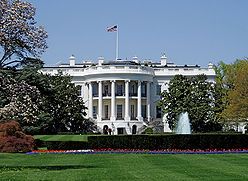
On this day on 1792, the cornerstone for the White House in laid in Washington, DC.
In 1800, President John Adams became the first president to reside in the executive mansion, which soon became known as the “White House” because its white-gray Virginia freestone contrasted strikingly with the red brick of nearby buildings.
The President’s house was a major feature of Pierre (Peter) Charles L’Enfant’s’s plan for the newly established federal city, Washington, D.C. The architect of the White House was chosen in a design competition, which received nine proposals, including one submitted anonymously by Thomas Jefferson. The nation’s first president, George Washington, traveled to the site of the federal city on July 16, 1792, to make his judgment. His review is recorded as being brief, and he quickly selected the submission of James Hoban, an Irishman living in Charleston, South Carolina. Washington was not entirely pleased with the original Hoban submission, however; he found it too small, lacking ornament, and not fitting the nation’s president. On Washington’s recommendation, the house was enlarged by thirty percent; the present East Room, likely inspired by the large reception room at Mount Vernon, was added.
Construction
Construction of the White House began with the laying of the cornerstone on October 13, 1792, although there was no formal ceremony. The main residence, as well as foundations of the house, were built largely by enslaved and free African-American laborers, as well as employed Europeans. Much of the other work on the house was performed by immigrants, many not yet with citizenship. The sandstone walls were erected by Scottish immigrants, employed by Hoban, as were the high relief rose and garland decorations above the north entrance and the “fish scale” pattern beneath the pediments of the window hoods. The initial construction took place over a period of eight years, at a reported cost of $232,371.83 ($2.8 million in 2007 dollars). Although not yet completed, the White House was ready for occupancy on or circa November 1, 1800.
Shortages, including material and labor, forced alterations to the earlier plan developed by French engineer Pierre Charles L’Enfant for a “palace” that was five times larger than the house that was eventually built.] The finished structure contained only two main floors instead of the planned three, and a less costly brick served as a lining for the stone facades. When construction was finished the porous sandstone walls were coated with a mixture of lime, rice glue, casein, and lead, giving the house its familiar color and name.
As it is a famed structure in America, many replicas of the White House have been constructed.

 The Bavarian royalty invited the citizens of Munich to attend the festivities, held on the fields in front of the city gates. These famous public fields were named Theresienwiese-“Therese’s fields”-in honor of the crown princess; although locals have since abbreviated the name simply to the “Wies’n.” Horse races in the presence of the royal family concluded the popular event, celebrated in varying forms all across Bavaria.
 The Mary Rose was a carrack-type warship of the English Tudor navy of King Henry VIII. After serving for 33 years in several wars against France, Scotland, and Brittany and after being substantially rebuilt in 1536, she saw her last action on 19 July 1545. While leading the attack on the galleys of a French invasion fleet, she sank in the Solent, the straits north of the Isle of Wight. The wreck of the Mary Rose was rediscovered in 1971 and salvaged in 1982 by the Mary Rose Trust in one of the most complex and expensive projects in the history of maritime archaeology. The surviving section of the ship and thousands of recovered artefacts are of immeasurable value as a Tudor-era time capsule.

Recent Comments