
If you do not get Current TV you can watch Keith here:
Jul 12 2011
Countdown with Keith Olbermann
Jul 12 2011
Obama: “Die Quickly”
(2 pm. – promoted by ek hornbeck)
We are doomed and so are our future generations.
President Obama at today’s (7/11) press conference:
As for Social Security, which he acknowledged is not the source of any deficit problems, he basically said that, as long as we’re doing a big deal, we might as well throw that in. “The reason to include that in this package is, if you’re going to take a bunch of tough votes, you might as well do it now,” Obama said.
Obama Offered To Raise Medicare Eligibility Age As Part Of Grand Debt Deal
by Sam Stein
According to five separate sources with knowledge of negotiations — including both Republicans and Democrats — the president offered an increase in the eligibility age for Medicare, from 65 to 67, in exchange for Republican movement on increasing tax revenues.
The proposal, as discussed, would not go into effect immediately, but rather would be implemented down the road (likely in 2013). The age at which people would be eligible for Medicare benefits would be raised incrementally, not in one fell swoop.
snip
A proposal to raise the eligibility age for Medicare — which was part of a budget plan put forth by Sens. Joseph Lieberman (I-Conn) and Tom Coburn (R-Okla.) — would face steep opposition from within the Democratic Party. The amount of money it would save is also relatively small, as the vast majority of Medicare funding is spent on more elderly populations. The Congressional Budget Office has estimated that if the Medicare eligibility age was increased from 65 to 67, the federal government would save $124.8 billion between 2014 and 2021.
Paul Krugman, Conscience of a Liberal
That’s a truly cruel idea; as it happens, I know several people who are hanging on, postponing needed medical care, hoping that they can make it to 65 before something terrible happens. And if I know such people in my fairly sheltered social circles, just imagine how widespread such stories must be.
But beyond that, think about what it means to move people out of Medicare into private insurance, if they can get it.
Medicare has its problems – but all the evidence says that it is substantially more cost-effective than private insurance. Partly this is because it has lower administrative costs; partly it’s because Medicare is able to use its market power to negotiate lower prices. And the international evidence is overwhelming: single-payer systems are much cheaper than systems centered on private insurance.
So think of this as a national interest thing rather than a budget thing: Lieberman is proposing that we move a substantial number of older Americans into a worse, more expensive health care system. Why would you want to do such a thing, as opposed to raising enough additional revenue to keep them on Medicare?
Where is the outrage?
Jul 12 2011
Evening Edition
Evening Edition is an Open Thread
| From Yahoo News Top Stories |
1 UK hacking scandal widens with Brown, royal claims
By Robin Millard, AFP
3 hrs ago
| Britain’s phone hacking scandal spiralled Monday amid reports that former premier Gordon Brown and the royals were targeted, as the government dealt a blow to Rupert Murdoch’s bid for pay-TV giant BSkyB.
In a story taking new twists and turns by the hour and shaking the entire establishment, Brown was reportedly hacked by The Sunday Times and The Sun, both stablemates of Murdoch’s doomed News of the World tabloid. The royal family were meanwhile allegedly targeted by the News of the World, Britain’s biggest selling weekly newspaper, which Murdoch shut down at the weekend amid allegations of widespread illegal phone hacking. |
2 European stocks slump
By Charly Triballeau, AFP
4 hrs ago
| European stock markets slumped on Monday, with banks hit by increasing signs that the eurozone debt crisis is spreading to Italy, as EU policymakers headed to an urgent meeting on Greece.
In London, BSkyB shares slumped more than seven percent on turmoil over the British satellite broadcaster’s future. In late afternoon deals, London’s FTSE 100 index of top shares dropped 1.17 percent to 5,920.66 points, Frankfurt’s DAX 30 shed 2.49 percent to 7,218.78 points and in Paris the CAC 40 index lost 2.84 percent to 3,802.52. |
3 Eurozone races to ease contagion fears
By Claire Rosemberg, AFP
18 hrs ago
| Eurozone leaders race to head off fresh worries of debt crisis contagion by seeking to iron out widening differences over the outline of a new Greek rescue package at talks in Brussels on Monday.
Amid signs that contagion is spreading to Italy, finance ministers from the 17-nation area meet from 1300 GMT, with counterparts from the full European Union 27 joining them Tuesday. Held on the back of a roller-coaster week that saw Italian banks buckle, the talks will focus on the divisive question of possible private-sector involvement in a second bailout of Greece — a deal not expected before September. |
4 Mobs storm US, French embassies in Syria
By Louai Beshara, AFP
5 hrs ago
| Angry mobs stormed the American and French embassies in Syria on Monday, after the two Western envoys visited the city of Hama, a flashpoint for protests against President Bashar al-Assad’s regime.
The foreign ministry in Paris said three French staff were wounded in the embassy attack, while a US official said “no staff were injured.” Guards at the French embassy had to fire three warning shots, the foreign ministry said. |
5 Obama, Republicans still deadlocked on debt deal
By Olivier Knox, AFP
1 hr 22 mins ago
| President Barack Obama on Monday pressed his Republican foes to accept a politically painful compromise on US debt in the face of an August 2 deadline to avert a likely economic calamity.
“I do not see a path to a deal if they don’t budge, period,” Obama warned as top Democratic and Republican lawmakers headed to the White House for a second straight day of crisis talks with no breakthrough in sight. The president, whose 2012 reelection bid will hinge on voter perceptions of how he has handled the jobs-poor US economy, portrayed himself as seeking a reasonable middle ground for the good of the country. |
6 Murdoch delays BSkyB bid; Brown a hacking target
By Kate Holton and Georgina Prodhan, Reuters
10 mins ago
| LONDON (Reuters) – Rupert Murdoch and the British government tried to draw the financial and political sting from a newspaper phone-hacking scandal by referring his $14-billion media takeover to regulators, even as police said former prime minister Gordon Brown appeared to have been a hacking target.
By referring News Corp’s bid for the highly profitable pay-tv operator BSkyB to a lengthy competition probe, the government hoped to shield it from a tide of outrage over allegations that News of the World reporters accessed the voicemails of murder and bomb victims, among others. But reports continue to emerge that illegal methods extended beyond the paper to other Murdoch publications, and the circle of victims continues to grow. |
7 Euro crisis talks struggle, markets hit Italy
By Julien Toyer and Dan Flynn, Reuters
1 hr 52 mins ago
| BRUSSELS (Reuters) – European finance officials struggled to find ways to resolve Greece’s debt crisis on Monday as sharply rising bond yields in Italy, the euro zone’s third largest economy, added to the sense of urgency.
One senior European Union official said the situation had become almost entirely a political rather than an economic crisis, with parties taking firm, irreconcilable positions. “We’ve painted ourselves into a corner. At this point, either someone — Germany, the ECB (European Central Bank) — has to fundamentally shift position, or everything blows up,” the official, who declined to be named, told Reuters. |
8 Assad loyalists storm U.S. and French embassies in Syria
By Khaled Yacoub Oweis, Reuters
2 hrs 27 mins ago
| AMMAN (Reuters) – Several loyalists of President Bashar al-Assad broke into the U.S. embassy in Damascus on Monday and security guards used live ammunition to prevent hundreds from storming the French embassy, diplomats said.
They said the attackers tore down U.S. embassy plaques and tried to break security glass in protests fueled by the government against a visit by U.S. and French ambassadors to the city of Hama, focus of demonstrations against Assad’s rule. “Four buses full of shabbiha (Alawite militia loyal to Assad) came from Tartous. They used a battering ram to try to break into the main door,” a resident of Afif, the old district where the U.S. embassy is located told Reuters by telephone. |
9 China raps U.S. over military drills in disputed seas
By Michael Martina, Reuters
4 hrs ago
| BEIJING (Reuters) – China’s military sharply criticized the United States on Monday for holding military drills in contested waters of the South China Sea, a dispute Beijing has warned Washington not to meddle in.
Chen Bingde, People’s Liberation Army Chief of the General Staff, said that if the United States really wanted peace in the South China Sea, then the timing of its recent military exercises in the region was poor. “The U.S. has said many times that it does not intend to get involved in the South China Sea dispute, but … is actually sending out the opposite signal,” Chen told a joint news conference with the United States’ top military officer, chairman of the Joint Chiefs of Staff Admiral Mike Mullen. |
10 In Iowa, Bachmann is early favorite for vote
By James B. Kelleher, Reuters
1 hr 51 mins ago
| INDEPENDENCE, Iowa (Reuters) – Only two weeks after announcing she was seeking the 2012 Republican presidential nomination, Tea Party favorite Michele Bachmann is already looking like the candidate to beat in Iowa’s first-in-the-nation caucuses in February.
The Minnesota congresswoman is tapping into the same vein of voter discontent at government spending that drove Republican victories at midterm elections last year. Bachmann, 55, is running neck-and-neck with Mitt Romney among Republicans in Iowa. But Romney, a former Massachusetts governor, has signaled that he will not campaign hard in the state so he can concentrate his energies elsewhere. |
11 Murdoch empire scandal spread to new papers
By GREGORY KATZ, Associated Press
2 hrs 15 mins ago
| LONDON (AP) – The scandal engulfing Rupert Murdoch’s media empire exploded in several directions Monday, with fresh reports of phone hacking attacks against some of the nation’s most powerful figures, including royals and former Prime Minister Gordon Brown.
Adding to the intrigue, Scotland Yard released an unusual statement accusing unidentified individuals of trying to sabotage its sprawling investigation. The police – themselves accused of accepting bribes from Murdoch’s journalists – said somebody was deliberately planting distracting information in the press. No one, it seems, had been safe from the prying eyes of corrupt journalists. |
12 Syrian protesters attack US, French embassies
By BASSEM MROUE, Associated Press
3 mins 47 secs ago
| BEIRUT (AP) – Hundreds of Syrian government supporters attacked the U.S. Embassy in Damascus Monday, smashing windows and spray-painting walls with obscenities and graffiti that called the American ambassador a “dog.” Guards at the French Embassy fired in the air to ward off another group of protesters.
The sharp escalation in tensions followed a visit last week by the American and French ambassadors to the city of Hama, a stronghold of opposition to authoritarian President Bashar Assad. Syrian authorities were angered by the visit and American Ambassador Robert Ford’s harsh criticism afterward of the government crackdown on a four-month-old uprising. Ford’s residence was also attacked on Monday. The U.S. and France both accused Syrian forces of being too slow to respond and demanded the government abide by its international obligations to protect diplomatic missions and allow envoys freedom of movement. The U.S. formally protested, calling the attacks “outrageous,” and saying protesters were incited by a television station heavily influenced by Syrian authorities. |
13 US protests Syria embassy attack
By MATTHEW LEE, Associated Press
16 mins ago
| WASHINGTON (AP) – The United States on Monday formally protested an attack on the U.S. embassy and the American ambassador’s residence in Syria and said it will seek compensation for damage caused when a mob of what it described as about 300 “thugs” breached the wall of the embassy compound before being dispersed by U.S. Marine guards.
Secretary of State Hillary Rodham Clinton condemned the attacks, as well as another against the French embassy in Damascus, and demanded that Syria uphold international treaty obligations to protect foreign diplomatic missions. “We demand that they meet their international responsibilities immediately to protect all diplomats and the property of all countries,” she told reporters at the State Department. Earlier, the department summoned a senior Syrian diplomat to register the U.S. complaints in person. |
14 In Pakistan, many say aid ‘snub’ dims US sway
By SEBASTIAN ABBOT, Associated Press
1 hr 54 mins ago
| ISLAMABAD (AP) – The decision to suspend more than one-third of American military aid to Pakistan could end up hurting Washington more than Islamabad as the U.S. seeks to navigate an end to the Afghan war and defeat al-Qaida, former Pakistani officials and analysts warned Monday.
Holding back the $800 million in aid is unlikely to pressure Pakistan to increase cooperation with the U.S. and could strengthen those in the government who argue that Washington is a fickle ally who can’t be trusted, they said. “If you still need the relationship, which clearly the United States does, then it really doesn’t make sense to take action at this time because it leaves the United States with less, not more, influence with the Pakistani military,” said Maleeha Lodhi, a former Pakistani ambassador to the U.S. “Cooperation cannot be coerced by punitive actions.” |
15 Cypriot defense min resigns after blast kills 12
By MENELAOS HADJICOSTIS, Associated Press
1 hr 57 mins ago
| MARI, Cyprus (AP) – Dozens of containers of gunpowder seized years ago from an Iranian cargo ship exploded on Cyprus’ main naval base Monday in a massive blast that killed 12 people, wounded 62 and wrecked a major power station, causing extensive blackouts.
The head of the island nation’s navy, Commodore Andreas Ioannides, was killed and its defense minister and military chief resigned. Ioannides’ son claimed top officials had repeatedly ignored his father’s warnings that the gunpowder was stored unsafely. Defense ministry officials would not comment on the allegation. A Cypriot official said right after the blast that a brush fire had ignited more than 90 containers confiscated in 2009 from a ship heading from Iran to Syria. The official, who spoke on condition of anonymity due to the sensitivity of the matter, later said that the fire may have started inside one of the containers. |
16 Obama increases pressure on Republicans on debt
By Steve Holland and Andy Sullivan, Reuters
38 mins ago
| WASHINGTON (Reuters) – President Barack Obama on Monday increased pressure on Republican lawmakers to make concessions for a deal to avoid an August 2 debt default and said both sides must “pull off the Band-aid” and make sacrifices.
“If not now, when?” Obama said. The president met for 90 minutes with top U.S. lawmakers for a second-straight day in the search for a way to break a budget impasse that is holding up a vote on raising the $14.3 trillion debt ceiling, which caps how much money Washington can borrow. |
17 No stopgap: Obama demands big deal for debt limit
AP
13 mins ago
| WASHINGTON (AP) – President Barack Obama declared Monday he would reject any stopgap extension of the nation’s borrowing limit, adding fresh urgency for Republicans and fellow Democrats to resolve intense tax and spending disputes and head off economic calamity.
The administration says there must be a deal by Aug. 2 or the U.S. will face its first ever debt default, something that could return the U.S. economy to recession and reverberate in global financial markets. “If not now, when?” Obama said in a news conference just ahead of his latest bargaining session with congressional leaders at the White House. That meeting lasted about 90 minutes. |
18 9th Circuit orders gov’t to state position on DADT
By JULIE WATSON, Associated Press
37 mins ago
| SAN DIEGO (AP) – A federal appeals court that has called for the immediate halt of the military’s ban on openly gay troops issued an order Monday requiring the U.S. government to state whether it will continue to defend the constitutionality of the policy in court.
Monday’s order comes less than a week after the 9th U.S. Circuit Court of Appeals in San Francisco ordered the Obama administration to immediately cease enforcing “don’t ask, don’t tell,” which could speed up its repeal. The ruling stems from a lawsuit filed by the gay rights organization, the Log Cabin Republicans, against the Department of Justice. The rights group last year persuaded a lower court judge to declare the ban unconstitutional. |
19 Astronauts get busy with space station stockpiling
By MARCIA DUNN, AP Aerospace Writer
1 hr 5 mins ago
| CAPE CANAVERAL, Fla. (AP) – The International Space Station got a year’s worth of groceries in a giant shopping cart on Monday, courtesy of the astronauts on NASA’s final shuttle flight.
Astronauts Sandra Magnus and Douglas Hurley used the space station’s hulking robot arm to hoist the bus-size container out of Atlantis’ payload bay and attach it to the orbiting outpost. The canister – 21 feet long and 15 feet across – is jammed with nearly 5 tons of household goods, enough to keep the 245-mile-high station and its inhabitants going for another year. Food alone accounted for more than 1 ton. Clothes also were stuffed inside the Italian-built cylinder, named Raffaello, as well as spare parts for the station. |
20 Science seeks ways to take sting out of sunburn
By LAURAN NEERGAARD, AP Medical Writer
37 mins ago
| WASHINGTON (AP) – If you’ve hit the beach, chances are you’ve experienced an unfortunate rite of summer: The sunburn. Skin so swollen it hurts to bend. The heat that rises from reddened shoulders. The “ow, ow, ow” from the shower after you’d thought the pain had faded.
For all the creams that promise to soothe, there aren’t super treatments for a sunburn. Dermatologists say the best bet: Some of the same pills you pop for a headache – like the ibuprofen found in Motrin and Advil, or naproxen brands such as Aleve. If that sounds too simple, well, scientists don’t know exactly what causes this kind of touch-sensitive pain. But research is getting them closer to some answers. |
Jul 11 2011
Bad Policy, Bad Politics- Part 1
Monday Business Edition
Economy Faces a Jolt as Benefit Checks Run Out
By MOTOKO RICH, The New York Times
Published: July 10, 2011
Close to $2 of every $10 that went into Americans’ wallets last year were payments like jobless benefits, food stamps, Social Security and disability, according to an analysis by Moody’s Analytics. In states hit hard by the downturn, like Arizona, Florida, Michigan and Ohio, residents derived even more of their income from the government.
By the end of this year, however, many of those dollars are going to disappear, with the expiration of extended benefits intended to help people cope with the lingering effects of the recession. Moody’s Analytics estimates $37 billion will be drained from the nation’s pocketbooks this year.
…
“If we don’t get more job growth and gains in wages and salaries, then consumers just aren’t going to have the firepower to spend, and the economy is going to weaken,” said Mark Zandi, chief economist of Moody’s Analytics, a macroeconomic consulting firm.Job growth has remained elusive. There are 4.6 unemployed workers for every opening, according to the Labor Department, and Friday’s unemployment report showed that employers added an anemic 18,000 jobs in June.
…
Consumers account for an estimated 60 to 70 percent of the country’s economic activity, but two years into the official recovery, businesses are still complaining that people simply are not spending enough.
…
Because benefit payments tend to be spent right away to cover basic needs like food and rent, they provide a direct boost to consumer spending. In a study for the Labor Department, Wayne Vroman, an economist at the Urban Institute, estimated that every $1 paid in jobless benefits generated as much as $2 in the economy.
Government Aid Dissipating, Damaging Economic Performance
By: David Dayen, Firedog Lake
Monday July 11, 2011 6:55 am
The Times story tells a simple tale, one rooted in elementary macroeconomic theory, and one which has escaped everyone in Washington. If you reduce benefits on those who have the highest propensity to spend money, that money gets taken out of the economy, and GDP suffers. And GDP has a direct bearing on unemployment. Our automatic stabilizers actually worked decently during the Great Recession. In fact, most of the stimulus went to tax cuts and beefing up those stabilizers, through aid to states and expanded benefits (in fact, too much so, as public investment in jobs was barely a sliver of the total stimulus). No doubt Republicans will see this article as some evidence of lazy Americans living on the dole, but it’s a direct result of an intelligently designed system to provide a safety net when the bottom drops out of the economy.
Regular readers of this blog know that I make a big deal of the failure of interest rates to rise despite massive government borrowing. There’s a reason for that: what happens to interest rates is a key indicator of which economic model, and hence which economic policies, are right.
The Very Serious position has been that government borrowing will drive up rates, crowd out private investment, and impede recovery. A Keynes-Hicks analysis, by contrast, says that when you’re in a liquidity trap, even large government borrowing won’t drive up rates – and hence won’t crowd out private investment. In fact, it will promote private investment by raising capacity utilization and giving firms more reason to expand.
…
What we usually get in response to this seemingly decisive data are a series of excuses – most recently, that rates were low because the Fed was buying all the bonds. Well, that program has ended, and interest rates are still low.
More Herr Doktor Professor on excuses–
The fact is, the United States economy has been stuck in a rut for a year and a half.
…
The truth is that creating jobs in a depressed economy is something government could and should be doing.
…
Our failure to create jobs is a choice, not a necessity – a choice rationalized by an ever-shifting set of excuses.Excuse No. 1: Just around the corner, there’s a rainbow in the sky.
- Remember “green shoots”? Remember the “summer of recovery”? Policy makers keep declaring that the economy is on the mend – and Lucy keeps snatching the football away. Yet these delusions of recovery have been an excuse for doing nothing as the jobs crisis festers.
Excuse No. 2: Fear the bond market.
- Two years ago The Wall Street Journal declared that interest rates on United States debt would soon soar unless Washington stopped trying to fight the economic slump. Ever since, warnings about the imminent attack of the “bond vigilantes” have been used to attack any spending on job creation.
But basic economics said that rates would stay low as long as the economy was depressed – and basic economics was right. The interest rate on 10-year bonds was 3.7 percent when The Wall Street Journal issued that warning; at the end of last week it was 3.03 percent.
Excuse No. 3: It’s the workers’ fault.
- (I)f there really was a mismatch between the workers we have and the workers we need, workers who do have the right skills, and are therefore able to find jobs, should be getting big wage increases. They aren’t. In fact, average wages actually fell last month.
Excuse No. 4: We tried to stimulate the economy, and it didn’t work.
- Everybody knows that President Obama tried to stimulate the economy with a huge increase in government spending, and that it didn’t work. But what everyone knows is wrong.
…
What happened to the stimulus? Much of it consisted of tax cuts, not spending. Most of the rest consisted either of aid to distressed families or aid to hard-pressed state and local governments. This aid may have mitigated the slump, but it wasn’t the kind of job-creation program we could and should have had. This isn’t 20-20 hindsight: some of us warned from the beginning that tax cuts would be ineffective and that the proposed spending was woefully inadequate. And so it proved.
Neoliberal Economics has as much credibility as Stalinist Genetics.
Jul 11 2011
Obama: Progressives, “Eat Your Peas”
(10 am. – promoted by ek hornbeck)
Catfood is made out of peas? Who knew? lambert
This press conference tells us that the austerity crap isn’t some bit of political posturing, it’s a belief. We’re doomed. Atrios
The right wing Republican talking points that were spewed by President Obama at his press conference were so thick that it has left no doubt the president is about to sell out the middle class and poor.
President Obama said Monday that he had “bent over backwards” to forge a compromise with Republicans on a debt limit deal – and that it was time for them to “budge.”
“I am prepared to take on significant heat from my Party to get something done and I expect the other side to be willing to do the same thing,” he said. . . . .
“We have to pull off the Band-aid — to eat our peas,” he said.
I don’t often agree with NYT Columnist Russ Douthat but his analysis of the “madness” cuts to the point:
Barack Obama wants a right-leaning deficit deal.
The not-so-secret secret is that the White House has given ground on purpose. Just as Republicans want to use the debt ceiling to make the president live with bigger spending cuts than he would otherwise support, Obama’s political team wants to use the leverage provided by those cra-a-a-zy Tea Partiers to make Democrats live with bigger spending cuts than they normally would support. . . .
Why? Because the more conservative-seeming the final deal, the better for the president’s re-election effort. In that environment, Republicans have every incentive to push and keep pushing. Since any deal they cut will be used as an election-year prop in 2012, they need to make sure the president actually earns his budget-cutting bona fides.
The problem is that voters don’t care about the deficit. They care about jobs and the economy. Spending cuts, tax cuts and austerity programs do ot create jobs. Even Ronald Reagan’s budget director, David Stockman, now admits that Reaganomics and the Bush tax cuts are a major cause of the current “debt crisis” and takes Obama and Rep. Paul Ryan to the “woodshed”
“In attacking the Bush tax cuts for the top 2 percent of taxpayers, the president is only incidentally addressing the deficit,” he writes. “Mr. Obama is thus playing the class-war card more aggressively than any Democrat since Franklin D. Roosevelt – surpassing Harry S. Truman or John F. Kennedy when they attacked big business or Lyndon B. Johnson or Jimmy Carter when they posed as champions of the little guy.”
“On the other side,” he continues, “Representative Ryan fails to recognize that we are not in an era of old-time enterprise capitalism in which the gospel of low tax rates and incentives to create wealth might have had relevance.”
Eat your peas, we are doomed.
Jul 11 2011
Punting the Pundits
“Punting the Pundits” is an Open Thread. It is a selection of editorials and opinions from around the news medium and the internet blogs. The intent is to provide a forum for your reactions and opinions, not just to the opinions presented, but to what ever you find important.
Thanks to ek hornbeck, click on the link and you can access all the past “Punting the Pundits”.
Paul Krugman: No, We Can’t? Or Won’t?
If you were shocked by Friday’s job report, if you thought we were doing well and were taken aback by the bad news, you haven’t been paying attention. The fact is, the United States economy has been stuck in a rut for a year and a half.
Yet a destructive passivity has overtaken our discourse. Turn on your TV and you’ll see some self-satisfied pundit declaring that nothing much can be done about the economy’s short-run problems (reminder: this “short run” is now in its fourth year), that we should focus on the long run instead.
This gets things exactly wrong. The truth is that creating jobs in a depressed economy is something government could and should be doing. Yes, there are huge political obstacles to action – notably, the fact that the House is controlled by a party that benefits from the economy’s weakness. But political gridlock should not be conflated with economic reality.
As things stand today, the US is hurtling toward a budget showdown in less than a month. Either President Obama will once again capitulate to extreme Republican budget-slashing demands, making Democrats seem as much of a threat to Medicare as Republicans, and virtually ensuring a GOP electoral sweep in 2012, or the US will default on its debt for the first time in its history, most likely plunging the world economy back into another five-continent recession, also costing Democrats the 2012 elections. These are the options left for a president and a political class completely divorced both from reality, and its own history of how one of the three greatest US presidents of all time steered the country from the brink of collapse eight decades ago
Entirely forgetting the real history of how Franklin D Roosevelt used activist government to save American capitalism from itself, the entire US political establishment is instead hypnotized by the false history woven around its most over-hyped president of all time: Ronald Reagan. Idolatry of Reagan’s supposed tax-cutting wonders propels the now widespread economic belief that up is down, that cutting government spending is the way out of – rather than into – a severe recession. At the same time, idolatry of Reagan’s supposed political wonders propels GOP extremists to ignore all other considerations.
Joseph E. Stiglitz: The Evils of Unregulated Capitalism
Just a few years ago, a powerful ideology – the belief in free and unfettered markets – brought the world to the brink of ruin. Even in its hey-day, from the early 1980s until 2007, US-style deregulated capitalism brought greater material well-being only to the very richest in the richest country of the world.
Indeed, over the course of this ideology’s 30-year ascendance, most Americans saw their incomes decline or stagnate year after year.
Moreover, output growth in the United States was not economically sustainable. With so much of US national income going to so few, growth could continue only through consumption financed by a mounting pile of debt.
I was among those who hoped that, somehow, the financial crisis would teach Americans (and others) a lesson about the need for greater equality, stronger regulation, and a better balance between the market and government.
Alas, that has not been the case.
Eugen Robinson: A little more revenue could go a long way
Do progressives care about reducing the national debt? Of course they do, no matter what the White House might believe.
“We think that obviously there are some Democrats who don’t feel as strongly about deficit reduction as [President Obama] does,” senior adviser David Plouffe said Wednesday at a breakfast with reporters and columnists. But that’s not obvious at all. It isn’t even true.
There’s no dispute about where we need to go. The question is what path to take.
Clearly, the federal government cannot continue spending at a rate of 25 percent of gross domestic product while taking in revenue that equals less than 15 percent of GDP, as is the case this year. We would reach the point where debt service crowds out health care, education and other priorities dear to progressives’ hearts. Major investments the nation desperately needs to make – for infrastructure and energy research, for example – would be impossible. Decline would be inevitable.
Steven J. D’Amico: Trade Deals are No Deal for US
LONG BEFORE 2008, when Wall Street’s unchecked greed brought the world’s economy to its knees, we in the middle class could feel our future slipping away. We knew that we were working longer and harder – we could see that even with two salaries, most families had less disposable income than families did in the 1960s and ’70s when one income was the norm. We knew that good quality jobs were harder to find and hold. And we knew that a big reason we were falling behind was a flawed trade policy that shipped many of our jobs overseas.
Yet even after losing 682,000 jobs to NAFTA since it took effect in 1994, and 2.4 million to China since it joined the World Trade Organization, Washington continues in its blind faith that somehow these trade deals are good for us. This summer Congress is expected to take up three new trade deals – with Korea, Panama, and Colombia. These trade pacts are bad for American workers, bad for our domestic economy, and bad for democracy.
New York Times: An Aggressive Ruling on Clean Air
The Environmental Protection Agency on Thursday issued a welcome and overdue rule compelling power plants in 27 states and the District of Columbia to reduce smokestack emissions that pollute the air and poison forests, lakes and streams across the eastern United States. The regulation reflects the E.P.A.’s determination to carry out its mandates under the Clean Air Act despite fierce Congressional opposition, and bodes well for progress on a host of other regulatory challenges the agency faces.
The rule, which takes effect in 2012, would cut emissions of sulfur dioxide, a component of acid rain, and nitrogen oxide, a component of smog, by more than half by 2014 compared with 2005 levels. The E.P.A. administrator, Lisa Jackson, said the rule would improve air quality for 240 million Americans in the states where the pollution is produced and in areas downwind.
Caroline Arnold: How Much Blame Do We Share for Our Leaders’ Failures?
Six years ago, in the wake of the botched management of Hurricane Katrina and its aftermath, a friend warned me against blaming Republicans.
I replied flippantly that as an unrepentant progressive, I quite enjoyed blaming Republicans, though I recognized that even the GOP, PNAC, and all their associated think-tanks and trained media rescue-dogs couldn’t have single-handedly created a disaster of that magnitude. I added that if the Republicans had planned Katrina, they probably would have directed it to Ohio. Of course there aren’t any hurricanes in Ohio, but heck, there weren’t any WMDs in Iraq, either.
Another friend who had volunteered in the cleanup of Katrina running a ham radio operation observed that among the agencies and organizations trying to help, the farther up the hierarchy of any institution, public or private, the worse prepared the people were, the more out of touch, the more incompetent, and the more their efforts were downright damaging.
… sounds like The Peter Principle to me. And an interesting corollary would probably be that the higher the hierarchy, the greater the level of incompetence.
Jul 11 2011
Le Tour- Rest Day 1
Le. Tour. De. France.
What did I say about the wicked? Oh… yeah.
Yesterday was hit and run day as a chase car plowed into 2 riders but neither one of them were forced to retire. Yet. It might have been bigger, new GC leader Voeckler was close enough to get whacked in the leg by Flecha as Flecha spun into a barbed wire fence.
The actual big crash happened earlier on a rain slick descent and took out Vinokourov who was a legitimate contender for Yellow in Paris. In all 8 riders retired, nearly doubling the list to 18.
On the Stage Sanchez (Louis-Leon) had the victory with Voeckler and Casar close behind. Almost 4 minutes back was a group including Gilbert, Evans, the 2 Schlecks, Sanchez (Samuel), and Contador. Hushovd finished tied for 79th on the day, 6:47 behind.
In the General Classification the 2 Medium Mountain days have bubbled up some of the usual suspects-
| Rank | Name | Team | ET | delta |
| 1 | Thomas Voeckler | Europcar | 38h 35′ 11″ | |
| 2 | Luis-Leon Sanchez | Rabo Bank | 38h 37′ 00″ | + 01′ 49″ |
| 3 | Cadel Evans | BMC | 38h 37′ 37″ | + 02′ 26″ |
| 4 | Frank Schleck | Leopard Trek | 38h 37′ 40″ | + 02′ 29″ |
| 5 | Andy Schleck | Leopard Trek | 38h 37′ 48″ | + 02′ 37″ |
| 6 | Tony Martin | HTC | 38h 37′ 49″ | + 02′ 38″ |
| 7 | Peter Velits | HTC | 38h 37′ 49″ | + 02′ 38″ |
| 8 | Andréas Kloden | Radio Shack | 38h 37′ 54″ | + 02′ 43″ |
| 9 | Philippe Gilbert | Omega Pharma | 38h 38′ 06″ | + 02′ 55″ |
| 10 | Jakob Fuglsang | Leopard Trek | 38h 38′ 19″ | + 03′ 08″ |
| … | ||||
| 16 | Alberto Contador | Saxo Bank | 38h 39′ 18″ | + 04′ 07″ |
| … | ||||
| 24 | Thor Hushovd | Garmin | 38h 40′ 24″ | + 05′ 13″ |
| … | ||||
| 36 | Levi Leipheimer | Radio Shack | 38h 42′ 27″ | + 07′ 16″ |
We have raced 989 miles of 2132 or 46%.
When the front of the peleton crashes overcooking a corner going 50mph+ downhill, that defines “a mess”. The yellow and green jersey wearers made the decision to neutralize the race until those involved still riding rejoined the peleton ~ despite the fact that it assured the yellow jersey wearer that he would surrender the maillot jeune, though the fact that he had not expected to still be wearing it today may have made the decision easier.
In the race for the Yellow, Voeckler is not considered to be a serious GC threat, so it serves the interests of the main GC contenders for him to be in yellow into the Pyrenees. The three fancied race winners all finished same time, but several podium threats crashed out, while Lulu Sanchez vaulted into second place, so he will have to be taken seriously as long as he holds the time.
In the race for Green, Phillipe Gilbert gained “best of the rest” sprint points at the only part of today’s stage close enough to flat to put a sprint point, and “best of the rest” points at the finish, to add 30 points to his Green Jersey talley ~ one more than the difference between winning a flat stage and finishing 8th. Cadel Evans finished “third best of the rest” to add 15 points to his 5th place in the Green Jersey, and Thor Hushovd picked up 7 points at the intermediate sprint just being near the front of the peleton as his team was still driving in an ultimately futile effort to hold the yellow. Thor goes into the rest day without having to worry about defending yellow, so can start thinking about staging an attack to move up in the Green Jersey competition.
Vs. Rest Day coverage starts at 8 am.
- Jada Yuan Previews the Hell Out of the Tour de France in the New Yorker, 7/1/11 at 2:00 PM
- Le Tour 2011 official site
- Your The Stars Hollow Gazette Le Tour coverage tags-
Jul 11 2011
On This Day In History July 11
This is your morning Open Thread. Pour your favorite beverage and review the past and comment on the future.
Find the past “On This Day in History” here.
July 11 is the 192nd day of the year (193rd in leap years) in the Gregorian calendar. There are 173 days remaining until the end of the year.
On this day in 1789, Jacques Necker is dismissed as France’s Finance Minister sparking the Storming of the Bastille.
Necker was seen as the savior of France while the country stood on the brink of ruin, but his actions could not stop the French Revolution. Necker put a stop to the rebellion in the Dauphiné by legalizing its assembly, and then set to work to arrange for the summons of the Estates-General of 1789. He advocated doubling the representation of the Third Estate to satisfy the people. But he failed to address the matter of voting – rather than voting by head count, which is what the people wanted, voting remained as one vote for each estate. Also, his address at the Estates-General was terribly miscalculated: it lasted for hours, and while those present expected a reforming policy to save the nation, he gave them financial data. This approach had serious repercussions on Necker’s reputation; he appeared to consider the Estates-General to be a facility designed to help the administration rather than to reform government.
Necker’s dismissal on 11 July 1789 made the people of France incredibly angry and provoked the storming of the Bastille on July 14. The king recalled him on 19 July. He was received with joy in every city he traversed, but in Paris he again proved to be no statesman. Believing that he could save France alone, he refused to act with the Comte de Mirabeau or Marquis de Lafayette. He caused the king’s acceptance of the suspensive veto, by which he sacrificed his chief prerogative in September, and destroyed all chance of a strong executive by contriving the decree of 7 November by which the ministry might not be chosen from the assembly. Financially he proved equally incapable for a time of crisis, and could not understand the need of such extreme measures as the establishment of assignats in order to keep the country quiet. Necker stayed in office until 1790, but his efforts to keep the financial situation afloat were ineffective. His popularity had vanished, and he resigned with a broken reputation.
472 – After being besieged in Rome by his own generals, Western Roman Emperor Anthemius is captured in the Old St. Peter’s Basilica and put to death.
1302 – Battle of the Golden Spurs (Guldensporenslag in Dutch) – a coalition around the Flemish cities defeats the king of France’s royal army.
1346 – Charles IV of Luxembourg is elected emperor of the Holy Roman Empire.
1405 – Ming admiral Zheng He sets sail to explore the world for the first time.
1476 – Giuliano della Rovere is appointed bishop of Coutances.
1576 – Martin Frobisher sights Greenland.
1616 – Samuel de Champlain returns to Quebec.
1735 – Mathematical calculations suggest that it is on this day that dwarf planet Pluto moved inside the orbit of Neptune for the last time before 1979.
1740 – Pogrom: Jews are expelled from Little Russia.
1750 – Halifax, Nova Scotia is almost completely destroyed by fire.
1776 – Captain James Cook begins his third voyage.
1789 – Jacques Necker is dismissed as France’s Finance Minister sparking the Storming of the Bastille.
1796 – The United States takes possession of Detroit from Great Britain under terms of the Jay Treaty.
1798 – The United States Marine Corps is re-established; they had been disbanded after the American Revolutionary War.
1801 – French astronomer Jean-Louis Pons made his first comet discovery. In the next 27 years he discovered another 36 comets, more than any other person in history.
1804 – A duel occurs in which the Vice President of the United States Aaron Burr mortally wounds former Secretary of the Treasury Alexander Hamilton.
1833 – Noongar Australian aboriginal warrior Yagan, wanted for the murder of white colonists in Western Australia, is killed.
1848 – Waterloo railway station in London opens.
1864 – American Civil War: Battle of Fort Stevens; Confederate forces attempt to invade Washington, D.C..
1882 – The British Mediterranean fleet begins the Bombardment of Alexandria in Egypt as part of the 1882 Anglo-Egyptian War.
1889 – Tijuana, Mexico, is founded.
1893 – The first cultured pearl is obtained by Kokichi Mikimoto.
1893 – A revolution led by the liberal general and politician, José Santos Zelaya, takes over state power in Nicaragua.
1895 – The Lumière brothers demonstrate film technology to scientists.
1897 – Salomon August Andrée leaves Spitsbergen to attempt to reach the North pole by balloon. He later crashes and dies.
1906 – The Gillette-Brown murder inspires Theodore Dreiser’s An American Tragedy.
1914 – Babe Ruth makes his debut in Major league baseball.
1919 – The eight-hour working day and free Sunday become law in the Netherlands.
1920 – In the East Prussian plebiscite the local populace decides to remain with Weimar Germany
1921 – A truce is called in the Irish War of Independence; see Irish calendar.
1921 – Former U.S. President William Howard Taft is sworn in as 10th Chief Justice of the U.S. Supreme Court, becoming the only person to ever be both President and Chief Justice.
1921 – The Red Army captures Mongolia from the White Army and establishes the Mongolian People’s Republic.
1922 – The Hollywood Bowl opens.
1930 – Australian cricketer Don Bradman scores a world record 309 runs in one day, on his way to the highest individual Test innings of 334, during a Test match against England.
1936 – The Triborough Bridge in New York City is opened to traffic.
1940 – World War II: Vichy France regime is formally established. Henri Philippe Pétain becomes Prime Minister of France.
1943 – Massacres of Poles in Volhynia.
1943 – World War II: Allied invasion of Sicily – German and Italian troops launch a counter-attack on Allied forces in Sicily.
1947 – The Exodus 1947 heads to Palestine from France.
1950 – Pakistan joins the International Monetary Fund and the International Bank.
1957 – Prince Karim Husseini Aga Khan IV inherits the office of Imamat as the 49th Imam of Shia Imami Ismaili worldwide, after the death of Sir Sultan Mahommed Shah Aga Khan III.
1960 – Independence of Benin, Burkina Faso and Niger.
1960 – To Kill a Mockingbird by Harper Lee is first published.
1960 – Congo Crisis: The State of Katanga breaks away from the Democratic Republic of the Congo.
1962 – First transatlantic satellite television transmission.
1971 – Copper mines in Chile are nationalized.
1972 – The first game of the World Chess Championship 1972 between challenger Bobby Fischer and defending champion Boris Spassky starts.
1977 – Martin Luther King Jr. is posthumously awarded the Presidential Medal of Freedom.
1978 – Los Alfaques Disaster: A truck carrying liquid gas crashes and explodes at a coastal campsite in Tarragona, Spain killing 216 tourists.
1979 – America’s first space station, Skylab, is destroyed as it re-enters the Earth’s atmosphere over the Indian Ocean.
1987 – According to the United Nations, the world population crosses the 5,000,000,000 (5 billion) mark.
1990 – Oka Crisis: First Nations land dispute in Quebec, Canada begins.
1995 – Over 8,000 Bosnian men and children (all Bosniaks) are killed by Serbian troops commanded by Ratko Mladic in Potocari near Srebrenica Bosnia and Herzegovina.
2006 – 209 people are killed in a series of bomb attacks in Mumbai, India.
* Bonfire Night, precursor to The Twelfth. (Northern Ireland)
* China National Maritime Day (People’s Republic of China)
* Christian Feast Day:
* Benedict of Nursia
* Olga of Kiev
* July 11 (Eastern Orthodox liturgics)
* Day of the Flemish Community (Flemish Community of Belgium)
* Gospel Day (Kiribati)
* Imamat Day (Ismailism)
* National Day of Commemoration, held on the nearest Sunday to this date. (Ireland)
* The first day of Naadam, also known as Revolution Day (Mongolia)
* World Population Day (International)
Jul 11 2011
Pique the Geek 20110710: Aspirin, a Wonder Drug
Before we get started, let me be clear that any information contained here, although to be best of my knowledge accurate, in in no way intended to be a substitute for advice and care from licensed medical professionals. OK, disclaimer stated.
Aspirin is one of the first synthetic drugs, and is still in wide use after over 100 years. It was first marketed by Bayer in 1899, and sales are still strong despite competition from drugs like acetaminophen, ibuprofen, and naproxin sodium. Bayer has in the past week or two come out with a new advert about its new “quick acting” aspirin.
This material is “quick acting” because the particle size is much smaller than that of regular aspirin. Since aspirin is only slowly soluble in water, the greater surface area for the same mass does speed up absorption.
Aspirin, more properly called acetylsalicylic acid or ASA, has been known since the mid 1800s, but only used as a drug since 1899 when Bayer started marketing it. The term aspirin was originally a trademark of Bayer’s but in many countries, including the US, Bayer has lost the right to the trademark. Just as an aside, at about the same time Bayer was also marketing diacetylmorphine, with the trademark name of heroin.
Here is the chemical structure for aspirin:
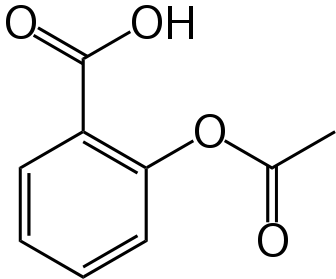
Note that it is a rather simple molecule as drugs go. It is produced by “capping” the free-OH group of salicylic acid with an acetyl group. It turns out that salicylic acid is also an effective drug, but with the -OH group uncapped is much more irritating to the GI track than is aspirin. Here is the chemical structure for salicylic acid:
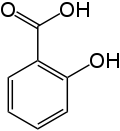
Salicylic acid is available large quantities in a high state of purity and very cheaply, and capping the hydroxy group is easy and cheap too. As a matter of fact, when I was a teaching assistant in graduate school that synthesis was a standard laboratory procedure in Organic Chemistry laboratory.
Actually, salicylates have been used since antiquity to treat fever and pain, but no one knew it. It turns out that there is a material in the bark of willow trees (genus name Salix) called salicin that is a relative of salicylic acid. Here is the chemical structure for salicin:
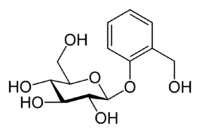
Do not worry about that big group on the left. It is just a glucose (sugar) molecule, which often is bonded to other materials in the plant kingdom.
It is, through a rather complex process, metabolized to salicylic acid when consumed, so willow bark tea actually was quite useful back in the ancient world. It is still used as a folk remedy in many areas and still works well.
Back in 1899 when aspirin was first marketed the mechanisms for its actions were completely unknown. I use the plural because aspirin has many different actions and many different mechanisms for those actions. About all that they knew at the time was that it was much better tolerated than the salicylate then in use, sodium salicylate, and just as effective at reducing fever, inflammation, and pain. They had no idea why it worked or of the many other actions other than these that it has.
Most people think of aspirin as a pain reliever and fever reducer. It is outstanding at those activities, being more effective than most other drugs (except for ibuprofen and narcotics for pain) for these purposes. Aspirin is not so good good for sudden pains, but rather for “dull” aches and throbs, like headache and joint pain. Interestingly, aspirin is just about as good as some of the newer, prescription only migraine drugs, and is much cheaper. Normally, a full gram is used for migraine while only about half that for other pain.
Aspirin has a multitude of actions, and not all have to do with pain. It turns out that the inflammatory process is mediated mainly by inhibition of cyclooxygenase enzymes (there are at least two subtypes, PTGS1 and PTGS2). Aspirin donates its acetyl group to the receptor site of the enzymes, permanently deactivating them. Without those enzymes, particularly PTGS2, chemical messengers called prostaglandins can not be produced, and the prostaglandins mediate the inflammatory reaction.
In recent years new drugs designed to affect only PTGS2 have been developed, with the promise of less GI irritation (it turns out that PTGS1 is protective of the GI mucosa) than aspirin which inhibits both. However, it turns out that PTGS1 also produces thromboxane A2 in platelets, causing them to aggregate and thus clot. Blocking PTGS1 reduces the tendency for clotting, and this has cardioprotective effects. It is thought that the vasculature of the body expresses PTGS2, and blocking it only and not PTGS1 as well increases the chance of a coronary clot, or heat attack. All of the so called COX 2 inhibitors except for one have been taken off the market because of this. One is left and is of good benefit for arthritis patients that can not tolerate aspirin.
Aspirin also increases the concentration of nitric oxide (NO) in the body. (Anyone remember from our discussion about nitrogen what, amongst other things, that NO does? Can you say Viagra?) There is some evidence that increased NO levels affect the way the white blood cells work, thus increasing the immune response. There is no clinical evidence that aspirin actually increases the immune response, but this potential sort of turns on its head the old saw that taking aspirin will make a cold last longer.
A very interesting article from last year at Oxford in the UK indicates that daily aspirin has a significant cancer reduction potential. This study, on a population of 25,000 people, indicates that a 10% reduction in prostate cancer rates, a 30% reduction in lung cancer rates, a 40% reduction in bowel cancer rates, and a whopping 60% reduction in esophageal cancer rates. This is a significant study, and those results are exciting. Here is a link to a report on that study.
Some people are sensitive to aspirin, asthmatics being prone to have their condition worsened by taking it. On the other hand, there is evidence that salicylates may be essential human nutrients. Do not worry, there are enough salicylates in fresh fruits and vegetables for you to get your minimum requirement.
Some people are unable to metabolize aspirin quickly enough and can get a toxic reaction from buildup in the system. The classic symptom of aspirin overdose is tinnitus, or ringing in the ears. If you are taking large doses of aspirin and your ears begin to ring, back off some.
The most common adverse effect of aspirin intake is GI bleeding because of the thromboxane inhibition. There are several methods to reduce this, such as buffered aspirin, taking aspirin with Vitamin C, enteric coatings (that do not release the aspirin until it clears the stomach, and by the way does not seem to work), licorice extract, and the amino acid S-adenosyl-methionine. This last approach has been shown to reduce GI bleeding by up to 90%.
The greatest risk posed by aspirin is that of Reye Syndrome in children adolescents. Reye syndrome is sort of a mystery, and the link to aspirin is really not that strong. However, due to the high mortality and morbidity rate of this syndrome, caution is the best action. It is wise to use an ibuprofen preparation for anyone under 19 unless aspirin is specifically indicated (the only indication that I know in that age group is the rather rare inflammatory disease termed Kawasaki Disease). I do not recommend acetaminophen for any reason for any one.
Well, that about does it for this evening. Sorry to be a little late, but I had a busy afternoon. Aspirin is indeed a very useful material and just because it was marketed starting 112 years ago does not make it obsolete.
Well, you have done it again! You have wasted many more einsteins of perfectly good photons reading this sour subject. And even though Michelle Bachman stops her Botox injections when she reads me say it, I always learn much more than I could ever possibly teach by writing this series, so keep those comments, questions, corrections, and other feedback coming. The comments section is usually the best part of my pieces. I shall hand around as long as comments warrant, and shall return tomorrow night after Keith’s (who still has not contacted by about that science adviser spot on Countdown) show.
Warmest regards,
Doc, aka Dr. David W. Smith
Jul 11 2011
Sunday Train: Chairman Mica to Cities ~ Screw You
(10 am. – promoted by ek hornbeck)
Burning the Midnight Oil for Progressive Populism
 Chairman Mica says:
this proposal maximizes the value of our available infrastructure funding through better leveraging, streamlining the project approval process, attracting private sector investment, and cutting the federal bureaucracy, … Most importantly, this six-year proposal provides the stability states need to plan major transportation improvements and create long-term jobs.
Decoding that, Chairman Mica is saying: “Screw You, Cities”.
And of course, a bit of “screw you countryside” too, since those votes can be taken for granted.
The Dot Points Decoded
Streamlining & Reform
- Streamlines the project delivery process by cutting bureaucratic red-tape, delegating more decision making authority to states, allowing federal agencies to review transportation projects concurrently, and setting hard deadlines for federal agencies to approve projects.
- Reforms the surface transportation programs by consolidating or eliminating approximately 70 programs that are duplicative or do not serve a federal purpose.
- No longer requires states to spend highway funding on non-highway activities, but permits them to fund those activities if they so choose.
- Provides states the flexibility to fund their highest project priorities, but holds them accountable for those decisions through performance measures.
The real bureaucratic red tape in transport, the FRA regulations that impose unnecessary costs and substandard performance on urban and intercity rail systems are untouched. So the “red tape” being addressed here would entail things like being prevented from build roads that are not designed to kill pedestrians and cyclists, having to show a real economic benefit to more funding of our massive new highway building boondoggles when we can’t maintain the roads we already have, and the like. “Flexibility to states” means that states can dump as much of the federal funding they receive into highway boondoggles as their state highway departments (sometimes misleading called “State Department of Transport) can finagle. Holding them accountable typically means preventing them to spend money in ways that benefit poor and urban populations when there are suburban and rural interests to be served.
Better Leveraging
- Provides additional funding for the TIFIA loan program to meet demand for low interest loans for transportation projects.
- Allows states to toll new lanes on the Interstate System, while ensuring that existing Interstate lanes remain toll-free.
- Encourages states to create and capitalize State Infrastructure Banks to provide loans for transportation projects at the state level.
This means, (1) putting a small amount into transit project finance if the local area taxes itself to contribute to our nation’s future, (2) getting more money poured into the road building boondoggle without using Federal money to do so, (3) and ditto from number 2.
Highways
- Distributes nearly all federal highway funding to state DOTs through formula programs designed to preserve existing highways, build new highway capacity, and address congestion, freight mobility, and highway safety.
- Focuses the federal highway program on the Interstate Highway System and the National Highway System – the highways that facilitate interstate travel and interstate commerce.
Shelters highway funding from having to show the positive economic return on investment that transit and intercity rail projects must show, and pulls funding out of state highways that are much of the limited benefit that urban areas gain from the highway trust funds, and from the county and township highways that rural areas depend on heavily, to concentrate the reduced funding on suburban areas.
Transit
- Removes current barriers that prevent the private sector from offering public transportation services.
- Provides more of a focus on transit programs that benefit suburban and rural areas and will improve transit options for the elderly and disabled.
Remove obstacles to lining private pockets with public money, and remove the limited transit funding counterbalance to the massive urban cross subsidy to highways serving suburban and rural areas by taking transit funding away from cities and putting it into suburban transit subsidies.
Highway and Motor Carrier Safety
- Prioritizes safety funding by holding highway and motor carrier safety programs harmless from any spending cuts in the bill.
- Ensures that federal regulators keep unsafe trucks and buses off the road while allowing companies that operate in a safe and responsible manner to continue to do so.
When the “focus on safety” involves specifying which safety programs are not cut, that obviously means there is to be no progress made in improved highway and especially truck freight safety in the proposed six year authorization.
Rail Transportation
- Improves access to the underperforming Railroad Rehabilitation and Improvement Financing (RRIF) program.
- Expedites project review process and streamlines project delivery.
Top line dot points that would normally be in the details section implies rail gets didley and squat.
Maritime Transportation
- Ensures that Harbor Maintenance Trust Fund revenues are invested as intended in maintaining the nation’s harbors, not tied up in a federal budgetary shell game.
- Expedites Corps of Engineers permit processing to reduce project backlog.
- Encourages short-sea shipping by eliminating double taxation on vessels transporting freight between domestic ports.
The first seems to mean that with the widening of the Panama Canal, Florida’s two main harbors will want expansion, and the money in the MHTF needs to be focused on projects “like that”. The second sounds like forcing the Corps of Engineer to be lax in permit processing rather than giving them the staffing to do the job right. The last sounds suspiciously like an effort to undermine US flag carriers in domestic maritime freight, but I don’t know much about maritime freight, so will be interested if anyone can fill that in.
Hazardous Materials Transportation
- Achieves greater safety through regulatory certainty and uniformity.
- Reduces regulatory burdens that do not enhance safety.
This sounds more like protecting the safety of the freight company’s bottom line than protecting the communities through which hazardous freight passes.
Overall: The Republican Proposal
 Mica wants to write the six year authorization now, when there is a big Republican House majority, since even a slender Republican House majority might be vulnerable to the log rolling that is possible in a transport authorization.
Infrastructure deficit? Forget bridging it.
Energy Independence? Forget pursuing it.
Brawny Recovery? The way to speed up the economy is to slam on the brakes.
This is a proposal with (1) many ambit claims, include focusing as much of the funding cut as possible on urban transport (2) many individual items that the Chairman hopes to slide through as attention of urban Democrats is focused on defending against the reckless attack on urban transport funding contained in the ambit claim and (3) some political baseball bats that the Republicans hope to use to beat the Democrats over the heads during the course of the “negotiations”.
A Counter-Proposal?
I know this is just silly, blue sky dreaming, but I’d like to see the counter-proposal do the same damn thing: include some ambit claims, some points the Democrats are trying to slide through in the midst of the fight, and some political bats to hit the opposition over the head with in the course of the “negotiations”.
One thing is clear: the Democrats ~ whether in the Senate or the House ~ are having so many of their constituents hammered so very hard in the Republican proposal that they have very little to lose from a “short” authorization that gets very little done. When the name of the strategy of the other side is “do maximum damage to your constituents”, then “getting little done” is by no means an unattractive Plan B.
Ambit Claim: Take Mica’s $6b for Tollway Boondoggles and direct it to sensible long term investment. Take the Infrastructure Fund funding in Chairman Mica’s Bill and crank it up to serious levels. The Railway infrastructure lending only gets streamlining of approvals processes, while the Highway RIF to provide subsidized public finance to private Tolled Interstate lane construction is slated for $6b. Allocate the $6b to Rail and Highway RIF combined, with eligibility driven by Total Benefit and Total Cost of each project.
Ambit Claim: Repeal $4b in Oil Company Subsidies to fund High Speed Rail. No, of course it won’t get through a Republican House, but they don’t have to expend effort in fighting it unless its put into the Senate version.
Ambit Claim: Impose $10b in finance transaction finance and fund energy independence electric transport. Again, the House will take it out again, but force them to fight it, rather than surrendering up front.
 Baseball Bats: Fix It First. Mandate that states must spend 100% of their formula funding spent on roads on bringing existing federally funded highways and bridges up to a state of good repair until at least 90% of their existing federally funded highways and bridges are in a state of good repair. (NB: in image, a field hockey stick stands in for a baseball bat.
When you need to score political points against an opponent bent on sabotaging the country’s future in service of today’s vested interests, Fix It First is a great bat. It is easy to say, hard to yell over top of, and many ordinary motorists are eager to hear it. It doesn’t directly undermine the yellow bellied surplus suckers in the road building industry, but it undermines many of their co-boondogglers who are focused on getting the capital gains from holding property where the next expressway exit is put in, and never mind the fact that the state cannot afford to maintain the roads it already has.
Slidethroughs: Update the FRA passenger rail regulations from the WWII era into the 21st Century. I’m not a transit blogger as such, but transit blogger Alon Levy has recently gone into some detail on regulatory reforms that would permit substantially greater bang for the intercity and local passenger rail buck. And its awfully hard for the House to get on their deregulation bandwagon and then reverse gears and fight to retain regulations that are convenient for their Big Oil sponsors in terms of preventing energy efficiency gains in rail transport and financial efficiency gains to leverage that energy efficiency.
Slidethroughs: The Steel Interstate. Since we know what a Steel Interstate needs, and we know what a Steel Interstate offers, we can in fact sneak Steel Interstate funding into Mica’s proposal. In the “encouragement of State Infrastructure Banks”, we need an ability to form a multi-state Infrastructure Bank for interstate transport corridors. Above, the pooling of Highway and Rail Infrastructure Fund lending can be leveraged by permitting these State Infrastructure Banks to borrow from the Federal Infrastructure Bank for projects that contribute to National Defense Strategic Transport needs. And finally, allow states to allocate up to 10% of Highway Formula funding on State Infrastructure Bank projects that reduces the maintenance cost imposed on Interstate, National and State Highways by interstate truck freight.
This is not, of course, a Steel Interstate program as such. But it permits any group of states that have a long enough length of Dept. of Defense STRACNET rail corridor to convert into a Steel Interstate to proceed with the project, borrowing ahead on future Highway Formula funding to get the work started immediately.
So, what’s your reaction …
… to Mica saying “Screw You” to the cities … for what appears the mortal sin of hosting too damn many Democratic voters.
Midnight Oil ~ Beds are Burning
Recent Comments