Six In The Morning

Al-Qaida turns to kidnappings as donations drop

‘That kind of money could go a long way to sustaining a terrorist organization,’ says expert

By STEPHEN BRAUN

Pressured by increased scrutiny of terrorist money sources and strikes aimed at its financiers, al-Qaida’s core organization in Pakistan has turned to kidnapping for ransom to offset dwindling cash reserves, according to U.S. officials, some of whom cited information in files retrieved from Osama bin Laden’s compound.

Bin Laden’s interest in kidnapping as a cash-raiser bolsters accounts that the financial squeeze has staggered al-Qaida, forcing it to search for alternative funding sources. Officials would not detail al-Qaida’s role in specific crimes, but the group’s affiliates have targeted diplomats, tourists and merchants.


Monday’s Headlines:

Bangladesh feels economic backlash from Middle East crisis

Bahraini leadership faces new claims that torture took place in hospital

Euro Group Postpones Decision on Greek Aid

Mugabe vows to defy rules on ‘blood diamonds’

2G scam: SC rejects Kanimozhi’s bail plea

Bangladesh feels economic backlash from Middle East crisis

Expatriate workers forced to leave Libya are returning with debts and causing massive reduction in country’s income

Syed Zain Al-Mahmood in Dhaka

The Guardian, Monday 20 June 2011  


Tens of thousands of Bangladeshi migrant workers are returning home from strife-torn Middle Eastern countries, threatening social and economic turmoil in their homeland which relies heavily on expatriates for a large part of its national income.

More than 36,000 people have returned from Libya alone in recent weeks. An estimated 70,000-80,000 Bangladeshis were working there before the current crisis.

According to the International Organisation for Migration (IOM), more than 36,500 Bangladeshis have been repatriated from Libya since the uprising against Muammar Gaddafi began.

Bahraini leadership faces new claims that torture took place in hospital

Human rights group says suspected protesters – and doctors and nurses who treated them – have been systematically abused

By Alistair Dawber Monday, 20 June 2011

The government of Bahrain faces fresh allegations that it systematically tortured people it suspected of taking part in demonstrations against its autocratic rulers earlier this year, and of deliberately undermining the country’s health system as 20 doctors go back on trial today for their supposed role in the protests.

One of the world’s most respected humanitarian organisations, Médecins Sans Frontières (MSF), alleges that security forces loyal to the tiny Gulf state’s authoritarian leader, King Hamad bin Isa al-Khalifa, regularly beat hospital patients who had injuries that could have been sustained during the rallies that started in February.

Euro Group Postpones Decision on Greek Aid

Ramping Up Pressure on Athens

 By Carsten Volkery in Luxembourg

It’s a reliable rule of thumb with European Union summits that the bigger the problem, the longer the meeting. In this case, the discussion lasted seven hours. It was not until early Monday morning that the finance ministers of the euro-zone countries emerged one by one from the conference center in Luxembourg City’s deadly quiet Kirchberg plateau, home to various EU institutions.

The euro group — as the euro-zone finance ministers are collectively known — had been discussing how to deal with Greece’s debt crisis. But the result they announced came as a surprise: The decision about whether to grant Greece new loans has been postponed.

Mugabe vows to defy rules on ‘blood diamonds’


Ben Doherty, New Delhi

June 20, 2011  


ZIMBABWEAN president Robert Mugabe has promised to sell diamonds from his country’s controversial Marange mine ”sanctions or no sanctions”, and the country that would be his biggest customer, India, is being urged by the industry there to buy Zimbabwe stones outside the international framework.

The Kimberley Process – the international protocol designed to stem trade of conflict diamonds – is in turmoil.

2G scam: SC rejects Kanimozhi’s bail plea


Dhananjay Mahapatra, TNN | Jun 20, 2011

NEW DELHI: A special Supreme Court bench on Monday rejected bail pleas of DMK MP Kanimozhi and Kalaignar TV MD Sharad Kumar in the 2G spectrum scam case.

However, the SC gave liberty to Kanimozhi to move to trial court afresh for bail after framing of charges in the case.

The apex court said she could invoke section 437 of criminal procedure code which provides for grant of bail to women in cognizable offences. This means Kanimozhi and other accused, including A Raja and corporate biggies, must wait in jail for framing of charges before they can move fresh bail pleas.

Pique the Geek 20110619: Recovering from Trouble

A comment thread on Friday evening’s Popular Culture installment got me to thinking about this, and I decided that it would be a good topic here, and some Geeky stuff that can be used by a wide range of the public.  Thus, I write this as a public service.

There are several situations that people can find themselves in due to circumstances beyond their control.  Many of them involve interruptions of utility service, but some other eventualities can also require fast attention to mitigate further damage or even personal injury.  We shall discuss a few of those this evening.

Probably the most common situation that occurs is electrical service interruption.  This can be more serious than one might think.

Electrical service can be interrupted several ways.  The most devastating ones are the ones that affect very large areas for a long time, usually caused by adverse weather.  People who depend on electrical service to survive (mostly folks with medical conditions that require electricity to power their life preserving medical devices) should have a back up generator and enough fuel to carry them for at least a week, if not longer.

For those of us fortunate enough not to depend on electricity to live, there are steps that can be taken to mitigate any damage that might result from an outage.  The problem (except for heating and food in the refrigerator for prolonged periods) is not that the power goes off, but what happens when it is restored.  Think about what happens when power is restored after a significant (larger than, say, a group of ten or so houses) outage is restored.

Usually, everyone leaves their electrical equipment as it was when the power failed.  When power is restored, all of those devices (some of which, like an electric water heater or HVAC equipment) use a LOT of power.  When the power comes back on, essentially EVERYTHING tries to restart at once.  Many of these loads are capacitive, meaning that they draw an unusual amount of current at first, then level off to a lower requirement after starting.  HVAC, refrigerators, and freezers are like that, as are other things with large electric motors.  Others are resistive, like incandescent lighting and water heaters.  They may have a bit higher initial requirement, but not by a lot and it falls off fast.  In any event, the result is that the electrical service, once restored, is subjected to incredible loads instantly, and neither voltage nor frequency of the restored power from the mains can cope with such a huge, instant load.

The result is that the supply voltage (nominally 120 or 240 V in North America) drops for some time, depending on the number of customers affected and can also spike to values well over nominal as the load becomes equilibrated with the supply.  In addition, the frequency (in North America, 60 Hz, extremely closely controlled by the utility company) fluctuates because of induction from the many new loads being added, and the waveform of the power (normally a really nice, well controlled sine wave) becomes distorted.  These factors combine to have the potential to cause real damage in electrical devices.

Capacitative devices and electronics are particularly sensitive to these distortions.  Purely resistive devices are more resistant, although voltage spikes can burn out incandescent filaments.  Here is what to do to prevent as much damage as possible to your devices.

First, keep a torch (I like the British term, but most of us call them flashlights) in a place that you can get to easily even in the dark.  For some reason, perhaps Murphy’s Law, power outages tend to occur after dark.  You will need it, if it is dark, to do the first and most important step.  Go to your power panel and shut off the main breaker (for older installations, remove the main fuse).  This will prevent any surges from getting into your house.  Next, turn off all of the secondary circuit breakers (or unscrew the fuses) to disable each individual circuit.  Assuming a total electric house, one will service the HVAC, another the range, another the dryer, another the water heater, and several more for lighting and small appliances, including electrical outlets that service pretty much everything else.  This is important for an orderly start up later.  Then go around the house and turn off or unplug all devices.

Do no open your freezer!  In normal conditions, unless you have put a lot of warm things inside recently, an unopened freezer will keep its contents frozen for 48 hours, give or take depending on the ambient temperature.  If you happen to have a gas range, cook any perishables from the refrigerator within a day or two and eat them.  If not, drink that milk and juice pretty quickly and plan on discarding the rest.  If you have a gas or charcoal grill, then that chicken or other meat can be cooked and eaten even if in a total electric house.  Use your judgment.  For something like an ice storm or hurricane or tornado, it is likely that the power will be out for a long time. For a lightening storm, a couple of hours is likely.  But still do the electrical things that I recommended.

Once the power has been restored, to the following.  How do you know when it is back?  I recommend that you take an incandescent light bulb and make sure that the circuit into which it is plugged is active.  You do that by turning back on the main breaker (or replacing the main fuse) and activating the single circuit that controls that lamp.  I used the lamp in my clothes dryer, since it was on a dedicated circuit and with the door open there was no chance of the dryer itself starting.  Begin restarting your equipment one item at a time.

Wait at least 10 minutes for the electricity supply to stabilize.  That will assure that it is fairly clean by then.  Do not get into too much of a hurry.  Remember, this is as important for a five minute outage as it is for a five day one.  Begin by closing all of the secondary circuit breakers (or screwing the fuses back in) slowly and one at a time.  The chances are that you missed at least a couple of loads when you were unplugging or turning them off, so go slow.  Do the biggest loads first, like the water heater and HVAC (one exception:  NEVER try to restart HVAC equipment until it has had at least 10 more minutes down time, so for a five minute interruption it is the last to go back on, and the same with refrigerators and freezers, because the compressors in them need time to release pressure.  You can trip breakers, blow fuses, or even damage the compressors if you do not wait long enough.)

Just go slowly and you can restore normal function in under a half hour without doing damage to your electric and electronic devices.  I have done this for decades, and NEVER have lost a device to a power failure, although neighbors have had to replace freezers (not to mention the lost food), TeeVees, refrigerators, and in the worst cases, entire HVAC compressors.  For HVAC and refrigeration, five minute outages are much worse than five day ones.

Another problem that is common is a water heater failing.  Prevention is the best way to avoid this situation (you have no control on the power coming into your home, but you DO have control on the location of the water heater, at least to some extent).  Water heaters fail in four ways, two harmless and two that can be unmitigated disasters, at least economically.  Electric water heaters often have an element burn out, and that is just a nuisance.  Gas ones sometime have burner problems, once again a nuisance.

The next more serious failure is for the thermostat to fail, causing the water heater to overheat.  All modern ones have a relief valve that is supposed to be connected to a drain to divert the boiling water and steam safely.  Make sure that the relief valve is connected with reliable piping to a clear drain, or you will flood.  Sometimes the relief valve fails open, dumping water anyway even though nothing is wrong with the heater itself.  You will still flood unless good connexions betwixt the valve and the drain are maintained, so make sure.

The most catastrophic failure is for the tank itself to fail.  This dumps water from the bottom of the tank (the relief valve is on the top), and because the tank has a continuous supply of feed water, it will keep dumping until the feed water is interrupted by the supply valve, usually on the top of the tank.  But there are still from 40 to 60 gallons of water in the tank, even if you close the valve, and there is no way to stop it from draining, and it is HOT!  By the way, except for the innocuous failure of a heating element in an electric water heater, this is the most common failure mode for any water heater.  If you have one long enough, it WILL get a rupture in the tank, so plan for it.

There are two strategies to deal with this.  The first is to have your water heater on the lowest level of your house.  In that way, when the tank fails, the water can not damage a lower floor.  That is not always feasible, and many multi level homes have water heaters on an upper floor.  Let that puppy rupture and you are looking at thousands of dollars of damage!

The way to counteract that is to set the water heater in a catch pan (a piece of galvanized steel of sufficient diameter to allow the water heater to sit inside) with a drain stub connected to a reliable, open drain.  If the tank ruptures, and it will given enough time, the water from the tank will be contained by the catch pan and vented harmlessly to the drain, unless the rupture is so severe that the pan is overwhelmed.  Remember, the water in the tank is under pressure, so it does not really run out, it shoots out of the tank.

The best strategy is to combine the two.  Put your water heater on the lowest level, if possible, and use a tall (12 inches or more) catch pan connected to the drain.  I promise you that given long enough, the tank in your water heater WILL fail.  There is no easy recovery from water damage, except for restoration.  In this case, preemptive action is much more effective than reaction after the fact.  Please be warned.  Fast action in shutting off the supply to the water heater is about the only action that you can take after a leak in the tank.

Interruption of water service is less common, but does happen, usually because of a broken main.  Depending on where it happens, it can take hours to weeks to repair it.  There is nothing that a homeowner can to to prevent this, and once again only preemptive actions can mitigate the effects except for a couple of sort of weak approaches.

Usually, there is no warning about such a thing, but in the rare cases that warning are given, fill up the bathtub!  That is a good reason to keep your bathtub clean.  A full bathtub ranges from 40 to 100 gallons of water, so that can keep you drinking and cooking for a long time.  Even if a boil order is given, that water is useful, if you have electricity or gas.  In an emergency, you can also use household bleach to kill pathogens in that same water, but that is a poor long term solution.  Eight drops of good bleach in a quart of water, shaken rapidly and allowed to stand for 15 minutes will kill most pathogens, rendering that water fit to drink.  I would recommend pouring it from container to container with a long stream to allow the air to remove most of the chlorine before drinking.

If you do not have any warning, you still have potable water in the house.  Personally, I keep a gallon or two in the refrigerator just because I like to have cold water to drink.  But short of this, you STILL have fresh, uncontaminated water to drink, and you will not believe the source!

A regular household toilet has a reservoir that contains several gallons of water.  I am not talking about the bowl, which is likely heavily contaminated with bacteria that you really do not want to drink, but the tank above it.  This water comes from the same supply as your taps, and is fine to drink or to use for cooking.  In addition, your water heater has 40 to 60 gallons of potable water in it.  Just be sure to turn off the water heater before you tap it, not only for personal safety from burns, but also to prevent burning out the top element (for electric ones) as you tap out the water.  All modern water heaters have a valve near the bottom that also has a connexion that fits a garden hose to use to flush the bottom of the tank from hard water scale.  You can, after allowing the heater to cool, use this device for potable water for a long time if your water supply is interrupted.

These are just a few of the more common troubles in which we can find ourselves.  There are more, but these are both common and difficult.  Please respond in the comments for other situations that you have encountered and how you dealt with them, and I will try to offer suggestions to you and others about possible alternatives.

Note that I did not say anything about an actual, outside flood.  It is almost impossible to protect against them, and mitigation of damage is costly to the extreme, if even possible.  I recommend that anyone who lives even near a flood zone to carry flood insurance (normal homeowner’s policies explicitly exclude flooding from the outside, but usually cover a water heater tank rupture) and to keep their precious possessions on the highest floor of their house, in the attic, or in a secure, out of the flood zone storage space.  I used to live by a creek that would get pretty lively during periods of heavy rain.

My house never flooded, but it was on the uphill side of the creek.  Over the course of several years I studied to topography and observed water flow during periods of extremely heavy rainfall, and decided that it was a poor use of resources to carry flood insurance, so I cancelled it.  Then one spring we had a REALLY big series of storms.  Sure enough, my studies paid off, and my house was never even close to flooding.  But the neighbors on the other side of the creek (the downhill side) had their newly redone basement (and most items in it) pretty much ruined when the creek came a foot higher than the outside entrance to it.

Fire is a real danger in most household settings.  The two major causes of fire in a home are cooking and smoking.  Keep a fire extinguisher in the kitchen and check the charge indicator when you change the batteries in your smoke detectors.  Most cooking fires are grease fires, and can easily be controlled by taking something like a large pizza pan and using it to cover the skillet.  I have heard the advice about throwing baking soda into a grease fire, but I strongly recommend that you do NOT do that.  Even though it IS carbon dioxide that is released when baking soda get hot, the rapid expansion of this gas is more apt to cause the grease to be forcefully thrown into the air, giving it MORE oxygen and thus increasing the intensity of the flame.  The same thing goes for water.  Water is fine for a trashcan fire, but NEVER put it into a grease fire or you will cause a minor incident to become an unmitigated disaster.

Update:  Here is a trailer from Mythbusters about what happens when you use water to attempt to put out a grease fire:

As far a smoking goes, you should not.  If you do, like I do, restrict the areas in your house where you smoke to ones that have been rendered safe if that cigarette falls off of the ash tray, there is no paper, carpeting, or other combustible materials for it to ignite.  A cigarette will not ignite a piece of plywood, so setting the ashtray on something like that, or a glass tabletop works.  NEVER smoke when you are sleepy or otherwise impaired, and NEVER smoke in bed.  Even though I have a waterbed, the bedclothes are still quite combustible.

ALWAYS keep your smoke detectors working.  There are two types:  a flame detector and a smolder detector.  You need one or more of each.  A flame detector works by detecting ions coming from a fast, bright fire, and those do not always produce a lot of smoke.  A smolder detector works by sensing the reduction in intensity of an infrared light beam in the detector.  They are good for detecting slow, smoky fires before they get really hot and bright.

Here is a personal story.  I have a total electric house, and in one of the bathrooms is an old (built in when the house was built around 1965) bare element electric heater in the wall.  After moving here, I was using that bathroom to store packing boxes as I emptied them.  I THOUGHT that the heater was turned completely off, but I was wrong.  One night it got quite cold, and the thermostat turned on the heater, igniting some empty boxes stored too close to it.  I awoke to one smoke detector blaring, and soon found the boxes.  They had not come to full flame yet, so the smolder detector caught it.  I threw the boxes into the bathtub and flooded them, no real harm done.

While of the subject of detectors, if you heat with anything other than electricity, get a carbon monoxide detector, too.  CO is an insidious toxin, and if a heat exchanger decides to have a seam fail whilst you are asleep, you may very well “wake up dead”, as they used to say over at home.

One final hazard:  lightening.  More people in the United States are killed by lightening than win big at the lottery.  When you hear thunder, get inside if at all possible.  Stay away from windows as far as possible, and use only cordless telephones.  Avoid bathing or even washing your hands until the cloud passes.  If you are in an automobile, stay in it.  The metal skin of a car forms an effective Faraday cage, so you are safe from the lightening as long as you are in the car with the doors closed.  If outside, find the lowest spot that you can and lie down or at least crouch to avoid being the tallest object nearby.  NEVER seek shelter under trees, since at the tallest objects nearby, they are the most likely to be struck.

Well, you have done it again!  Danggit!  You have wasted many more einsteins of perfectly good photons reading this soggy piece!  And even though Keith Olbermann has not responded to my offer to be his science adviser, I am confident it is just because he has not seen me write about it yet, since that blog, Popular Culture, just came out a couple of days ago.  I am confident that he will consider me for that spot when he becomes aware of my eagerness to do so.  The local NBC affiliate is only about half an hour from here.

Please remember that I always learn much more than I could possibly hope to teach by writing this series, so keep those comments, questions, and especially corrections coming!  That, with other feedback, keeps me going.  Remember, nothing about science or technology is ever off topic here, so comment freely!  I shall hang around as long as comments are coming, and shall return tomorrow, and for the first time in months can say, after Keith’s show.  It feels GOOD to be able to say that again!

Warmest regards,

Doc

Sunday Train: Chairman Mica aims to block equipment Amtrak needs to expand

(10 AM – promoted by TheMomCat)

Burning the Midnight Oil for Living Energy Independence

The headline spin on House Chairman of the Transport Committee is that he is proposing to privatize the NEC to allow HSR to be built in this decade.

However, if you follow the money trail, while he proposes a process to do that, there is no funding proposed to do that. And without a funding stream for the federal share of anywhere from $40b to $100b to bring the NEC up to a state of good repair and then to make the improvements required, under current FRA regulations, to meet Mica’s modest speed targets … that part of it is not a real proposal yet.

The real proposal is to have talking points to use to object to any funding that gets out of the Senate to allow Amtrak to buy more equipment so it can expand the capacity and frequency to meet the steady increase in demand for its services.

Amtrak vs Mica

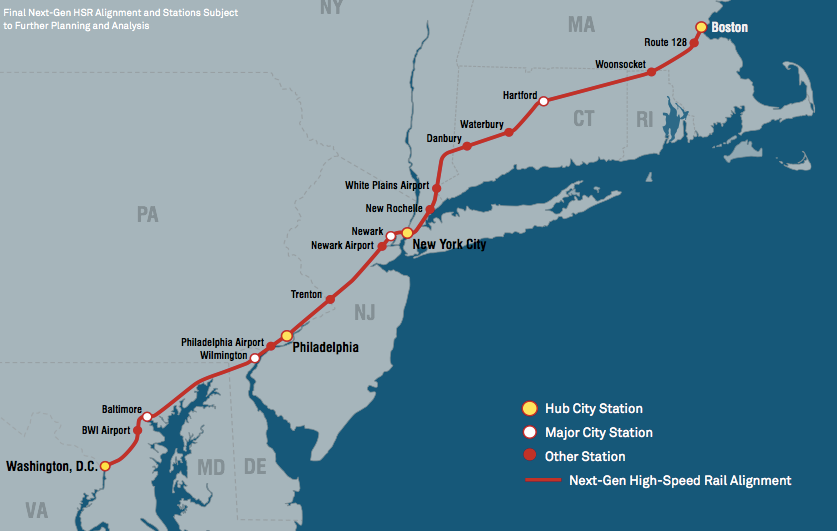
Last year, Amtrak set forward its NextGen proposal for a Ltd Stops Express HSR from DC to NYC to Boston in 3:23 (all stops 4:03).

Representative Mica proposed DC to NYC in 2:00 and NYC to Boston in 2:30, under a framework in which no project is graded up for achieving better times than that, so it can be taken as DC/Boston in 4:30, an hour slower than the NextGen.

The Amtrak NextGen has been criticized (in my personal opinion, with substantial reason) for being overengineered. Its headline price is $117b, which Mica uses to great effect. Of course, Mica knows that describing it as a $117b project is deceptive, since these are year of expenditure dollars for a project that is slated to be rolled out in two phases, one 2020-2030, and the next 2030-2040. Assuming a 2030 midpoint and 3% GDP inflation, $117b over 2020 to 2030 is about $65b in 2010 dollars.

This is on top of the Amtrak program to bring the NEC up to a state of good repair combined with needed upgrades to the NEC itself, which the private bidder for the NEC would be required to do.

How much does Mica’s project cost? He punts the price tag. All that the proposal says is that the private bidders will set forth their strategy for meeting the requirements, and how much public capital subsidy will be required, and that’s it. Say the winning bid is to upgrade the NEC to something between a Regional HSR system and the California HSR 220mph Express HSR system sets the public capital grant at $50b … where does the $50b come from?

That’s the beauty of Mica’s proposal as a source of talking points: there’s no price tag to be attached for his underwhelming speed goals. Its just “the private bid that best meets the requirements while requiring the least money”. The reactionary echo chamber is free to imagine a ridiculously low amount of public capital spending, to imagine a massive benefit/cost ratio … because its just “we’ll find out where the many $10b’s will come from when the time comes”.

Odds are that it’ll be cheaper than the combined Amtrak NEC Master Plan and Amtrak NextGen, because instead of upgrading the NEC and building a new Express HSR alignment, the proposal is to upgrade the NEC into a not-very Express HSR alignment, with all the details to be worked out by the bidding consortiums.

If its not a real Express HSR Proposal, What Is It Really?

What this is “really” is an effort to divide and conquer the political coalition behind Amtrak. That is a political tripod:

  • The Northeast, where replacing Amtrak intercity services would cost many $10b’s in roadwork and airport expansion in the most expansive part of the country for airport and road expansion
  • Rural communities dependent on Amtrak for regular intercity service into metropolitan areas, as they are too small and too far from a major metropolitan area for effective air service.
  • Those states that have increasingly effective state-subsidized regional corridor services, including California, Washington and Oregon, Illinois, Virginia and North Carolina.

At present, the Regional HSR Amtrak Acela service generates an operating surplus, and that operating surplus reduces the operating subsidy required by Amtrak to provide long haul passenger service, with regional corridor service primarily funded by state level rather than federal subsidy.

Under Mica’s proposal, all of the state corridors will be required to put service out to tender, with the winning bid having to involve less federal subsidy than under Amtrak. The long haul routes that are intrinsically subsidized public utility services when operated at conventional rail speeds will be subject to privatization if a private operator submits an expression of interest ~ and again, the winning bid will have to be at less than the Amtrak level of subsidy.

Privatize the NEC, and the political tripod is broken:

  • There is no longer a community of interest between rural communities dependent on subsidized intercity service and the heavily urbanized Northeast Corridor, since the increased operating surpluses generated by the privatized NEC will have been divided between capital improvements and operator profits.
  • Long Haul and Regional routes that run into the NEC will no longer have the right to do so, which means that the North Carolina and Virginia corridors, as well as the Cardinal, terminate at DC, and the Pennsylvanian terminates at Harrisburg, to transfer to a private rail operator at prices set by the private rail operators.
  • The authority of Amtrak to operate routes under its original founding agreement in which freight railroads were relieved of passenger rail service requirements will be replaced by “market negotiations” with Right of Way owners.

So that is the ambition of the proposal: break up the political coalition supporting Amtrak, and leave the Northeast, the states with regional corridors, and the rural communities dependent on long haul Amtrak routes to each fend for themselves in chasing individual capital or operating subsidies to meet their intercity transport needs.

But assuming that the Senate will not jump to break up Amtrak, there ought to be an immediate political ambition to the proposal as well. And that immediate political ambition is to use absurdly optimistic characterizations of what the bill will achieve as part of running interference against efforts to improve Amtrak service.

The Need to Block Purchase of New Rolling Stock

In the discussion on The Transport Politic, the commentator Woody lays out what Mica is trying to block:

Amtrak’s biggest problem is the crippling lack of new equipment.

It can’t come up with locomotives and coaches to make up a train for any new state-supported corridor.

It can’t add coaches to its own heritage short-distance trains, mostly in the Empire Corridor, NYC-Albany-Buffalo and the Wolverines, Chicago-Detroit.

It can’t run a daily Cardinal, NYC-D.C.-Charlottesville, VA-Charleston, WV-Cincinnati-Indianapolis-Chicago, much less a daily Sunset Limited, New Orleans-Houston-San Antonio-Tucson-almost Phoenix-L.A. It simply does not have equipment for the needed trains. So these three-times-a-week trains lag far behind the returns on the other, daily l.d. trains. The Cardinal and the Sunset thereby provide the cultist critics with the “big-money-losing, high-subdidy-needing” examples to make their case that Amtrak is a loser. The haters certainly don’t want those two l.d. trains to get improved.

It can’t add another l.d. train Chicago-East Coast that would visit Toledo (bus to Detroit)-Cleveland-Buffalo during daylight hours, or link thru Chicago-Toledo/Detroit-Cleveland to the Pennsylvanian’s Pittsburgh-Harrisburg-Philly cities.

It can’t extend more Regional trains down to Norfolk or Roanoke or Raleigh or Charlotte, or up from NYC to Albany or Syracuse or Hartford-Springfield-Worchester-Boston North Station-Portland.

Meanwhile, the current fleet is reaching the end of its normal life cycle, with increasing problems occurring while in service and increasing maintenance costs.

Amtrak has proposed a very large order of new-and-improved equipment. The railcars would still be FDA-heavy, but at least would offer larger windows, better toilet facilities, electric outlets at every seat, Wi-Fi capability, nicer seats – lots of stuff customers would like. Amtrak asked Congress to authorize a purchase of over 1,000 new coaches, sleepers, diners, lounges, baggage cars, crew dorms, whathaveyou, oh, locomotives it likes to describe as ‘faster-accelerating.’ That request is pending.

But instead of dealing with the real business needs of Amtrak, Congress will instead provide a circus’ worth of diversions about “privatizing” and “spinning off” and doing this or that or the nothing. Mostly the nothing. Nothing will be done about Amtrak’s need for new equipment or any of its other real world problems.

That’s what is really going on here: economic sabotage for political objectives, the real world consequences be damned.

What Can Be Done?

So, we have this fake proposal to establish HSR in the NEC through the magic of privatization with public subsidy with no upper bound on the amount of public subsidy required. Aimed at blocking any funding of substantial new rolling stock at the very least, and at shattering the coalition of interest supporting the various services provided by Amtrak at its most ambitious.

The shell game that will follow is obvious: after taking the NEC from Amtrak, and putting HSR out to bid, it will be found that all the bids cost too much, so we won’t even get the 4:30 Boston/DC promised in the bill. Except now Amtrak is a provisional operator, and has neither authority nor incentive to pursue capital improvements on the NEC.

The thing is, because Mica’s proposal is not a serious effort to actually achieve Express HSR in the Northeast Corridor, it leaves itself open to a messaging counter-offensive.

It costs too damned much: We know it costs too damned much because it does not tackle regulatory reform. If the NEC could adopt standards of the international railway industry organization, the UIC, it could run lighter weight trains which would accelerate faster and use less power, with greater allowed banking of express track and substantially greater allowed speed through turns for tilt trains, run with shorter turn-arounds, and could get more passenger benefit from the same capital subsidy.

It goes too damned : 4:30? Really? That’s an hour slower than best international commercial transit speeds. Why aim for no more than the international semi-finals? Since when did the US become so pathetic that we could no longer aim to be among the best?

Its the wrong damned privatization: What we need to get to 3:30 in the DC/Boston run is a new alignment. Mica criticizes the NG proposal, but fails to provide a new alignment.

So what to do with Mica’s proposal? Amend it beyond all recognition into some useful, stealing as many of its positive talking points as possible while supporting talking points against the original proposal.

The Amended Mica Proposal

Steal the Privatized HSR Thunder: Take all of the US DOT taking over the NEC, Executive Committee to lease the NEC, private bidder language, strip out the NEC take-over, and replace it with a new corridor. Make the requirements a 5-stop DC to Boston service in 3:45 or less and 15+ stops DC to Boston service in 4:15 or less.

Note that this takes the Mica decision to punt the price tag and turns it on its head. Since the proposal is, “private bidders bid, we’ll see how much it costs”, there is no need to price the improvement of service. Its just Mica’s halfway to Express HSR times vs world class Express HSR times.

And since the NEC itself is no longer privatized, it offers this “private Express HSR” system without taking current NEC service away.

Adopt the Regulatory Reform Mantle: Whenever a Republican passes over the opportunity to propose regulatory reform, it seems worthwhile to look at what regulatory reform might have to offer. In this case, mandate that Amtrak in cooperation with the Department of Transport identify and report on the benefits of adoption of common international standards, individually and in combination, to cost, capacity and service speed of NEC services in six months.

Extend the Cross-Subsidy Model for Regional HSR: The surpluses on the NEC cross-subsidize long haul services ~ but the NEC is far from the only corridor which can operate at transit speeds competitive with or faster than driving that could generate operating surpluses to cross-subsidize long-haul services. Mandate that Amtrak identify five regional corridors which if upgraded to Rapid Rail 110mph or better speeds and allocated to Amtrak could generate additional surpluses to cross-subsidize public utility long-haul and regional corridor passenger rail service.

And Give Amtrak the Rolling Stock It Needs: All of the above are essentially zero ticket price items, to put the Mica proposal on the back foot while requiring difficult political gymnastics to campaign against. Here, a funding source is identified ~ say, removal of a redundant oil company production subsidy ~ to fund the acquisition of the required rolling stock by the Department of Transport, under the management of the Executive Committee set up for the NEC HSR project ~ and leased to Amtrak for its services.

Short Term and Long Term Objectives

In the short term, its unlikely that the rolling stock acquisition will get made. But its a slippery proposal to run against, especially in a Presidential year electorate. It doesn’t, after all, take a stand on whether Amtrak or some private rail operator will be using the rolling stock ~ it just ensures that the rolling stock is available to provide the services. A populist candidate in a more conservative district can, with a straight face, campaign for the use of oil company windfall profits to buy the rolling stock, and for opening up provision of the service “to competition”.

Its hard to tell what the prospects of the “low ticket price” items are. The regulatory “reporting” mandate does not deliver direct outcomes, but the reports lay the foundation for election year bills that may be hard to vote against or hard to campaign against. Voting against even finding out what savings are available from regulatory reform is a vote that some reactionary politicians just will not take, since it can be used to undermine their “deregulation” credentials.

The offer of the “public/private partnership” Express HSR corridor with the break-up of Amtrak stripped out means that all of the investment into talking up how much better a “PPP” approach is has to be either walked back, or directed into exactly what the dominant reactionary wing of the Republican party does not want, which is to get the ball rolling on a serious Express HSR corridor project in the NEC. So at the very least the political capital invested into that messaging is wasted, and at best it is diverted into a public good rather than a public bad.

But it is the corridor cross-subsidy that is the most politically insidious proposal, since it offers the prospect in more urbanized states of additional Federal capital funding combined with the prospect in more rural areas of subsidized intercity rail that does not require ongoing Congressional appropriation to maintain.

The best packaging of this counter-attack is therefore in two bills. The rolling stock acquisition for the DoT to be leased out to whatever operator is providing federally mandates intercity rail services goes into one bill, and the free-standing Next Generation Express HSR for the Northeast, regulatory reform mandate, and corridor cross-subsidy mandate is the amended version of whatever happens to Mica’s proposal in the House.

Midnight Oil ~ One Country


…

One country one

Country one country

Who wants to sit around

Turn it up, turn it down

Only a man can be

What his life can be

One vision

One people

One landmass

We are defenceless

We have a lifeline

One ocean

One policy

Seabed lies

One passion

One movement

One instant

One difference

One lifetime

One understanding

On This Day In History June 19

This is your morning Open Thread. Pour your favorite beverage and review the past and comment on the future.

Find the past “On This Day in History” here.

Click on images to enlarge.

June 19 is the 170th day of the year (171st in leap years) in the Gregorian calendar. There are 195 days remaining until the end of the year.

On this day in 1964, the Civil Rights Act of 1964 is approved after surviving an 83-day filibuster in the United States Senate.

Passage in the Senate

(President Lyndon B.) Johnson, who wanted the bill passed as soon as possible, ensured that the bill would be quickly considered by the Senate. Normally, the bill would have been referred to the Senate Judiciary Committee, chaired by Senator James O. Eastland , Democrat from Mississippi. Given Eastland’s firm opposition, it seemed impossible that the bill would reach the Senate floor. Senate Majority Leader Mike Mansfield took a novel approach to prevent the bill from being relegated to Judiciary Committee limbo. Having initially waived a second reading of the bill, which would have led to it being immediately referred to Judiciary, Mansfield gave the bill a second reading on February 26, 1964, and then proposed, in the absence of precedent for instances when a second reading did not immediately follow the first, that the bill bypass the Judiciary Committee and immediately be sent to the Senate floor for debate. Although this parliamentary move led to a filibuster, the senators eventually let it pass, preferring to concentrate their resistance on passage of the bill itself.

The bill came before the full Senate for debate on March 30, 1964 and the “Southern Bloc” of 18 southern Democratic Senators and one Republican Senator led by Richard Russell (D-GA) launched a filibuster to prevent its passage. Said Russell: “We will resist to the bitter end any measure or any movement which would have a tendency to bring about social equality and intermingling and amalgamation of the races in our (Southern) states.”

The most fervent opposition to the bill came from Senator Strom Thurmond (D-SC): “This so-called Civil Rights Proposals, which the President has sent to Capitol Hill for enactment into law, are unconstitutional, unnecessary, unwise and extend beyond the realm of reason. This is the worst civil-rights package ever presented to the Congress and is reminiscent of the Reconstruction proposals and actions of the radical Republican Congress.”

After 54 days of filibuster, Senators Everett Dirksen (R-IL), Thomas Kuchel (R-CA), Hubert Humphrey (D-MN), and Mike Mansfield (D-MT) introduced a substitute bill that they hoped would attract enough Republican swing votes to end the filibuster. The compromise bill was weaker than the House version in regard to government power to regulate the conduct of private business, but it was not so weak as to cause the House to reconsider the legislation.

On the morning of June 10, 1964, Senator Robert Byrd (D-W.Va.) completed a filibustering address that he had begun 14 hours and 13 minutes earlier opposing the legislation. Until then, the measure had occupied the Senate for 57 working days, including six Saturdays. A day earlier, Democratic Whip Hubert Humphrey of Minnesota, the bill’s manager, concluded he had the 67 votes required at that time to end the debate and end the filibuster. With six wavering senators providing a four-vote victory margin, the final tally stood at 71 to 29. Never in history had the Senate been able to muster enough votes to cut off a filibuster on a civil rights bill. And only once in the 37 years since 1927 had it agreed to cloture for any measure.

On June 19, the substitute (compromise) bill passed the Senate by a vote of 71-29, and quickly passed through the House-Senate conference committee, which adopted the Senate version of the bill. The conference bill was passed by both houses of Congress, and was signed into law by President Johnson on July 2, 1964.

 1269 – King Louis IX of France orders all Jews found in public without an identifying yellow badge to be fined ten livres of silver.

1306 – The Earl of Pembroke’s army defeats Bruce’s Scottish army at the Battle of Methven.

1586 – English colonists leave Roanoke Island, N.C., after failing to establish England’s first permanent settlement in America.

1807 – Admiral Dmitry Senyavin destroys the Ottoman fleet in the Battle of Athos.

1816 – Battle of Seven Oaks between North West Company and Hudson’s Bay Company, near Winnipeg, Manitoba, Canada.

1846 – The first officially recorded, organized baseball match is played under Alexander Cartwright’s rules on Hoboken, New Jersey’s Elysian Fields with the New York Base Ball Club defeating the Knickerbockers 23-1. Cartwright umpired.

1850 – Princess Louise of the Netherlands marries Crown Prince Karl of Sweden-Norway.

1862 – The U.S. Congress prohibits slavery in United States territories, nullifying the Dred Scott Case.

1865 – Over two years after the Emancipation Proclamation, slaves in Galveston, Texas, United States, are finally informed of their freedom. The anniversary is still officially celebrated in Texas and 13 other contiguous states as Juneteenth.

1867 – Maximilian I of the Mexican Empire is executed by a firing squad in Querétaro, Querétaro.

1870 – After all of the Southern States are formally readmitted to the United States, the Confederate States of America ceases to exist.

1875 – The Herzegovinian rebellion against the Ottoman Empire begins.

1910 – The first Father’s Day is celebrated in Spokane, Washington.

1934 – The Communications Act of 1934 establishes the United States’ Federal Communications Commission (FCC).

1943 – Race riots occur in Beaumont, Texas.

1944 – World War II: First day of the Battle of the Philippine Sea.

1953 – Julius and Ethel Rosenberg are executed at Sing Sing, in New York.

1961 – Kuwait declares independence from the United Kingdom.

1964 – The Civil Rights Act of 1964 is approved after surviving an 83-day filibuster in the United States Senate.

1966 – Shiv Sena a political party in India is founded in Mumbai.

1970 – The Patent Cooperation Treaty is signed.

1974 – A female resident of Bellevue, Washington, becomes the first person to be saved by the Heimlich maneuver.

1978 – Garfield appears in his first comic strip.

1982 – In one of the first militant attacks by Hezbollah, David S. Dodge, president of the American University in Beirut, is kidnapped.

1982 – The body of God’s Banker, Roberto Calvi is found hanging beneath Blackfriars Bridge in London.

1987 – Basque separatist group ETA commits one of its most violent attacks, in which a bomb is set off in a supermarket, Hipercor, killing 21 and injuring 45.

1990 – The current international law defending indigenous peoples, Indigenous and Tribal Peoples Convention, 1989, is ratified for the first time by Norway.

2006 – Prime ministers of several northern European nations participate in a ceremonial “laying of the first stone” at the Svalbard Global Seed Vault in Spitsbergen, Norway.

Holidays and observances

   * Birthday of José Gervasio Artigas (Uruguay)

   * Christian Feast Day:

       * Gervasius and Protasius (Roman Catholic Church)

       * Juliana Falconieri

       * Romuald

       * Zosimus

       * June 19 (Eastern Orthodox liturgics)

   * Day of the Independent Hungary (Hungary)

   * Feast of Forest (Palawan)

   * Juneteenth (United States, especially African Americans)

   * Labour Day (Trinidad and Tobago)

   * Laguna Day (Laguna)

   * Never Again” Day and Birthday of José Gervasio Artigas (Uruguay)

   * Surigao del Sur Day (Surigao del Sur)

   * World Sickle Cell Day (International)

Busy, busy, busy

I’ve been in touch with TheMomCat and as it turns out both she and I will be without Internet connectivity for most of the day and probably tomorrow too.

I’d like to thank our regular contributors for maintaining their activity during his time and want to remind everyone else that this is a “community” blog and features your pieces too.  While even promotions will be difficult today I invite and encourage you to make your own fun in our Diaries section.

My schedule is going to be extremely problematic for the remainder of June though I expect TheMomCat will be back from Netroots Nation soon.  I understand she had a very productive and entertaining trip.

I hope you are enjoying your Father’s Day weekend and will “see” you online as soon as I can.

ek hornbeck

Six In The Morning

NATO put on defensive over Libya attacks

‘This is another night of murder, terror and horror in Tripoli caused by NATO,’ Gadhafi aide says; NATO denies targeting civilians

msnbc.com news services  

TRIPOLI, Libya – The Libyan government accused NATO of bombing a residential neighborhood in the capital and killing civilians early Sunday, adding to charges that the alliance is striking nonmilitary targets.

Journalists based in the Libyan capital were rushed by government officials to a neighborhood where rescue efforts were under way at a destroyed building, which appeared to have been partially under construction.


Sunday’s Headlines:

Yelena Bonner, Russian rights activist, dies at 88

Revolting! Jamie wins battle of Los Angeles

Emmerson Mnangagwa vs Morgan Tsvangirai: the two opposing faces of Zimbabwe

Missing Iraq cash ‘as high as $18 billion’

Little lizard could cause big disruptions for Texas drillers

Yelena Bonner, Russian rights activist, dies at 88

Yelena Bonner was the widow of Nobel peace prize winner Andrei Sakharov and a tireless human rights campaigner

Associated Press

guardian.co.uk, Sunday 19 June 2011    


Yelena Bonner, the Russian rights activist and widow of the Nobel peace prize winner Andrei Sakharov, has died aged 88.

Bonner died of heart failure on Saturday afternoon in Boston, according to her daughter, Tatiana Yankelevich. She had been in hospital since February, Yankelevich said.

Bonner grew famous through her marriage to Sakharov, the Soviet Union’s leading dissident, but she carved out her own reputation as a tireless human rights campaigner in the face of relentless hostility from Soviet authorities.

Revolting! Jamie wins battle of Los Angeles

Schools ban junk foods after chef’s TV campaign

By Guy Adams in Los Angeles Sunday, 19 June 2011

They can take away his television series, but they’ll never take Jamie Oliver’s freedom to do what he does best: attempting to cajole and shame the world’s fattest nation into slowing the flow of junk-food into the stomachs of its schoolchildren.

After a rocky few months, in which the Los Angeles version of Jamie Oliver’s Food Revolution was temporarily pulled from the airwaves due to falling viewership, the British chef (pictured left) has achieved one of his key aims: persuading America’s largest school board to remove chocolate and strawberry-flavoured milk from its canteen menus.

Emmerson Mnangagwa vs Morgan Tsvangirai: the two opposing faces of Zimbabwe

Power-sharing brought Zimbabwe back from the brink of anarchy, but now fears are growing for what follows when Robert Mugabe finally departs

By Colin Freeman, Harare7:30AM BST 19 Jun 2011  

His enemies call him “The Crocodile”, but even that does scant justice to the long list of charges levelled against Emmerson Mnangagwa, the one person in Zimbabwe more feared than Robert Mugabe.

The former head of Zimbabwe’s ruthless central intelligence organisation, his name gets a dishonourable mention in many of the most sinister episodes of Mr Mugabe’s rule, from the massacre of thousands of political opponents during the 1980s, through to the violence of the disputed 2008 election, in which Mr Mugabe is widely accused of stealing victory from Morgan Tsvangirai.

Missing Iraq cash ‘as high as $18 billion’

Iraq’s parliament speaker tells Al Jazeera unaccounted reconstruction money is three times the reported $6.6bn.

Last Modified: 19 Jun 2011  

Osama al-Nujaifi, the Iraqi parliament speaker, has told Al Jazeera that the amount of Iraqi money unaccounted for by the US is $18.7bn – three times more than the reported $6.6bn.

Just before departing for a visit to the US, al-Nujaifi said that he has received a report this week based on information from US and Iraqi auditors that the amount of money withdrawn from a fund from Iraqi oil proceeds, but unaccounted for, is much more than the $6.6bn reported missing last week.

“There is a lot of money missing during the first American administration of Iraqi money in the first year of occupation

Little lizard could cause big disruptions for Texas drillers


BY ANNA M. TINSLEY

atinsley@star-telegram.com


Deep in the West Texas sand dunes is something that some say could threaten the state’s oil and gas production:

A tiny lizard.

But it’s not just any lizard: It’s a dunes sagebrush lizard, also known as the sand dune lizard.

This little brown reptile is a concern for state officials, who hope that federal officials don’t designate it an endangered species. That, they say, could disrupt oil and gas exploration in the heart of Texas’ oil country, leading to higher gas prices and shrinking dollars for schools.

DocuDharma Digest

Regular Features-

Featured Essays for June 18, 2011-

DocuDharma

Random Japan

Photobucket

HITTING THE ROOF

The TMG discovered that opium poppies were being sold at home improvement centers in Tokyo and 18 other prefectures.

A tanker truck spilled 18 metric tons of milk after overturning in a single-vehicle accident in Shiga Prefecture late last month. The 32-year-old driver suffered minor injuries, mostly to his ego.

The education ministry announced that the number of Japanese studying abroad has declined every year since 2004.

A collection of drawings of coal miners by artist Sakubei Yamamoto (1892-1984) are the first Japanese works that UNESCO will list as a “Memory of the World.”

Two Japanese climbers were killed-likely by an avalanche-after summiting Mt. McKinley in Alaska.

Panasonic and eight other companies have banded together to build a “sustainable smart town” in Fujisawa, Kanagawa Prefecture. The village will feature, among other energy-saving devices, “a system for sharing electric vehicles.”

Stats

16.8

Percentage of Japanese women who have been sexually harassed in the workplace, according to a survey by the Japanese Trade Union Confederation

3.6

Percentage of Japanese men who have suffered sexual harassment, according to the same survey

15

Unwanted newborns left at the so-called “baby hatch” at Jikei Hospital in Kumamoto in fiscal 2009

18

Number of babies left behind

UPWARD AND ONWARD

A team of scientists at Osaka University has come up with a new way of producing stem cells that may make it easier to use the cells in regenerative medicine.

It was announced that if the planned free-trade agreement between Japan, China and South Korea takes effect, Japan’s GDP would rise by 0.3 percent.

A study by the European New Car Assessment Program declared that the Nissan Leaf “proves that electric vehicles can achieve the same safety levels as traditional cars.”

Mitsubishi Electric launched a communications satellite into orbit from a space center in French Guyana. The satellite, a joint venture between telecom firms in Singapore and Taiwan, will beam services to the Middle East, Central Asia, India and Southeast Asia.

It will take just 67 minutes to travel between Tokyo and Osaka on JR Tokai’s proposed maglev train line. Construction is due to begin in fiscal 2014.

Headline of the Week: “Potatoes May be More Dangerous than Other Vegetables” (via Asahi.com).

The government said that hospitals, nursing homes, semiconductor factories and railways will be exempt from the 15 percent power-reduction order that’s in effect for the rest of Kanto and Tohoku this summer.

Metaphor alert: “Flip-flopping Government Shoots Self in Foot” (via The Daily Yomiuri).

The family of a 23-year-old Japanese woman killed in the Christchurch earthquake in February announced that they would fund a hostel for international students about an hour outside the city.

The Diet passed legislation that will authorize welfare officials to temporarily suspend the parental rights of people who abuse their kids.

This Train

Isn’t Moving  

Through A  

Teenagers Eyes

That Wasn’t  

Meant For The Toilet

Tepco begins work to clean coolant water

Month needed to make reactor circulation safe

 By KAZUAKI NAGATA

Staff writer


Tokyo Electric Power Co. confirmed Friday that the treatment facility to clean highly radioactive water accumulating at the crippled Fukushima No. 1 nuclear plant started full-scale operations at 8 p.m.

Tepco also revealed its updated road map to bring the Fukushima nuclear crisis under control, saying it aims to cool the stricken reactors with a circulating coolant system through processed contaminated water in a month as well as to improve the medical care and mitigate the radiation exposure of its workers.

Health and Fitness News

Welcome to the Stars Hollow Health and Fitness weekly diary. It will publish on Saturday afternoon and be open for discussion about health related issues including diet, exercise, health and health care issues, as well as, tips on what you can do when there is a medical emergency. Also an opportunity to share and exchange your favorite healthy recipes.

Questions are encouraged and I will answer to the best of my ability. If I can’t, I will try to steer you in the right direction. Naturally, I cannot give individual medical advice for personal health issues. I can give you information about medical conditions and the current treatments available.

You can now find past Health and Fitness News diaries here and on the right hand side of the Front Page.

Farm-Fresh Favas

Photobucket

   They require double peeling, a job you might find tedious. But it goes more quickly than you’d think, especially if you have some company around to help, glasses of rosé in hand. Don’t believe those who tell you that young favas in particular don’t require double peeling; the light green skins that surround the beautiful darker bean have nothing going for them – they’re bitter and fibrous.

   When the beans are really young, you can eat them uncooked as a snack. I learned this from Lulu Peyraud, the proprietress of the famous French winery Domaine Tempier. She would serve tender shelled favas as an aperitif with chilled wine, red or rosé, setting them out on plates for guests to skin and snack on before dinner.

   To skin favas, bring a medium pot of salted water to a boil. Fill a bowl with ice water. Drop the shelled fava beans into the water, and boil them for five minutes. Drain, and transfer immediately to the cold water. Allow the beans to cool for several minutes, then, holding several beans in one hand, slip off their skins by pinching the eye of the skin and squeezing gently. Place the shelled favas in a bowl.

Fava Bean Purée

A simple fava bean purée from Apulia, in Southern Italy.

Fava and Buttermilk Soup

Inspired by a soup made with buttermilk and peas in Patricia Wells’s wonderful new book, “Salad as a Meal.”

Fresh Fava Bean and Shrimp Risotto

This luxurious risotto is a cinch to make.

Spaghetti With Fava Beans, Bread Crumbs and Marjoram

A southern-Italy-inspired dish that can also be made with peas rather than fava beans.

Mediterranean Artichoke and Fresh Fava Stew

Here’s a way to use favas, artichokes, spring onions and green garlic – all fleetingly in season at this time of year.

General Medicine/Family Medical

Cancer Deaths in U.S. Still Dropping

By Salynn Boyles

But Death Rates for Less Educated People Remain High

June 17, 2011 — The death rate from cancer is still dropping in the United States, continuing a trend that began almost two decades ago, according to the American Cancer Society (ACS).

Close to 900,000 Americans who would have been expected to die of cancer have not, with death rates down 22% for men and almost 14% for women from 1990 and 2007, ACS officials say.

Magic Mushrooms Drug Shows Promise as Therapeutic Tool

By Brenda Goodman

Researchers Say Lower Doses Produced Lasting Benefits With Less Risk of a ‘Bad Trip’

June 16, 2011 — Psilocybin, a powerful psychoactive substance derived from magic mushrooms, can safely be used in a controlled setting to help people have positive and often life-altering experiences, a new study shows.

The study is part of a renaissance of research into the benefits of hallucinogenic drugs that were first popularized, and villainized, in the counterculture movements of 1960s.

Bariatric Surgery Helps People Who Are Less Obese

By Kathleen Doheny

People With BMI Below 35 Lost a Greater Percentage of Excess Weight, Had Diabetes Go Into Remission

June 16, 2011 — Bariatric surgery works for less obese people, new research suggests.

People with a body mass index or BMI below 35, on whom the surgery is not typically done, lost weight, says researcher John M. Morton, MD, MPH, associate professor of surgery and director of bariatric surgery and surgical quality at Stanford University.

Their type 2 diabetes also went into remission.

Little Insects, Big Allergic Reactions

by Bill Hendricks

At-Risk People Should Arm Themselves With Knowledge, Epinephrine, Allergy Groups Say

June 16, 2011 — Insect stings are little more than painful nuisances for most people. But for others, the venom from insects can cause severe allergic reactions and even death. That’s according to a joint task force of the American College of Allergy, Asthma and Immunology, the American Academy of Allergy, Asthma & Immunology, and the Joint Council of Allergy, Asthma and Immunology, which has updated practice guidelinesfor diagnosing and treating stinging insect allergies.

Warnings/Alerts/Guidelines

FDA: Chantix Linked to Heart Attack in People With Heart Disease

By Denise Mann

Small Increased Risk Seen in Chantix Users With Cardiovascular Disease

June 16, 2011 — The smoking cessation drug Chantix (varenicline) may result in a small increased risk for heart attacks and other heart problems among people with cardiovascular disease, according to the FDA.

The FDA reviewed data on 700 smokers with cardiovascular disease who were treated with either Chantix or placebo. Those individuals who took Chantix were more likely to quit smoking for at least one year, but the drug did slightly increase their risk for developing heart problems including heart attacks, when compared with their counterparts who took placebo. Information on this potential risk will now be added to Chantix’s label and included in a patient medication guide

New Bladder Cancer Warning for Diabetes Drug Actos

By Jennifer Warner

FDA: Increased Risk of Bladder Cancer for Patients Taking Actos the Longest

June 16, 2011 — The FDA has issued a new warning of increased bladder cancer risk associated with use of the diabetes drug Actos (pioglitazone).

The warning comes after a review of data from a five-year analysis of an ongoing study of Actos by the manufacturer, Takeda Pharmaceuticals.

Women’s Health

HPV Vaccine: Early Evidence of Impact

By Salynn Boyles

Dramatic Drop in Precancerous Cervical Lesions Seen in Australian Teens

June 17, 2011 — Health officials in Australia are reporting what may prove to be the first evidence that the vaccine targeting the human papillomavirus (HPV) could prevent cervical cancer in a large population.

The incidence of lesions that lead to cervical cancer dropped dramatically among Australian teen girls after a nationwide, school-based HPV vaccination program was implemented in that country.

Men’s Health

ER Visits for Drug-Related Suicide Attempts Up in Men

By Denise Mann

Increase Related to Use of Pain Medication, Antidepressants, Anti-anxiety and Insomnia PillsJune 17, 2011 — New data highlight a 55% increase in emergency room visits for drug-related suicide attempts among men aged 21 to 34 from 2005 to 2009.

“This study shows an increase in the number of people using prescription medications for suicide attempts,” says researcher Peter J. Delany, PhD, director of the Center for Behavioral Health Statistics and Quality at the Substance Abuse and Mental Health Services Administration (SAMHSA) in Rockville, Md. “This is not showing an increase in suicide attempts, just an increase in emergency room visits for drug-related suicide attempts.”

Pediatric Health

Teens and Planning Ahead: It Takes Time

By Kathleen Doheny

Researchers Find Risky Choices Tied to Still-Developing Capacity to Think Things Through

June 17, 2011 — Teens and risky behavior often go together, leaving parents frustrated when their adolescents make poor choices.

Now, new research shows that by late adolescence teens usually do have the ability to think ahead and make decisions as well as do most adults. However, the teens may not use those skills before they decide to do something risky.

Only 12% of High School Students Get Enough Exercise

By Denise Mann

Nearly One-Quarter of U.S. High School Students Drink Regular Soda Every Day

June 16, 2011 — Two new reports provide a snapshot of the physical activity and beverage habits of U.S. high school students. About one in 10 high school students gets the recommended amount of aerobic and muscle-strengthening exercise, and nearly a quarter of students drink at least one sugary soda every day.

Punting the Pundits

“Punting the Pundits” is an Open Thread. It is a selection of editorials and opinions from around the news medium and the internet blogs. The intent is to provide a forum for your reactions and opinions, not just to the opinions presented, but to what ever you find important.

Thanks to ek hornbeck, click on the link and you can access all the past “Punting the Pundits”.

Ari Berman: Netroots to Obama White House: Where’s the Love?

Given the angst about the Obama administration at this year’s Netroots Nation conference-from the president’s policies on Afghanistan and civil liberties to his prioritization of deficit reduction over jobs-there was much speculation about what type of reception White House Communications Director Dan Pfeiffer would get during his appearance Friday morning. And sure enough, Daily Kos moderator Kaili Joy Gray-a k a “Angry Mouse”-grilled Pfeiffer about the president’s positions on jobs, gay marriage, Libya and his reluctance to fight back against the GOP and use his executive authority to circumvent Republican obstruction.

Things were testy from the start, when Gray asked Pfeiffer why Obama has not introduced a new jobs plan to boost the lagging economy. “It is a false decision to say we don’t have a jobs bill,” Pfeiffer responded. “We have a number of proposals in Congress that have been blocked by Republicans.” He pointed to a national infrastructure bank, a national wireless program, clean energy investments and tax credits for small businesses as examples. “You can expect the president will unveil a number of new initiatives,” Pfeiffer said when pressed on the issue.

John Nichols: Senate Democrats Should Have Embraced Surtax on Millionaires

North Dakota Senator Kent Conrad does not serve as a Democrat.

He serves as a Democrat-Non-Partisan League senator.

That’s a recognition of the fact that the North Dakota Democratic Party and the old Non-Partisan League, a radical grouping that challenged corporate interests and the wealthy elites(with a state-owned bank, publicly-run grain elevators and progressive taxation) merged in 1956.

Conrad, the chairman of the Senate Budget Committee, showed a little of his NPL side when he floated the very good idea of using a surtax on millionaires as a way to bring down budget deficits.

Few scholars of North Dakota politics would confuse the senator with the NPL activists of old. Conrad’s actually a budget hawk. But he reached into the NPL cabinet and found a good idea for balancing budgets and addressing deficits: taxing the rich.

Conrad reportedly considered a three-percent surtax on the wealthy as part of an effort by Conrad to gain the support of Vermont Independent Bernie Sanders, who serves on the committee and has argued that at least half of any deficit-reduction plan must be paid for with new revenue – as opposed to deep cuts to needed domestic programs.

Simon Jenkins: Eisenhower’s Worst Fears Came True. We Invent Enemies to Buy the Bombs

Britain faces no serious threat, yet keeps waging war. While big defence exists, glory-hungry politicians will use it

Why do we still go to war? We seem unable to stop. We find any excuse for this post-imperial fidget and yet we keep getting trapped. Germans do not do it, or Spanish or Swedes. Britain’s borders and British people have not been under serious threat for a generation. Yet time and again our leaders crave battle. Why?

Last week we got a glimpse of an answer and it was not nice. The outgoing US Defense Secretary, Robert Gates, berated Europe’s “failure of political will” in not maintaining defense spending. He said NATO had declined into a “two-tier alliance” between those willing to wage war and those “who specialize in ‘soft’ humanitarian, development, peacekeeping and talking tasks”. Peace, he implied, is for wimps. Real men buy bombs, and drop them.

Danny Schechter: In Spain’s Tahrir Square: A Revolution Struggles to Be Born

MADRID, Spain — Spain is justly proud of the Paella, a distinctive dish that mixes diverse vegetables or seafood into a tasty fusion of delectability.

They have now created a political version in the form of Tahrir Square type encampment in Madrid’s Puerta del Sol where a diverse mix of activists—old, young, male-female, disabled, immigrant, activists from Western Sahara, have created a beachhead for what many say is the closest this country has come to a popular and distinctive revolutionary movement since the 1930’s.

Its been a month now since Real Democracy, a grass roots “platform,” as it called, began a march that initially only attracted a relative handful of activists but by the time it reached the shopping district at Puerta del Sol, it had swelled to over 25,000, surprising its organizers, participants and politicians from the two major parties.

Load more