
On This Day In History June 17

This is your morning Open Thread. Pour your favorite beverage and review the past and comment on the future.

Find the past “On This Day in History” here.

June 17 is the 168th day of the year (169th in leap years) in the Gregorian calendar. There are 197 days remaining until the end of the year.
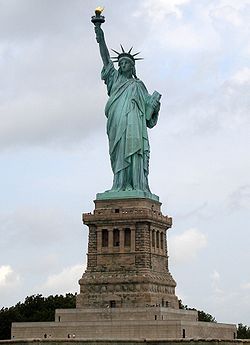
On this day in 1885, the Statue of Liberty, a gift of friendship from the people of France to the people of the United States, arrives in New York City’s harbor.

The Statue of Liberty (Liberty Enlightening the World, French: La Liberté éclairant le monde) is a colossal neoclassical sculpture on Liberty Island in New York Harbor, designed by Frédéric Bartholdi and dedicated on October 28, 1886. The statue, a gift to the United States from the people of France, is of a robed female figure representing Libertas, the Roman goddess of freedom, who bears a torch and a tabula ansata (a tablet evoking the law) upon which is inscribed the date of the American Declaration of Independence. A broken chain lies at her feet. The statue has become an icon of freedom and of the United States.

Bartholdi was inspired by French law professor and politician Édouard René de Laboulaye, who commented in 1865 that any monument raised to American independence would properly be a joint project of the French and American peoples. Due to the troubled political situation in France, work on the statue did not commence until the early 1870s. In 1875, Laboulaye proposed that the French finance the statue and the Americans provide the pedestal and the site. Bartholdi completed both the head and the torch-bearing arm before the statue was fully designed, and these pieces were exhibited for publicity at international expositions. The arm was displayed in New York’s Madison Square Park from 1876 to 1882. Fundraising proved difficult, especially for the Americans, and by 1885 work on the pedestal was threatened due to lack of funds. Publisher Joseph Pulitzer of the World initiated a drive for donations to complete the project, and the campaign inspired over 120,000 contributors, most of whom gave less than a dollar. The statue was constructed in France, shipped overseas in crates, and assembled on the completed pedestal on what was then called Bedloe’s Island. The statue’s completion was marked by New York’s first ticker-tape parade and a dedication ceremony presided over by President Grover Cleveland.

The statue was administered by the United States Lighthouse Board until 1901 and then by the Department of War; since 1933 it has been maintained by the National Park Service. The statue was closed for renovation for much of 1938. In the early 1980s, it was found to have deteriorated to such an extent that a major restoration was required. While the statue was closed from 1984 to 1986, the torch and a large part of the internal structure were replaced. After the September 11 attacks in 2001, it was closed for reasons of safety and security; the pedestal reopened in 2004 and the statue in 2009, with limits on the number of visitors allowed to ascend to the crown. The statue is scheduled to close for up to a year beginning in late 2011 so that a secondary staircase can be installed. Public access to the balcony surrounding the torch has been barred for safety reasons since 1916.

 1462 – Vlad III the Impaler attempts to assassinate Mehmed II (The Night Attack) forcing him to retreat from Wallachia.

1497 – Battle of Deptford Bridge – forces under King Henry VII defeat troops led by Michael An Gof.

1565 – Matsunaga Hisahide assassinates the 13th Ashikaga shogun, Ashikaga Yoshiteru.

1579 – Sir Francis Drake claims a land he calls Nova Albion (modern California) for England.

1631 – Mumtaz Mahal dies during childbirth. Her husband, Mughal emperor Shah Jahan I, will spend more than 20 years building her mausoleum, the Taj Mahal.

1673 – French explorers Jacques Marquette and Louis Jolliet reach the Mississippi River and become the first Europeans to make a detailed account of its course.

1775 – American Revolutionary War: Battle of Bunker Hill

1789 – In France, the Third Estate declares itself the National Assembly.

1839 – In the Kingdom of Hawaii, Kamehameha III issues the Edict of toleration which gives Roman Catholics the freedom to worship in the Hawaiian Islands. The Hawaii Catholic Church and the Cathedral of Our Lady of Peace are established as a result.

1863 – Battle of Aldie in the Gettysburg Campaign of the American Civil War.

1876 – Indian Wars: Battle of the Rosebud – 1,500 Sioux and Cheyenne led by Crazy Horse beat back General George Crook’s forces at Rosebud Creek in Montana Territory.

1877 – Indian Wars: Battle of White Bird Canyon – the Nez Perce defeat the U.S. Cavalry at White Bird Canyon in the Idaho Territory.

1885 – The Statue of Liberty arrives in New York Harbor.

1898 – The United States Navy Hospital Corps is established.

1901 – The College Board introduces its first standardized test, the forerunner to the SAT.

1930 – U.S. President Herbert Hoover signs the Smoot-Hawley Tariff Act into law.

1932 – Bonus Army: around a thousand World War I veterans amass at the United States Capitol as the U.S. Senate considers a bill that would give them certain benefits.

1933 – Union Station Massacre: in Kansas City, Missouri, four FBI agents and captured fugitive Frank Nash are gunned down by gangsters attempting to free Nash.

1939 – Last public guillotining in France: Eugen Weidmann, a convicted murderer, is guillotined in Versailles outside the Saint-Pierre prison.

1940 – World War II: Operation Ariel begins – Allied troops start to evacuate France, following Germany’s takeover of Paris and most of the nation.

1940 – World War II: sinking of the RMS Lancastria by the Luftwaffe near Saint-Nazaire, France.

1940 – World War II: the British Army’s 11th Hussars assault and take Fort Capuzzo in Libya, Africa from Italian forces.

1940 – The three Baltic states of Estonia, Latvia and Lithuania fall under the occupation of the Soviet Union.

1944 – Iceland declares independence from Denmark and becomes a republic.

1948 – A Douglas DC-6 carrying United Airlines Flight 624 crashes near Mount Carmel, Pennsylvania, killing all 43 people on board.

1953 – East Germany Workers Uprising: in East Germany, the Soviet Union orders a division of troops into East Berlin to quell a rebellion.

1958 – The Ironworkers Memorial Second Narrows Crossing, in the process of being built to connect Vancouver and North Vancouver (Canada), collapses into the Burrard Inlet killing many of the ironworkers and injuring others.

1958 – The Wooden Roller Coaster at Playland, which is in the Pacific National Exhibition, Vancouver, Canada opens. It is still open today.

1960 – The Nez Perce tribe is awarded $4 million for 7 million acres (28,000 km2) of land undervalued (4 cents/acre) in the 1863 treaty.

1961 – The New Democratic Party of Canada is founded with the merger of the Cooperative Commonwealth Federation (CCF) and the Canadian Labour Congress.

1963 – The United States Supreme Court rules 8 to 1 in Abington School District v. Schempp against allowing the reciting of Bible verses and the Lord’s Prayer in public schools.

1963 – A day after South Vietnamese President Ngo Dinh Diem announced the Joint Communique to end the Buddhist crisis, a riot involving around 2,000 people breaks out, killing one.

1971 – President Richard Nixon declares the U.S. War on Drugs.

1972 – Watergate scandal: five White House operatives are arrested for burglarizing the offices of the Democratic National Committee, in an attempt by some members of the Republican party to illegally wiretap the opposition.

1987 – With the death of the last individual, the Dusky Seaside Sparrow becomes extinct.

1991 – Apartheid: the South African Parliament repeals the Population Registration Act which required racial classification of all South Africans at birth.

1992 – A ‘joint understanding’ agreement on arms reduction is signed by U.S. President George H. W. Bush and Russian President Boris Yeltsin (this would be later codified in START II).

1994 – Following a televised low-speed highway chase , O.J. Simpson is arrested for the murders of his wife, Nicole Brown Simpson, and her friend Ronald Goldman.

Holidays and observances

   * Bunker Hill Day (Suffolk County, Massachusetts)

   * Christian Feast Day:

       * Albert Chmielowski

       * Botolph (England)

       * Gondulphus of Berry

       * Hervé

       * Hypatius of Bithynia (Eastern Orthodox and Byzantine Catholic Churches)

       * Rainerius

       * June 17 (Eastern Orthodox liturgics)

   * Day of German Unity, celebrated before October 1990. (West Germany)

   * Father’s Day (El Salvador and Guatemala)

   * National Day, celebrates the independence of Iceland from Kingdom of Denmark in 1944.

   * Soviet Occupation Day (Latvia)

   * World Day to Combat Desertification and Drought (International)

   * Zemla Intifada Day (Sahrawi Arab Democratic Republic)

Six In The Morning

Egyptian revolution’s unsung heroes languish in hospitals

An estimated 11,000 people were injured in protests that toppled Hosni Mubarak. But months later, as many still undergo costly treatment, officials have done little to compensate their families or prosecute their attackers.

By Molly Hennessy-Fiske, Los Angeles Times

June 17, 2011

Reporting from Cairo– When Rahma Mohamed steps out of her son’s line of sight, he begins to tremble. She rushes to cradle the 23-year-old’s thin frame, kissing his stubbly cheek.

“Relax,” she murmurs. “I’m here next to you; you’re all right. Don’t cry.”

Since Jan. 28, when security forces beat him and ran him over during the protests that toppled President Hosni Mubarak, Mahmoud Mohamed has been unable to speak, walk, eat or use the bathroom on his own. His head is a tapestry of scars and bandages, tubes sprout from his neck, and his palsied hands are clasped in front of a now-bony chest.

He was trying to protect two friends. His mother says both were shot to death by security forces.


Friday’s Headlines:

Tunisia woos tourists with controversial advertising campaign

Athens on ‘political suicide mission’ to pass cuts after €12bn loan deal

Syria crisis: Troops move into towns in north

Nato pounds Tripoli as rebels reject election offer

Vietnam-China Spratly Islands dispute threatens to escalate

Tunisia woos tourists with controversial advertising campaign

Commercial messages mock country’s post-revolution reputation in attempt to win back important source of income

  Angelique Chrisafis

The Guardian, Friday 17 June 2011


With tourism in crisis since the revolution, Tunisia is trying to woo back British and other European holidaymakers with a controversial advertising campaign mocking its post-revolution reputation.

Fresh to London buses after gracing the Paris metro, the ads include a woman being massaged and the line “They say that in Tunisia some people receive heavy-handed treatment”. Another shows an archaeological site captioned: “They say Tunisia is nothing but ruins”.

Ad executives said they were playing on misplaced fears. Tunisia’s tourism minister has argued that despite Tunisia’s state of emergency, tourists are not in danger and the country is a safer than South Africa.

Athens on ‘political suicide mission’ to pass cuts after €12bn loan deal


By John Lichfield and Nathalie Savaricas in Athens Friday, 17 June 2011

Fears that the Greek debt crisis could generate another banking meltdown and global economic crash persisted yesterday despite a short-term fix by the EU and IMF.

The European Union agreed terms with the International Monetary Fund to release a €12bn (£10.5bn) tranche of loans to prevent Greece becoming the first developed economy to default since the 1950s. But the loans are conditional on an increasingly fragile Greek government pushing through new spending cuts and tax rises against street and parliamentary opposition in the next two weeks.

Syria crisis: Troops move into towns in north

Syrian troops travelling on tanks, armoured personnel carriers and buses have moved into two northern towns.

The BBC  

Security forces were gathering in Khan Sheikhun and Maarat al-Numan, a town of 90,000 between Damascus and Aleppo.

UN Secretary General Ban Ki-moon has urged Syria to halt the bloodshed and “stop killing people”.

The UN says that at least 1,100 people have died as the government has violently sought to quash protests over the past three months.

Nato pounds Tripoli as rebels reject election offer


NICK CAREY TRIPOLI, LIBYA – Jun 17 2011

Gaddafi’s son, Saif al-Islam, told an Italian newspaper that the elections could be held within three months and transparency could be guaranteed through international observers.

He said his father would be ready to cede power if he lost the election, though he would not go into exile.

But Prime Minister al-Baghdadi Ali al-Mahmoudi appeared to throw the potential concession into question, saying on Thursday that the leader of the revolution was not concerned by “any referendum”.

Vietnam-China Spratly Islands dispute threatens to escalate

Tensions between China and Vietnam have risen in recent weeks, with Vietnam expressing alarm at what it says are increasingly aggressive actions by China in disputed waters.

By Helen Clark, Contributor  

Hanoi, Vietnam

Tensions between Vietnam and China over disputed claims to the resource-rich Spratly Islands in the South China Sea are threatening peace in the region.

China sent its largest patrol ship Thursday on what it claimed was a routine trip through the area, but the deployment comes after a spate of other moves, including Vietnam’s staging of a live-fire exercise in the area and China’s denouncement of it.

Neither country is likely to back down easily, and if they did, neither population would see it in a favorable light. Because of this, some worry tensions could escalate to the point of exchange of fire.

DocuDharma Digest

Regular Features-

Featured Essays for June 16, 2011-

DocuDharma

Punting the Pundits

“Punting the Pundits” is an Open Thread. It is a selection of editorials and opinions from around the news medium and the internet blogs. The intent is to provide a forum for your reactions and opinions, not just to the opinions presented, but to what ever you find important.

Thanks to ek hornbeck, click on the link and you can access all the past “Punting the Pundits”.

Sen. Bernie Sanders: Stop Oil Speculation Now

The increased cost of oil and gasoline is damaging the American economy and is causing severe economic pain to millions of people, especially in rural America, who often have to drive long distances to work. Many workers are already seeing stagnant or declining wages and high gas prices are just taking another bite out of their paychecks.

People in Vermont and across the country are also worried about the high price of heating oil for the coming winter.

The price of oil today, while declining somewhat in recent weeks, was still over $95 a barrel today. That’s about $30 higher than it was two years ago.

The theory behind the setting of oil prices is that price is determined by the fundamentals of supply and demand. The fact of the matter is that there is more supply and less demand today than there was two years ago when gas prices averaged about $2.44 a gallon.

Robert Reich: Why the Republican War on Workers’ Rights Undermines the American Economy

The battle has resumed in Wisconsin. The state supreme court has allowed Governor Scott Walker to strip bargaining rights from state workers.

Meanwhile, governors and legislators in New Hampshire and Missouri are attacking private unions, seeking to make the states so-called “open shop” where workers can get all the benefits of being union members without paying union dues. Needless to say this ploy undermines the capacity of unions to do much of anything. Other Republican governors and legislatures are following suit.

New York Times Editorial: Can Justice Be Bought?

Two years ago, the Supreme Court tried to bolster public trust in the nation’s justice system by disqualifying a state judge in West Virginia from a case that involved a coal company executive who had spent more than $3 million to help get the judge elected.

At a time when torrents of special interest campaign spending is threatening the appearance and reality of judicial impartiality, the ruling in Caperton v. Massey drove home the need for states to adopt more rigorous rules for recusal. The message has largely gone unheeded.

Richard Reeves: Here We Go Again: Reform in California

Forget the midnight ride of Paul Revere, Callista Gingrich’s jewelry collection and Anthony Weiner’s … well, you know. The most important political people right now are 14 Californians you don’t know. They are the members of the Citizens Redistricting Commission of this great state.

American elections are rarely decided by debates in New Hampshire or even hundreds of millions of dollars in television advertising. By and large, American elections are determined by who comes out to vote, the fine print of election laws and squiggly lines on state maps. Except for presidential elections, which can surprise you, more than 90 percent of congressional and legislative elections are decided before ballots are even printed.

Robert Scheer: Seven Republican Dwarfs

They assumed the stance of the Seven Dwarfs, not as a matter of physical but rather intellectual stature. Not one of the candidates for the GOP presidential nomination who debated Monday night rose to a point of seriousness in addressing the nation’s grievous problems. Instead, they ever so playfully thumbed their collective noses at any possible meaningful government reaction to the mess that we are in. It was Herbert Hoover warmed over, leaving Barack Obama secure in the mantle of FDR whether he deserves that tribute or not.

Obama, who has been inconsistent and weak in reining in the Wall Street greed that got us into this deep economic morass, is now under no pressure from the opposition to improve his performance. The Republican knee-jerk reaction-government bad, big business great, and don’t dare say that the Wall Street scoundrels who created this crisis need a timeout-gets Obama off the hook from legitimate criticism he needs to hear. As The Wall Street Journal headlined the non-debate: “Candidates Run Against Regulation.”

Glen Ford: How the Corporate Right Divided Blacks from Teachers Unions and Each Other

Back in the mid-Nineties, devious right-wing activists at the Bradley Foundation, in Milwaukee, hit upon a “wedge” issue designed to wreck the alliance at the core of the Democratic Party’s urban base. Blacks and public employee unions – particularly teachers – were the foundations of Democratic power in the cities. Aware that African Americans revered education but were often in conflict with largely white teachers unions over issues of racism and community control, the Bradley gang, under president Michael Joyce, created out of whole cloth a “movement” for publicly-funded vouchers for private schools. No such Black community “demand” had ever existed, but well-aimed infusions of millions of dollars among opportunistic politicians like Cory Booker, a first term city councilman who aspired to become mayor of Newark, New Jersey, grafted Black faces onto a Hard Right corporate scheme to divide key progressive constituencies: Blacks and unions.

On This Day In History June 16

This is your morning Open Thread. Pour your favorite beverage and review the past and comment on the future.

Find the past “On This Day in History” here.

June 16 is the 167th day of the year (168th in leap years) in the Gregorian calendar. There are 198 days remaining until the end of the year.

On this day in 1933, The National Industrial Recovery Act is passed.

The National Industrial Recovery Act (NIRA), officially known as the Act of June 16, 1933 (Ch. 90, 48 Stat. 195, formerly codified at 15 U.S.C. sec. 703), was an American statute which authorized the President of the United States to regulate industry and permit cartels and monopolies in an attempt to stimulate economic recovery, and established a national public works program. The legislation was enacted in June 1933 during the Great Depression as part of President Franklin D. Roosevelt’s New Deal legislative program. Section 7(a) of the bill, which protected collective bargaining rights for unions, proved contentious (especially in the Senate), but both chambers eventually passed the legislation and President Roosevelt signed the bill into law on June 16, 1933. The Act had two main sections (or “titles”). Title I was devoted to industrial recovery, and authorized the promulgation of industrial codes of fair competition, guaranteed trade union rights, permitted the regulation of working standards, and regulated the price of certain refined petroleum products and their transportation. Title II established the Public Works Administration, outlined the projects and funding opportunities it could engage in, and funded the Act.

The Act was implemented by the National Recovery Administration (NRA) and the Public Works Administration (PWA). Very large numbers of regulations were generated under the authority granted to the NRA by the Act, which led to a significant loss of political support for Roosevelt and the New Deal. The NIRA was set to expire in June 1935, but in a major constitutional ruling the U.S. Supreme Court held Title I of the Act unconstitutional on May 27, 1935, in Schechter Poultry Corp. v. United States, 295 U.S. 495 (1935). The National Industrial Recovery Act is widely considered a policy failure, both in the 1930s and by historians today. Disputes over the reasons for this failure continue, however. Among the suggested causes are that the Act promoted economically harmful monopolies, that the Act lacked critical support from the business community, and that the Act was poorly administered. The Act encouraged union organizing, which led to significant labor unrest. The Act had no mechanisms for handling these problems, which led Congress to pass the National Labor Relations Act in 1935.

 1487 – Battle of Stoke Field, the final engagement of the Wars of the Roses.

1586 – Mary, Queen of Scots, recognizes Philip II of Spain as her heir and successor.

1745 – British troops take Cape Breton Island, which is now part of Nova Scotia, Canada.

1745 – Sir William Pepperell captures the French Fortress Louisbourg in Louisbourg, Nova Scotia during the War of the Austrian Succession.

1746 – War of Austrian Succession: Austria and Sardinia defeat a Franco-Spanish army at the Battle of Piacenza.

1755 – French and Indian War: the French surrender Fort Beauséjour to the British, leading to the expulsion of the Acadians.

1774 – Foundation of Harrodsburg, Kentucky.

1779 – Spain declares war on the Kingdom of Great Britain, and the siege of Gibraltar begins.

1795 – First Battle of Groix otherwise known as Cornwallis’ Retreat.

1815 – Battle of Ligny and Battle of Quatre Bras, two days before the Battle of Waterloo.

1836 – The formation of the London Working Men’s Association gives rise to the Chartist Movement.

1846 – The Papal conclave of 1846 concludes. Pope Pius IX is elected Pope beginning the longest reign in the history of the papacy (not counting St. Peter).

1858 – Abraham Lincoln delivers his House Divided speech in Springfield, Illinois.

1858 – Battle of Morar takes place during the Indian Mutiny.

1871 – The University Tests Act allows students to enter the Universities of Oxford, Cambridge and Durham without religious tests, except for courses in theology.

1883 – The Victoria Hall theatre panic in Sunderland, England kills 183 children.

1891 – John Abbott becomes Canada’s third Prime Minister.

1897 – A treaty annexing the Republic of Hawaii to the United States is signed; the Republic would not be dissolved until a year later.

1903 – The Ford Motor Company is incorporated.

1903 – Roald Amundsen commences the first east-west navigation of the Northwest Passage by leaving Oslo, Norway.

1904 – Eugen Schauman assassinates Nikolai Bobrikov, Governor-General of Finland.

1904 – Irish author James Joyce begins a relationship with Nora Barnacle and subsequently uses the date to set the actions for his novel Ulysses; this date is now traditionally called “Bloomsday”.

1911 – A 772 gram stony meteorite strikes the earth near Kilbourn, Columbia County, Wisconsin damaging a barn.

1915 – Foundation of the British Women’s Institute.

1922 – General election in the Irish Free State: a large majority goes to the pro-Treaty Sinn Féin.

1924 – The Whampoa Military Academy is founded.

1925 – The most famous Young Pioneer camp of the USSR, Artek, is established.

1930 – Sovnarkom establishes decree time in the USSR.

1933 – The National Industrial Recovery Act is passed.

1940 – World War II: Marshal Henri Philippe Pétain becomes Premier of Vichy France.

1940 – A Communist government is installed in Lithuania.

1958 – Imre Nagy, Pal Maléter and other leaders of the 1956 Hungarian Uprising are executed.

1963 – Soviet Space Program: Vostok 6 Mission – Cosmonaut Valentina Tereshkova becomes the first woman in space.

1967 – Monterey Pop Festival begins

1972 – Red Army Faction member Ulrike Meinhof is captured by police in Langenhagen.

1972 – The largest single-site hydro-electric power project in Canada is inaugurated at Churchill Falls, Labrador.

1976 – Soweto uprising: a non-violent march by 15,000 students in Soweto, South Africa turns into days of rioting when police open fire on the crowd.

1977 – Oracle Corporation is incorporated in Redwood Shores, California, as Software Development Laboratories (SDL) by Larry Ellison, Bob Miner and Ed Oates.

1989 – Imre Nagy, the former Hungarian Prime Minister, is reburied in Budapest.

1997 – The Dairat Labguer massacre in Algeria; 50 people are killed.

2000 – Israel complies with UN Security Council Resolution 425 after 22 years of it issuance, which calls on Israel to completely withdraw from Lebanon. Israel withdraws from all of Lebanon, except the disputed Sheba Farms.

Holidays and observances

   * Bloomsday (Dublin, James Joyce fans)

   * Christian Feast Day:

       * Benno

       * Lutgardis

       * Quiricus and Julietta

       * June 16 (Eastern Orthodox liturgics)

   * International Day of the African Child (Organisation of African Unity)

   * Martyrdom of Guru Arjan Dev (Sikhism)

   * Sussex Day (Sussex)

   * Youth Day (South Africa)

Six In The Morning

Al-Zawahri succeeds Osama bin Laden as new al-Qaida leader

Al-Qaida statement gives no details about the selection process

msnbc.com news services  

Al-Qaida has selected its longtime No. 2 to succeed Osama bin Laden following last month’s U.S. commando raid that killed the terror leader, according to a statement posted Thursday on a website affiliated with the network.

Ayman al-Zawahri, who will turn 60 next week, is the son of an upper middle class Egyptian family of doctors and scholars.

Al-Qaida “announces that Sheikh Dr. Ayman al-Zawahri, may God guide him, assumed responsibility as the group’s amir [leader],” the BBC reported.


Thursday’s Headlines:

Iran launches second satellite into orbit, claims state TV

Pakistanis accused of CIA collusion over Bin Laden raid

Greek PM George Papandreou to unveil new cabinet

‘Urban Mining’ Could Reduce Reliance on Metal Imports

Côte d’Ivoire launches probe into conflict crimes

Iran launches second satellite into orbit, claims state TV

Tehran says Rasad launch is to help produce high-res maps but move prompts concern over nuclear ambitions

Associated Press

guardian.co.uk, Thursday 16 June 2011    

Iran has launched a satellite into orbit, state television reported, a move likely to raise concerns among those who fear Iran’s intentions and nuclear development programme.

The report said the locally produced satellite, called Rasad, or observation, was launched successfully by a Safir missile on Wednesday. There was no independent confirmation of the launch or of the satellite achieving orbit.

If successful, it would be the second satellite Iran has put into orbit. The first, named Omid, was launched in 2009.

Pakistanis accused of CIA collusion over Bin Laden raid

Spy agency arrests at least five in attempt to ‘shut down unauthorised US operations’

By Omar Waraich in Islamabad and David Usborne in New York Thursday, 16 June 2011

Pakistan’s most powerful intelligence agency is interrogating at least five Pakistanis on suspicions of collusion with the CIA in the months leading up to the US raid that killed Osama bin Laden in a garrison town just two hours from the capital.

The New York Times reported that the arrested men include a serving Pakistani army major – a claim that the Pakistani military fiercely denied yesterday. It is unclear how many are being held. A Pakistani army officer said that 30 to 40 civilians had been questioned in recent days, with some released on Tuesday.

Greek PM George Papandreou to unveil new cabinet

Greek Prime Minister George Papandreou is set to announce a new cabinet in a concessionary move as he seeks support for new austerity measures.

The BBC  

Mr Papandreou, who will stay in his post, says he will put the new government to a vote of confidence in the parliament.

Renewed fears that Greece will default on its debt have shaken markets.

The proposed measures are necessary to gain EU and IMF aid, but have been met with fierce opposition in Greece.

Athens witnessed some of the most violent protests in more than a year on Wednesday as demonstrators went on to the streets and took part in a general strike.

‘Urban Mining’ Could Reduce Reliance on Metal Imports

Treasure from the Trash  

By Alexander Jung  

Thierry Van Kerckhoven has an eye for hidden value. The Belgian can look at a pile of shredded scrap metal from electronic devices and recognize what it is made of. Not only that, he can tell how much it’s worth.

Kerckhoven works as a buyer of such waste in the world’s largest recycling facility for complex precious metals in Hoboken, a section of the Belgian city of Antwerp. The Umicore Group owns the facility, where deliveries are stored in individual concrete bays. Kerckhoven removes his sunglasses and surveys his treasures.

The powdery and shiny material in Box 2051 on the far left, Kerckhoven explains, used to be printed circuit boards and monitors.

Côte d’Ivoire launches probe into conflict crimes


ABIDJAN, CôTE D’IVOIRE – Jun 16 2011

The government led by President Alassane Ouattara made the decision at a Cabinet meeting, said a statement from spokesperson Bruno Nabagne Kone on Wednesday.

The “national commission of inquiry is to shed light on all the human rights violations committed during the post-electoral crisis,” said the statement.

The president had called for the inquiry to be carried out as quickly as possible so that those responsible could be identified and punished, he added.

DocuDharma Digest

Featured Essays for June 16, 2011-

DocuDharma

Rolling in the Mud

Sometimes it’s deeper than others.  I recall a year when I foolishly volunteered to help park cars.  Now when I say it was raining hard I’m not talking 40 days and 40 nights, but it was more than merely damp.

And the drainage was poor.

Now my practice when it rains, which it does more frequently than you ordinarily notice but are forced to confront when working out doors, is to ignore it.  Yeah you’re wet, but you’re going to get wet anyway (though Gortex is a wonderful thing) and unlike Margaret Hamilton you’re not going to melt (My beautiful wickedness!  What a world, what a world).

Well, this was hipboots and waders and the job was to squish through to the cars and get them from the unpaved lot to the driveway in front of the nice dry tent where the owners were waiting.

Now sometimes being good is not exactly a blessing and my winter driving skills honed in the lake effects of upstate New York meant that I was less likely than some others I could name, but won’t, to grind the cars into an almost untowable morass.  This resuling in my spending a lot more time than the untrainable or unlucky getting dirty and moist.

It was almost the last car of the day that I got my first tip which I wasn’t really expecting but gratefully pocketed and I said to the driver as he climbed in the car “I’m not sure you’ll think it’s as good as all that once you sit where I was sitting, but thank you just the same.”

My Little Town 20110615: Granddad Part the First

(9 PM – promoted by TheMomCat)

Those of you who read this regular series know that I am from Hackett, Arkansas, just a mile or so from the Oklahoma border, and just about 10 miles south of the Arkansas River.  It was a redneck sort of place, and just zoom onto my previous posts to understand a bit about it.

I rarely write about living people except with their express permission, but may make an exception or two here because it might be important to talk about some of her decedents who still breathe.  None of those references will be derogatory.

I actually know less about Granddad than I do about Ma, because he died in 1969 at the age of 91.  I was only 12 years old then.  Ma lived until she saw me as an adult and married and their mother having her great, great grandchildren.  Here is what I know about his history.

Granddad, on my paternal side (the one on my maternal side died years before I was born) was born in Birkenhead, England around 1877, give or take a year or two.  My paternal grandmother was apparently born around the same time.  I have conflicting information about when they immigrated to the United States, but best as I can tell it was after they were married, likely around 1896, once again give or take a year or two.  If any of you are connected with a genealogy site, perhaps you can help me to piece more details about them together.

His name was Richard Smith, and my grandmother’s name was Elizabeth (Elisabeth?).  They settled, as far as I can tell, near Hackett, Arkansas before 1900.  As far as I can tell, they were legal immigrants, but there is little information available.  What I do know for sure is that my Uncle Richard was born in 1900, likely at home, near Hackett.  I remember him quite well.

Next was Aunt Hazel, born in 1915, whom I also remember well.  She was nothing but nice to me.

Dad came next born 19190404.  His name was Roy Willard Smith.  Aunt Hazel wanted to name him Strath Conner, for reasons obscure to me.

The next one was an uncle for whom I can not remember his name.  He suffered from Type I diabetes, and died early.  Even with our modern medicine and science, it is still a horribly difficult condition.

Finally, there was Uncle Troy, the baby.  He served in World War II, and died fairly young from a blood disorder.  I suspect that it was multiple myeloma, but that is just an educated guess decades after he died and long before I ever met him, since I was just one of many ova in my mother’s ovaries at the time, around 1955.

Anyway, this is just some background about my paternal side of the family.  The rest of this post is involved with recollections that I personally had with Granddad.  Once again, if anyone has leads, please tell me.

When my nuclear family left Hackett (in 1961 or 1960, because the company for which my father worked wanted him in Little Rock, AR, not Fort Smith, AR), I was just little.  Born in the early months of 1957, I was only two or three years old, but I remembered the house perfectly then, and do now.  My parents bought a very small house in North Little Rock, AR, and I even remember the street address: 2012 Poplar Street.  How can I remember this from when I was just a toddler?  But I DO!  I also remember that we were “catty cornered” from the Fischer Honey plant just down the street.

My parent bought the house from one of the Fischer scions, and were were happy enough there.  But all of their conversations were about moving back to Hackett.  Granddad got quite ill during that time and came to live with us for a while.  He and my mum were not what you would call the best of buddies, so that did not work out very well.  He later went to live with Aunt Hazel (who moved to California shortly thereafter, presumably to get away from him), but by then he had recovered and was able to move back to the farm.  He would have been around 85 at the time.  I barely remember him staying with us in North Little Rock, but by the time that we moved back to Hackett in 1964 my memories of him are clear.

He had rented out his rock house (that he had built himself) to the Boggs family who sort of look after him while he lived in a school but that he had converted into a “home”.  I remember it very well, and will describe it in another installment about him.  He lived almost at the Oklahoma border, about a mile and a half from town.  Before he had fallen ill, he would walk to town and back once or twice a day, but after his illness he just did not have the stamina to do that any more, especially in the brutal summers in west central Arkansas.  He knew that at his age he could not get a driver’s license (although he could drive), so he bought a tractor.  In Arkansas the law reads that “implements of agriculture or husbandry” neither have to have a license plate nor does the driver have to have a driver’s license, mostly because fairly young kids have to help on the farms there.

So, around 1963 he bought a green Oliver tractor (which my Uncle David still has and uses) and used it for his car.  He was mobile again!  I remember him on that tractor coming and going all of the time.  He used it until he got really ill again around 1967, when he again came to live with us (Aunt Hazel was still in California, and Uncle Richard was in Illinois).  It worked out for time very well.

The reason that he lived in the bus has to do with the reason that he finally went to the nursing home in late 1967.  Granddad smoked (he actually taught me to smoke hand rolled Prince Albert cigarettes back around 1965, and I am smoking one as I write this), and did not do a very good job in rolling.  Besides, at the time when you bought Prince Albert in the pocket sized tins, a pack of ungummed rolling papers came with the tin.  He had a bad habit of rolling them loose, and that, along with no gum on the paper and his habit of dozing off on the couch whilst one was still alit, caused him to burn down three houses!  All three times he essentially escaped with only the clothes on his back.  He finally decided on the bus, since it was essentially all metal, making it difficult do burn.  Another time I shall go into great detail about his place on the farm, including the last wooden house and the bus.

The forth time he pulled the cigarette and stuffed chair trick was when he was staying with us in 1967.  My parents had hired a very nice local lady, Viola Moses, to look after him (and me, when I was not at Ma’s) during the day while my mum was at work in Fort Smith.  Viola came in the living room from the kitchen to discover Granddad, asleep in the smoldering stuffed rocking chair!  The cigarette had burnt a fairly large hole in the foam rubber (now days polyurethane foam, pretty much self extinguishing, is used in place of foam rubber) seat, and the cotton stuffing in the chair itself had started to smolder.  I was playing outside at the time, so did not see the almost fire.  Viola doused the burning area with a pitcher of water and shouted for me to come and help her drag it to the front porch, which was concrete.  The hole was pretty big.

In under a week, Granddad was a resident at the Pink Bud Home for the Golden Years in Greenwood, about nine miles east.  He did not really want to go, but both of my parents agreed that the risk of burning down the house was just too great to keep him there.  At that time, you could smoke in nursing homes and in hospitals.  He lived there until about a week before he died in 1969 of a massive stroke, when they took him to hospital.  He never regained consciousness after the stroke, and had been pretty vigorous, so he went out the right way.  He even liked the nursing home after a couple of months, because he had people with whom to talk and swap stories.  The Boggs had children, and children, except for me for some reason, annoyed him.

I have lots more stories about Granddad, most of which are very funny (some almost unbelievable), and a few very sad, like the one when he killed his wife, my Grandmother whom I never knew since it was before I was born.  As for the chair in question, I still have it.  I did not realize that this was the chair in question until I decided to recover it, since the old upholstery was getting ratty.  After I stripped off the old cover, I noticed that the seat was polyurethane, and did not really think anything of that, but when I got down to the stuffing I saw some water marks.  Everyone who reads my regular Sunday evening series, Pique the Geek, knows that I am the curious sort, so I looked further.

When I moved the stuffing aside, sure enough, there was the partially charred wooden support member!  This was the very chair that got him put in the home!  I recovered the chair, and I still have it.  From where I sit to write, if I just look to my left I can see it.  It is a nice rocking chair, overstuffed and padded everywhere.  Incidentally, my parents bought that chair new when I was a baby, and my mum and Ma used to rock me to sleep in it.  Until the upholstery job I had not made the connexion.

That is all for this evening.  Next week we shall discuss some other denizens of Hackett, but I have not decided who it will be just yet.  For topics like this, I tend to write at the last minute since I do not have to do any research, but rather just remember.  I would be interested any any recollections that you have about your early childhood in the comments.

Warmest regards,

Doc

Vox Frustrati (Vol. 4 ): Demand

2 pm.


Welcome to the Vox Frustrati diary series.  Vox is a persona and this project is a collaboration by a group of people.

Vox Frustrati is here to give voice to our progressive concerns.  He welcomes correspondence from you at VoxFrustrati at gmail dot com.

If you have something to say, a rant, a comment or a question, Vox might decide to lend you his voice, either anonymously or with your byline. It is your choice.  Vox does reserve editorial rights.

Transcript:


This is Vox Frustrati, a voice for progressives everywhere.

Today we feature an article entitled “Demand” from a correspondent who wishes to remain anonymous.


FROM ANONYMOUS CORRESPONDENT:

“Demand”

Welcome, this is Vox frustrati version 9.1 percent. Unemployment hits the working class hard, officially. Unofficially it’s much worse counting U3 and U6 adding up to the aforementioned foreclosure crisis. It remains UN-HAMP-ERED.

It will be worse than before.

Problems remain for the working poor.

They can afford no more, rent.

They spent their lives under water.

They are merely fodder for the owner class;

laughing in their board rooms where, bar none, no one really gives a rat’s ass.

Here we are; a sad state of affairs. The politicians don’t really care. We thought we elected someone who truly did. He wouldn’t dare take a principled stand on anything. Or maybe he has, under cover, another backroom deal like monopolistic insurance reform.

Consider yourself forewarned as costs continue to rise.

I DESPISE the Oligarchy steering this sinking ship behind closed doors.

There’s a war on the poor and it’s not on poverty itself.

1984 pulled straight from the shelf.

In stealth I warn this Oligarchy is bad for your health.

Righteous anger is the elixir!

America is broken. How do we fix her?

Demand!

Demand those in power care about demand!

Not Supply! Demand!

We say Say’s Law is a demonstrable lie!

Why?

Supply does not create its own demand! It never has and it never will. And yet still there’s almost 2 trillion dollars hoarded away by the business community with perpetual impunity.

Without demand in our economy it will stay and we will never have our economic say! Only demand will push that capital our way creating jobs in this jobs crisis today.

Consumption, consumption what’s your function?

Sustainable aggregate demand; demand that does not escape to the foreign market where no labor or environmental standards reside!

We only confide in domestic sustainable aggregate demand so capital doesn’t outgo ergo it flows right here!

These are our demands! We demand an end to the endless wars!

We demand our civil liberties back from the Patriot Act and more!

We demand accountability for the war criminals of the Bush administration.

We demand a look back for the good of this nation!

We demand that the Democratic Party return to the real Democratic Party Platform!

If these demands are not met, be forewarned!

That concludes our correspondent’s remarks.

Vox notes Frederick Douglass’s famous remark that:


“Power concedes nothing without a demand. It never did and it never will.”

And, David Dayen points out that businesses are investing in capital equipment for the future, but aren’t hiring for the simple reason that they don’t have enough customers and the idea that “making business costs cheaper in the hope that businesses will then hire rather than pocket the money” simply won’t fly because, as our correspondent points out, it is a problem of demand not supply.

Demonstrate and demand!

Demand or the demagogues will dissimulate and deny, defer the development of a deal. They’ll dispassionately damn those on the dole to despair and despond, to discomfort and desolation, to doubt and distress, to destitution and disaster while dunderheaded Dems derelict in their duty desert them.  

Demand or die.

Demand , demand, demand.

© Vox Frustrati


Do you have something to say?  Send it to Vox.  We look forward to hearing from you.

Until next time,

Vox Frustrati

Ways to contact Vox Frustrati:

Kosmail: voxfrustrati

Email: voxfrustrati at gmail dot com

Twitter: voxfrustrati

Previous Diaries by Vox Frustrati can be found here.

© Vox Frustrati

Load more