
Sunday Train: Steel Interstates, Fast Freight, and Brawny Recovery

(10 am. – promoted by ek hornbeck)

Burning the Midnight Oil
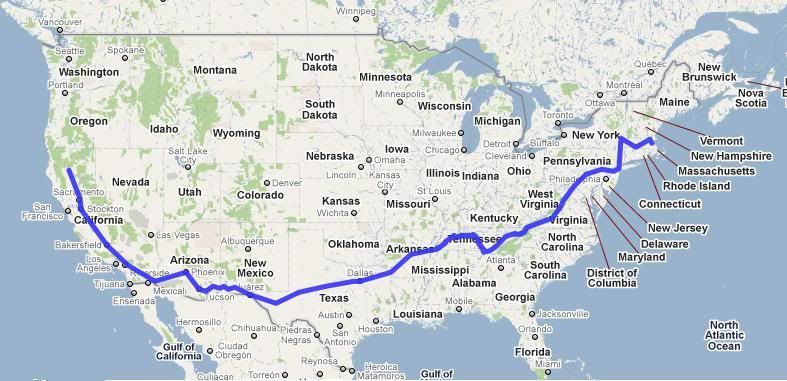
(Right: Liberty Line) The Steel Interstate proposal is an effort to build Rapid Electric Freight Rail Tollways across the country ~ east to west and north to south ~ to:

  • Take a substantial slice our of our oil imports
  • Insure our national economy and national defense against disruptions of our oil supply
  • Increase the productivity of our manufacturing and logistics sectors,
  • Overcome decades of neglect of our national electricity transmission infrastructure, and
  • Protect our legacy investment in our Interstate Highway system from the battering it receives at the hands of long haul trucks.

The point of the Steel Interstate system is that it is a system: it consists of several parts that work together to give more bang for the buck than any one could provide on its own.

Steel Interstates and Line Development Banks

There are multiple fundamental resources available to get caught up on the basic Steel Interstate concept. The Millenium Institute Report on the benefits available from a broad Steel Interstate program is written up in this Oil Drum post which is an excellent in depth introduction.

The RAIL Solution group promotes establishment of a trial corridor from Harrisburg, Pennsylvania through the Shenandoah Valley of Virginia through to Knoxville, Tennessee ~ incorporated into part of my “Liberty Line” proposal, above ~ and several pages on their site give useful introductions to various aspects of the concept.

The Steel Interstate Coalition is intended to be an umbrella organization pushing the concept, founded by RAIL Solution.
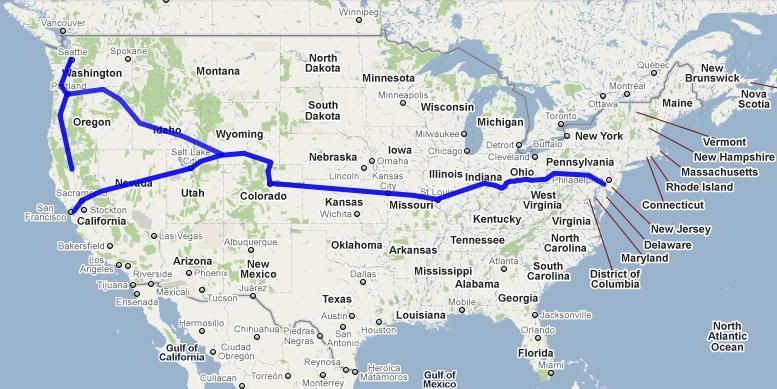
(Right: National Line) I know how much some people love national network maps. And I’ve sketched out what I think of as a plausible national network map, based primarily on existing STRACNET (Dept. of Defense designated STrategic RAil Corridor NETwork rail corridors) lines and focusing on existing long haul truck freight flows.

But I would, of course, far prefer that Steel Interstates are established without every using my map than to get agreement on my maps for a system that is never implemented.

The point is more to sort out freight corridors in a general sense that can be given to specific “Line Development Banks” to develop.

A Line Development Bank is established along the same lines as a federal/state “Regional Development Bank”, as a public not for profit corporation operating under a board nominated by Federal and appropriate State governments. The finance for a Line Development Bank will be some dedicated source of interest subsidy for bonds (or other instruments) to be issued by the Bank to fund the start of construction. Then the capital cost of the construction will be refunded by user and access fees on the corridor.
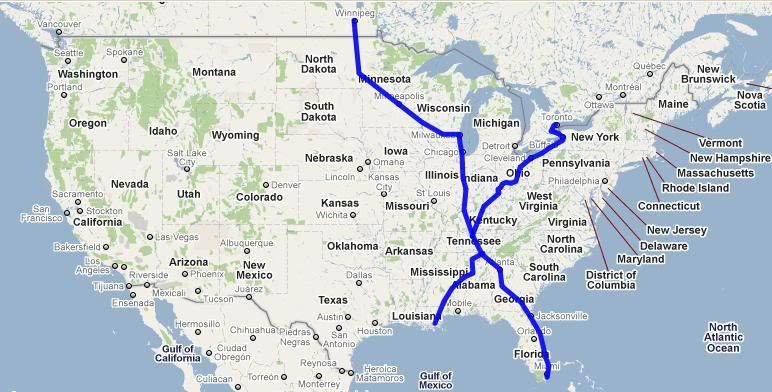
(Right: Heartland Line) This system avoids “putting all our eggs in one basket” by establishing four distinct Line Development Banks. The Federal Government, as source of the interest subsidy, would establish the common design envelope, and ensure that rail operators can move seamlessly from one Steel Interstate to another when they meet at a junction.

You Catch More Bees With Honey …

A critical element of the Steel Interstate system is that the Steel Interstates will be built primarily on privately owned right of way. Indeed, one reason why I would not insist on my maps being the “right” maps is that the intention here is to operate in cooperation with the private rail operators.

After all, if the system is to be successful in eliminating 7% or more of our oil consumption, and therefore 10% or more of our oil imports, it will be because the private freight operators have successfully won that business.  So it would be the responsibility of the Line Development Banks to enter into negotiations with the owners of the various corridors that can be used to connect the markets they are charged with connecting.

There would be four different types of infrastructure owned by the Line Development Banks. The first would be electrification infrastructure available for use by trains on the existing private track in the corridor. The second would be dedicated Express Freight Rail paths consisting of higher speed express freight tracks and overhead electrification, balanced for heavy freight rail travel at 60mph and permitting light freight rail movements at 100mph.

The third type of infrastructure is the Positive Train Control signaling system required for safe operation of the Rapid Freight Rail service.

The fourth type of infrastructure would be Ultra High Voltage Direct Current power lines, strung above the rail power supply lines, to provide Electricity Superhighways connecting important renewable power resource areas with important power consuming areas.

So, what are the benefits to the private rail operators? First, private railroads are capital intensive operations, and are exposed to the risk of economic downturns undermining the revenues required to service the financing of capital improvements. This system takes that burden off their hands. They will still own (and be responsible for) the main heavy freight networks that are the core of the bulk freight markets that they now dominate.

However, if it is useful, they can switch from diesel to electric locomotives on those lines by paying a User Fee for the overhead infrastructure. It is a public good if they do that, so we make it available to them on no-risk terms: use it when its a benefit, otherwise don’t. We would expect that its in return for having that no-risk choice available that they will grant an easement for the construction of that publicly infrastructure.

And if they wish to run on the Express Freight tracks, they will pay Track Access Fees for doing so ~ given the economics of track maintenance, probably at a different rate for trains of different maximum weight. That is, again, a no-risk choice: they can continue to run as they presently do on their present track for any train where the opportunity of running on the Express Freight tracks is not worth the track access fee, but still have the extra capacity available for use where it is of benefit.

The Passenger Rail Side-Effect

(Right: Gulf and Altantic Line) These lines are laid out to serve major long-haul truck freight markets. However, the establishment of electrified Express Freight rail corridors also allows for the establishment of Amtrak-style long-haul services that operate at 110mph max, 60mph~80mph trip speeds rather than 79mph max, 35mph~55mph trip speeds.

Further, since the services would be operating on systems designed to allow for high-reliability rapid freight rail service, they would be able to offer substantially higher reliability passenger rail service than the current Amtrak long haul services running primarily on heavy bulk freight rail corridors.

Long haul passenger services are not primarily “end to end” services at present: even though a service may run for several days, the average trip is six hours long. This upgrade in speed for the portions that can run on Steel Interstates means an increase in demand for the services. It also an increase in the availability of passenger cars to cater to that increase in demand, since the quicker transit time means that the same cars can run more routes in a given week.

And it also means a decrease in costs per passenger mile. The labor costs of staffing the long haul trains are paid by the hour, rather than by the mile, so even at the same staffing levels, faster trains mean lower costs per mile. And the cost to power the electric locomotives from overhead electrical supply is lower than the cost to power the diesel locomotives today.

The absence of a Steel Interstate for some or all of an existing Amtrak heavy rail corridor does not imply that the heavy rail corridor should be closed. But there is a strong benefit in using a Steel Interstate for then rural and emergency back-up transport services provided by the long-haul corridors wherever there is a Steel Interstate available.

A Steel Interstate is More Than The Sum of Its Parts

“If it makes so much sense, why don’t the private railroads do it today?”

Why is it that freight rail focuses so much on bulky, low-value per ton freight in the first place? We heavily cross-subsidize freight trucking in this country, by charging truck freight substantially less in diesel highway taxes than the damage that they cause to the Interstate, National, State, County and Township highways that they travel on. Those subsidies squeeze trains out of a substantial range of markets that they might compete successfully in, given a more level playing field.

Indeed, we impose property taxes on private freight rail corridors while truck freight runs primarily on tax-free publicly owned right of way.

So its natural that freight railways focus on those freight markets where their competitive advantages are so strong that they overcome the heavy subsidy granted to freight trucking. And that focuses railroads on moving freight for the lowest cost per ton mile that they can get away with. And that cost focus implies running routes for minimum operating cost, rather than to meet transit time or reliable time of delivery targets.

The principle advantage of regular and rapid electric freight rail in competing for energy wasting truck freight markets is in long haul markets. But you can’t expand into long haul markets in small, incremental steps: unlike a High Speed Rail passenger corridor, a “long haul freight” corridor of two or three hundred miles is simply too short to have a substantial market impact.

Yet carrying the financial exposure of financing a one or two thousand mile long Steel Interstate corridor presents a private railroad with a major business risk, if there should be a recession in the middle of the construction of the corridor and the railroad cannot afford the finance during the construction period.

And many of the benefits of the system ~ reducing damage to Interstate, National and State highways, increasing economic resilience in the face of an oil price shock, reducing the ongoing drain of paying for oil imports ~ are not benefits to the private railways. Because of the competitive advantages of having a Steel Interstate system available, we can be confident it will be used if made available.

But no market is able to design a complex system on its own, so if we want to gain these benefits, and this system is beyond the reach of individual private railroads, then we need to intervene to bring the system into existence.

And Brawny Recovery

Our last two GDP recoveries have been Wall Street “casino finance” based recoveries. And building a GDP recovery on the back of casino finance is trying to build our economic house on a foundation of sand.

The idea of a Brawny Recovery is to try something that we did more of back in the 1950’s and 1960’s: building our recoveries on the back of spending that lays a foundation for further income growth. That is, a GDP recovery that actually builds the economic muscles of our society.

And the Steel Interstate system is an opportunity to get back to doing that. The Millenium Institute system was a full system cost of $475b, including the Electricity Superhighway, so divided between four Line Development Banks would be about $120b worth of works each. At 3% to 5% interest rates, a $2b interest subsidy is about $40b to $60b in capital funding, which would be sufficient to get a substantial line up and going and start the process of generating Access and User fees to complete the system.

So with a dedicated $2b/yr, a Line Development Bank can be launched and can proceed with $40b to $60b in works. Four Line Development Banks, with $8b in interest subsidy, could proceed with $160b to $240b in capital works.

What makes this a Brawny Recovery Strategy is that as usable segments are completed and start to be used, the rail operators will invest in more rolling stock and expand their container terminal facilities to take advantage of their new market position. And as the Electricity Superhighways are completed, that supports investment in wind turbines for wind farms and other renewable energy resources, further increasing private investment.

The investment in the Steel Interstates is itself a public/private partnership, with the public side providing the security of interest subsidy and the private side refunding the original capital cost of the construction. But it is also part of a broader public/private partnership, in which public development of infrastructure leads to further useful private investment in real productive capacity.

Midnight Oil ~ Truganini

Evening Edition

Evening Edition is an Open Thread

From Yahoo News Top Stories

1 Syria troops press sweep for dissidents in northwest

AFP

1 hr 48 mins ago

The Syrian army made sweeping arrests in a crackdown on dissent in the northwest of the country on Sunday, as troops deployed in the hotbed central city of Hama, an activist said.

The move came as some 100 independent figures met in the capital to discuss a “third way” for Syria, which has been rocked by deadly anti-regime protests for three months.

Troops backed by 97 tanks and personnel carriers advanced late Saturday on Kfar Rumma village and made arrests in the district of Jabal al-Zawiyah, said Rami Abdel Rahman of the Syrian Observatory for Human Rights.

2 Biofuel deal sparks land debate in Sierra Leone

By Rod Mac Johnson, AFP

2 hrs 16 mins ago

Hailed as the biggest ever investment in Sierra Leone’s agriculture, a plan to grow thousands of hectares of sugarcane to produce ethanol has raised fears over food security and land rights.

Swiss group Addax & Oryx announced on June 17 that it had signed a 258 million euro ($368 million) deal with seven European and African development banks to finance the bioenergy project near Makeni in the north of the country.

The hot and rainy west African nation, recovering from a brutal civil war which ended in 2002, has the ideal climate to grow sugarcane, much like that of ethanol powerhouse Brazil which has led the way in using the crop for biofuel.

3 Ocean floor muddies China’s grip on ’21st-century gold’

By Richard Ingham, AFP

2 hrs 29 mins ago

China’s monopoly over rare-earth metals could be challenged by the discovery of massive deposits of these hi-tech minerals in mud on the Pacific floor, a study on Sunday suggests.

China accounts for 97 percent of the world’s production of 17 rare-earth elements, which are essential for electric cars, flat-screen TVs, iPods, superconducting magnets, lasers, missiles, night-vision goggles, wind turbines and many other advanced products.

These elements carry exotic names such as neodymium, promethium and yttrium but in spite of their “rare-earth” tag are in fact abundant in the planet’s crust.

4 Shuttle Atlantis prepares to rocket into history

By Kerry Sheridan, AFP

2 hrs 34 mins ago

The shuttle Atlantis is poised to launch Friday on the final flight of the 30-year American program, a journey that marks the end of an era of US dominance in human space exploration.

The liftoff is scheduled for July 8 at 11:26 am (1526 GMT) from Kennedy Space Center in Florida’s Cape Canaveral, sending Atlantis on a 12-day mission to the International Space Station.

Four American astronauts will ride the shuttle on its last tour of duty to stock the orbiting research outpost with plenty of supplies — 8,000 pounds (3,600 kilograms) worth in all — and bring back a failed ammonia pump, NASA said.

5 Thaksin allies win landmark Thai election

By Daniel Rook, AFP

2 hrs 34 mins ago

Allies of Thailand’s fugitive ex-leader Thaksin Shinawatra stormed to victory in elections Sunday, in a remarkable comeback after years of turmoil sparked by his overthrow in a military coup.

Prime Minister Abhisit Vejjajiva conceded defeat and congratulated the opposition led by Thaksin’s youngest sister, Yingluck Shinawatra, who is now set to become Thailand first female premier.

With almost all the votes counted, Puea Thai had won a clear majority with 263 seats out of 500, well ahead of Abhisit’s Democrats with 161, according to the Election Commission, which estimated turnout at 74 percent.

6 Afghan drawdown plan ‘unnecessary risk’: McCain

By Mark Wilson, AFP – Sun, Jul 3, 2011

Top US lawmakers on Sunday slammed President Barack Obama’s military drawdown plans for Afghanistan as “risky”, unsupported by his military commanders and a threat to progress made in the last year.

Withdrawal at the rate Obama has planned on — including the removal of 33,000 surge troops by the end of next summer — “is an unnecessary risk and that is why there was no military leader who recommended it”, Republican Senator John McCain said during a visit to Kabul.

Joined by fellow Republican senators Lindsey Graham and Joe Lieberman in the Afghan capital, the trio spoke to media after visiting US troops.

7 Belarus violently breaks up opposition protest

By Valery Kalinovsky, AFP

2 hrs 56 mins ago

Belarussian police fired tear gas, beat up activists and arrested dozens Sunday to thwart a major opposition protest in Minsk against the rule of authoritarian President Alexander Lukashenko.

The protesters, responding to calls on a social networking site, sought to show their dissatisfaction with Lukashenko by continuously clapping their hands but police arrested anyone who joined in the applause, young or old.

Dozens of people, including photo journalists, were led away into waiting vans from the Independence Day protest while police subdued some demonstrators by kicking or punching them, an AFP correspondent at the scene reported.

8 Contador loses more time to key rivals

By Justin Davis, AFP

Sun, Jul 3, 2011

Three-time Tour de France champion Alberto Contador’s disappointing start to the defence of his yellow jersey continued Sunday when the Spaniard lost more time to key rivals.

A day after losing 1min 14sec to Luxembourg’s Andy Schleck and 1:17 to Australian Cadel Evans when he got caught up in a crash 9km from the stage finish, Contador dropped more time on the 23 km team time trial.

Norwegian Thor Hushovd took possession of the yellow jersey from Philippe Gilbert of Belgium when his Garmin-Cervelo team dominated the race against the clock in a time of 24min 48sec.

9 Ex-rebels warn of Sudan conflict over Kordofan

By Simon Martelli, AFP

40 mins ago

The northern branch of the ex-rebel Sudan People’s Liberation Movement warned on Sunday that the South Kordofan conflict would spread along the country’s new southern border unless Khartoum agreed to a ceasefire.

“There are some voices in Khartoum that are against this framework agreement (signed on Tuesday). Those voices are playing with fire,” the SPLM north’s secretary general Yasser Arman told AFP.

“The only alternative to this agreement is a war, from Blue Nile to Darfur. We don’t want that,” he added.

10 Annecy bid chief launches veiled attack on rivals

By Pirate Irwin, AFP

Sun, Jul 3, 2011

Annecy winning the right to host the 2018 Winter Olympics would be a reward for a bid that wants to inspire the world and not just bag a trophy for a company or a country, the bid president Charles Beigbeder told AFP on Sunday.

The 46-year-old entrepreneur, who agreed to step into the role in January after predecessor Edgar Grospiron stepped down in December, was speaking just three days away from the vote by the International Olympic Committee.

Long-time favourites, South Korea’s Pyeongchang, have largely been seen to be bankrolled by Samsung and they have also played a lot on bringing the Games to Asia for only the third time.

11 Anti-China demo in Vietnam despite clampdown

By Ian Timberlake, AFP

Sun, Jul 3, 2011

About 100 anti-China protesters marched peacefully in Vietnam Sunday despite a heavy security clampdown and a vow by both countries to rein in public opinion over tensions in the South China Sea.

Protests — which are not common in authoritarian Vietnam — have taken place in the capital Hanoi for five weekends in a row over the maritime dispute.

Plainclothes and uniformed security agents poured into the area around the Chinese embassy and sealed off surrounding roads, but about 40 protesters penetrated the cordon to gather some distance from the embassy. They marched towards central Hanoi, trailed by riot police and other security personnel.

12 Europe struggles with Act II of Greek debt tragedy

By Laurent Thomet, AFP

Sun, Jul 3, 2011

Europe bought time this weekend to avoid a Greek bankruptcy, but tough negotiations lie ahead to save Athens and prevent the eurozone debt crisis from descending into global drama.

Greece will be able to pay its bills this month after eurozone finance ministers cleared the way late Saturday for the next 12-billion-euro tranche of a 110-billion-euro ($160 billion) bailout granted last year by the EU and IMF.

But the ministers still need to work on a second rescue package potentially of similar size to ensure Athens can stay afloat until at least 2014, warding off a devastating default that would reverberate across Europe.

13 Pakistan energy crisis shrinking the textile trade

By Khurram Shahzad, AFP

9 hrs ago

Spinning yarn into cloth used to be a path to fortune in Pakistan, but a story of decline encapsulates how far a crippling energy crisis and rocketing inflation are suffocating the economy.

Power cuts sometimes lasting more than 12 hours a day have forced factory owners in the country’s cloth capital Faisalabad to switch off the lights and sell their looms for scrap, leaving tens of thousands of workers jobless.

The country is the world’s fourth-largest producer of cloth and the industry accounts for 60 percent of export revenue according to official data. But the shortages are heaping pressure on Pakistan’s crippled and debt-ridden economy.

14 New IMF chief faces challenges as job begins

By Hugues Honore, AFP

9 hrs ago

The International Monetary Fund’s new Managing Director, Christine Lagarde, will make her debut under intense pressure this coming week, as Greece’s financial woes pose an urgent challenge.

The French executive is expected to land in Washington on Monday, the Independence Day holiday for the United States. She will officially begin work on Tuesday morning and hold a press conference Wednesday.

A “busy work agenda awaits,” declared the IMF in its internal online magazine, while it stressed one of Lagarde’s most pressing items includes the “difficult policy choices needed to help global recovery (and) address the euro area crisis.”

15 Cameron ‘to pull 500 UK troops from Afghanistan’

By Corporal Barry Lloyd Rlc, AFP

9 hrs ago

British Prime Minister David Cameron is to announce the withdrawal of at least 500 troops from Afghanistan by the end of 2012 following a similar drawdown by the United States, reports said Sunday.

The move would take the number of British troops in Afghanistan below the key figure of 9,000 and mark a major step towards Cameron’s stated aim of having all British combat forces out of the country by 2015.

Cameron would announce on Wednesday plans to withdraw up to 800 troops by the end of next year, the Sunday Times reported. The Sunday Telegraph put the figure at 500 and said they would leave in mid-2012.

16 Libya rebels poised for push towards Tripoli

By Andrew Beatty, AFP

11 hrs ago

Buoyed by French arms drops and intensified NATO air strikes on the regime’s frontline armour, Libya’s rebel army said it is poised for an offensive that could put it within striking distance of Tripoli.

The rebels’ announcement late on Saturday came as a prolonged deadlock on the battlefield prompted mounting pressure from countries outside the NATO-led coalition for a negotiated solution to a conflict that has dragged on for four and a half months.

South Africa, which has taken a lead role in mediation efforts, said that President Jacob Zuma would hold talks in Moscow on Sunday with representatives of the International Contact Group on Libya as well as Russian officials.

17 London Olympics official suspended over W.Ham link

By David Poultney, AFP

Sun, Jul 3, 2011

A 2012 Olympic Park Legacy Company executive has been suspended after a Sunday newspaper revealed she had been working for West Ham, the football club which won the bid to take over the main stadium.

The OPLC board voted 14-0 in February to make the Hammers the first choice to move into the £486 million ($776 million) Olympic Stadium once the London Games are over, edging out Tottenham Hotspur.

The future of the 80,000-seater venue in Stratford, east London, has been a bone of contention, trying to match the Games organisers’ pledge for an athletics legacy with the need to make the stadium viable in the long term.

18 Europe clears urgent aid to save Greece from default

By Laurent Thomet, AFP

Sun, Jul 3, 2011

Eurozone finance ministers cleared the way for Greece to receive urgent funds to avoid imminent bankruptcy, but warned it would take weeks to conclude a new bailout for the debt-hit nation.

Greece is expected to receive 12 billion euros from the eurozone and IMF by July 15 after the ministers approved the fifth tranche of aid from last year’s 110-billion-euro ($160 billion) financial rescue package.

The IMF is due to clear its slice of the next installment, 3.3 billion euros, next week. The eurozone’s share amounts to 8.7 billion euros.

19 Cuisine to excite the mind, as well as the palate

By Mariano Andrade, AFP

14 hrs ago

There is cuisine which aims to excite the palate, and cuisine to please the eye.

Argentine neurologist-turned-chef Miguel Sanchez Romera, however, has another proposition: restaurant fare which, with originality and purity, awakens and excites the brain.

When he opens his high-concept “Romera” restaurant next month in New York’s edgy meatpacking district, the Michelin-ranked chef will be serving up what he calls “neurogastronomy” meant to deliver complete sensory experience on a plate.

20 Filipinos fight for US citizenship in Afghanistan

By Ben Sheppard, AFP

Sun, Jul 3, 2011

Darby Ortego, 25, endures gunfire and mine attacks fighting for the United States army in Afghanistan, but this July 4 will be his first as a citizen of the country he serves.

Ortego, who battles insurgents in the violent eastern province of Khost with Bravo Company, 1-26 Infantry, recently attended a naturalisation ceremony at a US base near Kabul ahead of this year’s Independence Day celebrations.

Like thousands of fellow Filipinos, he sees the US military as a fast-track to American citizenship, securing his own future and also helping his family back home.

21 Czech cider courts world’s greatest beer lovers

By Jan Flemr, AFP

14 hrs ago

Starting a cider-making business in a country that guzzles the most beer per head in the world may seem risky, but the Czech Republic’s first cider house has taken up the challenge.

In only three years since it started, the Mad Apple firm in Novy Saldorf, a village in a wine-making region about 200 kilometres (125 miles) southeast of Prague, is set to increase output a hundredfold, has won an industry medal and launched into the export market.

Its young owner, 29-year-old Vaclav Beran, started the business with his sister and a friend after a trip to England where apple cider has a devoted following.

22 West Bank: ancient priesthood predicting future

By Majeda El Batsh, AFP

Sun, Jul 3, 2011

In the northern West Bank city of Nablus, a small and ancient Samaritan community is managing to make ends meet by dabbling in the age-old practice of fortune-telling.

University Avenue, in the hill-ringed city of Nablus, is lined with white banners with the names of Samaritan priests, renowned among their Palestinian neighbours for astrology and divination.

Palestinians go to the Samaritans’ booths along the avenue or to their homes on nearby Mount Gerizim hoping to find answers to their most pressing problems.

23 Indonesian capital faces $3 bln traffic nightmare

By Alvin Soedarjo, AFP

Sun, Jul 3, 2011

Jakarta’s traffic chaos costs Indonesia billions of dollars a year in a depressing reminder of the gap between the country’s ambitions for growth and its daily realities, analysts said.

The Indonesian capital ranked last of all in a global survey of commuter satisfaction in 23 cities published last month by business research firm Frost & Sullivan.

The Journey of Experience Index poll of almost 15,000 people around the world found that travellers in Jakarta were the most miserable of all, gloomier even than those in Rio de Janeiro and Cairo — notorious for its dire gridlock.

24 Ex-Iceland PM says he saved economy

By Nina Larson, AFP

Sat, Jul 2, 2011

Iceland’s former prime minister Geir Haarde, facing trial over the country’s 2008 financial meltdown, describes the case as a farce, insisting he actually helped rescue the economy from a fate similar to that of Greece.

“We saved the country from going bankrupt,” Haarde, 68, told AFP in an interview this week, claiming that if he and his government had acted differently when all the major banks failed in October 2008, the economy could have fallen off a cliff.

“That is evident if you look at our situation now and you compare it to Ireland or not to mention Greece,” he said, adding that the two debt-wracked EU countries “made mistakes that we did not make … We did not guarantee the external debts of the banking system.”

25 Libyans ‘executed’ for shunning Kadhafi rally: relative

By Andrew Beatty, AFP

Sat, Jul 2, 2011

Hours after thousands packed Tripoli’s Green Square cheering for Moamer Kadhafi, Mohammed said the still warm body of his nephew was dumped outside the family home with two bullets in his head.

Mohammed told AFP why he is certain 30-year-old’s Ahmed’s fate was sealed while green flags were waving on the other side of the capital and as Kadhafi dished out threats against Europe, NATO and Libyan “traitors” on Friday.

Ahmed’s execution, he said, was punishment for his family’s refusal to take part in the rally, a vital show of strength by the Libyan leader amid a five-month-long uprising that has pushed the regime to the brink of collapse.

Rant of the Week: Jon Stewart

Warning this video contains very graphic matter that you may not want to watch

Moral Kombat

The Supreme Court has good news for the makers of graphically violent video games and bad news for the makers of Super Mario Boners.

But just a provocatively posed naked body is a No-No.  

On This Day In History July 3

This is your morning Open Thread. Pour your favorite beverage and review the past and comment on the future.

Find the past “On This Day in History” here.

Click on images to enlarge.

July 3 is the 184th day of the year (185th in leap years) in the Gregorian calendar. There are 181 days remaining until the end of the year.

On this day in 1863, Battle of Gettysburg ends

On the third day of the Battle of Gettysburg, Confederate General Robert E. Lee’s last attempt at breaking the Union line ends in disastrous failure, bringing the most decisive battle of the American Civil War to an end.

Third day of battle

General Lee wished to renew the attack on Friday, July 3, using the same basic plan as the previous day: Longstreet would attack the Federal left, while Ewell attacked Culp’s Hill. However, before Longstreet was ready, Union XII Corps troops started a dawn artillery bombardment against the Confederates on Culp’s Hill in an effort to regain a portion of their lost works. The Confederates attacked, and the second fight for Culp’s Hill ended around 11 a.m., after some seven hours of bitter combat.

Lee was forced to change his plans. Longstreet would command Pickett’s Virginia division of his own First Corps, plus six brigades from Hill’s Corps, in an attack on the Federal II Corps position at the right center of the Union line on Cemetery Ridge. Prior to the attack, all the artillery the Confederacy could bring to bear on the Federal positions would bombard and weaken the enemy’s line.

Around 1 p.m., from 150 to 170 Confederate guns began an artillery bombardment that was probably the largest of the war. In order to save valuable ammunition for the infantry attack that they knew would follow, the Army of the Potomac’s artillery, under the command of Brig. Gen. Henry Jackson Hunt, at first did not return the enemy’s fire. After waiting about 15 minutes, about 80 Federal cannons added to the din. The Army of Northern Virginia was critically low on artillery ammunition, and the cannonade did not significantly affect the Union position. Around 3 p.m., the cannon fire subsided, and 12,500 Southern soldiers stepped from the ridgeline and advanced the three-quarters of a mile (1,200 m) to Cemetery Ridge in what is known to history as “Pickett’s Charge”. As the Confederates approached, there was fierce flanking artillery fire from Union positions on Cemetery Hill and north of Little Round Top, and musket and canister fire from Hancock’s II Corps. In the Union center, the commander of artillery had held fire during the Confederate bombardment, leading Southern commanders to believe the Northern cannon batteries had been knocked out. However, they opened fire on the Confederate infantry during their approach with devastating results. Nearly one half of the attackers did not return to their own lines. Although the Federal line wavered and broke temporarily at a jog called the “Angle” in a low stone fence, just north of a patch of vegetation called the Copse of Trees, reinforcements rushed into the breach, and the Confederate attack was repulsed. The farthest advance of Brig. Gen. Lewis A. Armistead’s brigade of Maj. Gen. George Pickett’s division at the Angle is referred to as the “High-water mark of the Confederacy”, arguably representing the closest the South ever came to its goal of achieving independence from the Union via military victory.

There were two significant cavalry engagements on July 3. Stuart was sent to guard the Confederate left flank and was to be prepared to exploit any success the infantry might achieve on Cemetery Hill by flanking the Federal right and hitting their trains and lines of communications. Three miles (5 km) east of Gettysburg, in what is now called “East Cavalry Field” (not shown on the accompanying map, but between the York and Hanover Roads), Stuart’s forces collided with Federal cavalry: Brig. Gen. David McMurtrie Gregg’s division and Brig. Gen. Custer’s brigade. A lengthy mounted battle, including hand-to-hand sabre combat, ensued. Custer’s charge, leading the 1st Michigan Cavalry, blunted the attack by Wade Hampton’s brigade, blocking Stuart from achieving his objectives in the Federal rear. Meanwhile, after hearing news of the day’s victory, Brig. Gen. Judson Kilpatrick launched a cavalry attack against the infantry positions of Longstreet’s Corps southwest of Big Round Top. Brig. Gen. Elon J. Farnsworth protested against the futility of such a move but obeyed orders. Farnsworth was killed in the attack, and his brigade suffered significant losses.

 324 – Battle of Adrianople Constantine I defeats Licinius, who flees to Byzantium.

987 – Hugh Capet is crowned King of France, the first of the Capetian dynasty that would rule France till the French Revolution in 1792.

1608 – Québec City is founded by Samuel de Champlain.

1754 – French and Indian War: George Washington surrenders Fort Necessity to French forces.

1767 – Pitcairn Island is discovered by Midshipman Robert Pitcairn on an expeditionary voyage commanded by Philip Carteret.

1767 – Norway’s oldest newspaper still in print, Adresseavisen, is founded and the first edition is published.

1775 – American Revolutionary War: George Washington takes command of the Continental Army at Cambridge, Massachusetts.

1778 – American Revolutionary War: British forces kill 360 people in the Wyoming Valley massacre.

1819 – The Bank of Savings in New York City, the first savings bank in the United States, opens.

1839 – The first state normal school in the United States, the forerunner to today’s Framingham State College, opens in Lexington, Massachusetts with 3 students.

1844 – The last pair of Great Auks is killed.

1848 – Slaves are freed in the Danish West Indies (now U.S. Virgin Islands) by Peter von Scholten in the culmination of a year-long plot by enslaved Africans.

1849 – The French enter Rome in order to restore Pope Pius IX to power. This would prove a major obstacle to Italian unification.

1852 – Congress establishes the United States’ 2nd mint in San Francisco, California.

1863 – American Civil War: The final day of the Battle of Gettysburg culminates with Pickett’s Charge.

1866 – Austro-Prussian War is decided at the Battle of Koniggratz, resulting in Prussia taking over as the prominent German nation from Austria.

1884 – Dow Jones and Company publishes its first stock average.

1886 – Karl Benz officially unveils the Benz Patent Motorwagen – the first purpose-built automobile.

1886 – The New York Tribune becomes the first newspaper to use a linotype machine, eliminating typesetting by hand.

1890 – Idaho is admitted as the 43rd U.S. state.

1898 – Spanish-American War: The Spanish fleet, led by Pascual Cervera y Topete, is destroyed by the U.S. Navy in Santiago, Cuba.

1913 – Confederate veterans at the Great Reunion of 1913 reenact Pickett’s Charge; upon reaching the high-water mark of the Confederacy they are met by the outstretched hands of friendship from Union survivors.

1938 – World speed record for a steam railway locomotive is set in England, by the Mallard, which reaches a speed of 126 miles per hour (203 km/h).

1938 – President Franklin D. Roosevelt dedicates the Eternal Light Peace Memorial and lights the eternal flame at Gettysburg Battlefield.

1940 – World War II: the French fleet of the Atlantic based at Mers el Kébir, is bombarded by the British fleet, coming from Gibraltar, causing the loss of three battleships: Dunkerque, Provence and Bretagne. One thousand two hundred sailors perish.

1944 – World War II: Minsk is liberated from Nazi control by Soviet troops during Operation Bagration.

1952 – The Constitution of Puerto Rico is approved by the Congress of the United States.

1952 – The SS United States sets sail on her maiden voyage to Southampton. During the voyage, the ship takes the Blue Riband away from the RMS Queen Mary.

1962 – The Algerian War of Independence against the French ends.

1969 – The biggest explosion in the history of rocketry occurs when the Soviet N-1 rocket explodes and subsequently destroys its launchpad.

1970 – The Troubles: the “Falls Curfew” begins in Belfast, Northern Ireland.

1970 – A British Dan-Air De Havilland Comet chartered jetliner crashes into mountains north of Barcelona, Spain killing 113 people.

1979 – U.S. President Jimmy Carter signs the first directive for secret aid to the opponents of the pro-Soviet regime in Kabul.

1988 – United States Navy warship USS Vincennes shoots down Iran Air Flight 655 over the Persian Gulf, killing all 290 people aboard.

1988 – The Fatih Sultan Mehmet Bridge in Istanbul, Turkey is completed, providing the second connection between the continents of Europe and Asia over the Bosporus.

1994 – The deadliest day in Texas traffic history, according to the Texas Department of Public Safety. Forty-six people are killed in crashes.

1996 – Stone of Scone is returned to Scotland.

2001 – A Vladivostok Avia Tupolev Tu-154 jetliner crashes on approach to landing at Irkutsk, Russia killing 145 people.

2005 – Same-sex marriage in Spain becomes legal.

2006 – Valencia metro accident leaves 43 dead in Valencia, Spain.

2011 – Novak Djokovic wins Wimbledon final against Rafael Nadal

Holidays and observances

   * Christian Feast Day:

       * Heliodorus of Altino

       * Mucian

       * Patriarch Anatolius of Constantinople

       * Pope Leo II

       * Translation of Saint Thomas, one of four days in the year on which Quarter Sessions sat.

       * July 3 (Eastern Orthodox liturgics)

   * Emancipation Day (United States Virgin

Islands)

   * Independence Day, celebrates the liberation of Minsk from Nazi occupation by Soviet troops in 1944. (Belarus)

   * The start of the Dog Days according to The Old Farmer’s Almanac but not according to established meaning in most European cultures.

   * Women’s Day (Myanmar)

   * Lady Gaga Day (Taiwan)

Punting the Pundits: Sunday Preview Edition

“Punting the Pundits” is an Open Thread. It is a selection of editorials and opinions from around the news medium and the internet blogs. The intent is to provide a forum for your reactions and opinions, not just to the opinions presented, but to what ever you find important.

Thanks to ek hornbeck, click on the link and you can access all the past “Punting the Pundits”.

The Sunday Talking Heads:

This Week with Christiane Amanpour: This week a special rountable discussion about the Constitution with George Will, Michael Eric Dyson, a professor at Georgetown University, Jill Lepore, a professor of history at Harvard University and Time magazine editor-in-chief Richard Stengel.

Immigration will be the topic of the second rountable with former D.C. Schools Chancellor Michelle Rhee, a first-generation American, former Sen. Mel Martinez, R-Fla., who immigrated from Cuba as a boy, and Jose Antonio Vargas, a Pulitzer Prize-winning former reporter for the Washington Post.

Face the Nation with Bob Schieffer: This week’s guests are Governor Deval Patrick (D-MA), Governor John Kasich (R-OH), Governor Scott Walker (R-WI) and Los Angeles Mayor Antonio Villaraigosa who will disuss their views of what’s wrong with Washington.

The Chris Matthews Show: This week’s guests are Dan Rather HDNet Global Correspondent, Katy Kay, BBC Washington Correspondent, Gloria Borger, CNN Senior Political Analyst and John Harris, Politico Editor-in-Chief who will discuss: How new media have affected modern politics and new media’s upsides

Meet the Press with David Gregory: We are spared Mr. Gregory this week. Instead you can watch the Men’s Final at Wimbledon

State of the Union with Candy Crowley: Guests Steve Case, AOL co-founder and Chair of the White House Startup America Partnership, Urban Development Secretary Shaun Donovan, Harlem Children’s Zone CEO Geoffrey Canada, personal finance expert Suze Orman and entrepreneur Russell Simmons to discuss making it in America.

Fareed Zakaris: GPS: Fareed will have an exclusive interview with National Security Advisor, Tom Donilon.

New York Times Editorial: Unfinished Business: The Defense of Marriage Act

Last month, with almost no fanfare, the federal government did a very decent thing: It canceled the deportation of a Venezuelan man after he married an American man in Connecticut and claimed legal residency as a spouse. But the government did not say that it was formally recognizing their marriage, because it cannot. The Defense of Marriage Act, which ranks with the most overtly discriminatory laws in the nation’s history, remains on the books, prohibiting federal recognition of legal same-sex marriages.

The deportation dismissal was an isolated act of kindness by the Immigration and Customs Enforcement agency. It is heavily outweighed by the continuing inequality imposed on thousands of same-sex couples who have been legally married in the five states – plus the District of Columbia – where it is already allowed. Likewise, the many couples who will take advantage of New York’s new marriage equality law will not be married in the eyes of Washington.

Maureen Dowd: When a Predator Collides With a Fabricator

SO what’s the moral of this Manhattan immorality tale?

That the French are always right, even when their hauteur is irritating?

They were right about Iraq and America’s rush to war. And they may be right about Dominique Strauss-Kahn and America’s rush to judgment.

In both cases, French credibility was undermined, so we resisted seeing things from their point of view.

John Nichols: What Michele Bachmann and Her Teapot ‘Patriots’ Do Not Know About America

The unsettling thing about Michele Bachmann’s failed discussion of the founders and slavery is not that the Tea Party “Patriot” knew so little about the birth of the American experiment that she made John Quincy Adams-the son of a somewhat disappointing founder (John) and the cousin of one of the true revolutionaries (Sam)-into something he was not.

Bachmann has for some time peddled the notion that the nation’s founding fathers worked “tirelessly until slavery was no more in the United States.” She is simply wrong about this. The last of the revolutionaries generally recognized by historians as the founders-signers of the Declaration of Independence and the Constitution, and their chief political and military comrades-passed in 1836, with the death of James Madison. That was twenty-seven years before the Emancipation Proclamation was issued, and twenty-nine years before the finish of the Civil War.

But Bachmann has never bothered by the facts. Until now.

Robert Parry: Neocons Want War and More War

The neoconservatives remain powerful in Washington in large part because of their continued influence inside leading opinion-setting journals like the New York Times and the Washington Post, two prestige newspapers that have pressed ahead with the neocon agenda despite serious blows to their credibility in recent years

Sometimes the New York Times and the Washington Post behave like two vintage ocean-liners competing to see which will edge out the other in a competition to become the flagship for American neoconservatism. Think of a cross-Atlantic race between the Titanic and the Lusitania.

The Times was pouring on the coal in Friday’s editions, pushing the Obama administration and NATO to finish off the war in Libya. The Times editors seemed most concerned at the prospect of negotiations to resolve the conflict without a clear-cut military victory over Col. Muammar Gaddafi.

Mike Lux: Back to Where We Started

Two hundred thirty-five years ago, the Continental Congress in Philadelphia voted to declare independence from Britain. From our very earliest days, this country has been involved in a heated debate about our collective soul, a foundational debate about what we stand for and what kind of people we want to be. Our founding fathers had a dream, but there were people who were afraid to change and wanted to rely on the traditions and rulers that were in place. Then as now, the debate raged over equality and democracy and the nature of tyranny, over whether we were indeed one people with equal opportunities and rights or whether the elites should be able to do whatever they want.

From those terribly risky early days, when the odds were so steeped against us winning the revolution and then forming a new kind of democratic government that would last, we have had a hell of a run. We’ve survived and prospered as a country through some very shaky early days, through a horrendous civil war just barely won, through a Great Depression, through the terrible threat of Hitler and Japan in WWII, to become the most wealthy and powerful country in the world over the last seven decades. But we have come to a juncture serious enough to raise those old foundational questions again.

Le Tour 2011- Stage 2

Les Essarts to Les Essarts (14 miles)

Le.  Tour.  De.  France.

Some exciting eh?

Actually I missed the significant part live, but it is clear that people have a hard time keeping their wheels underneath them on the slippery cobbles of that sunken road even when parading and not racing.

Other than that not much of note until the crash at 5.8 miles out which had the effect of spliting the Peloton with Contador caught in the wrong part of it.  The second crash a mere 1.5 miles before the finish under Le Tour’s Turn Left Racing rules was of no consequence since all the riders in that group get the same time as the first finisher under the 3 km exception.

Still there’s no denying that Contador is now 82nd in the General Classification behind by about twice last year’s margin of victory and real competitors like Evans, Hushovd, and Schleck.

Today are Team Time Trials which are like Team Pursuit on a road course instead of a Velodrome.  These are the events Armstrong used to dominate to the extent that they eliminated them just to reduce his margin of victory and were it U.S. Postal and not Saxo Bank what you could expect would be a soul crushing display that didn’t just erase the time deficit, but put the championship effectively out of reach.

Can Contador do that?  I suppose we shall see.

Since the course is only slightly longer than 14 miles and elevation changes minimal most teams will be turning in sub 17 minute times so today’s action will be quick.  Because of the Armstrong induced rule changes which include the reduction of the duration of this event it’s highly unlikely tonight’s holder of the maillot jaune will not come from yesterday’s first finishing group, there’s just not enough racing to change things much.

There will be 22 teams contending today.  Saxo Bank is ranked right at the bottom, 4:58 in arrears.  Coverage starts at 8 am on Vs., 3 pm on NBC.

Six In The Morning

Starvation returns to the Horn of Africa

Drought and war threaten millions with famine, as the refugee camps overflow .

By David Randall, Simon Murphy and Daud Yussuf in Kenya  Sunday, 3 July 2011

In the Horn of Africa, unseen as yet by the world’s television cameras, a pitiful trek of the hungry is taking place. Tens of thousands of children are walking for weeks across a desiccated landscape to reach refugee camps that are now overflowing. They are being driven there by one of the worst droughts in the region for 60 years which, combined with the war in Somalia and soaring food prices, is threatening a famine that could affect between eight and 10 million people.

The malnourished children, some of whom become separated from their parents on the way, are now arriving at the camps in northern Kenya at a rate of 1,200 every day.


Sunday’s Headlines:

Thailand’s redshirts prepare for another poll victory

Biofuels land grab in Kenya’s Tana Delta fuels talk of war

Shelling, militant raids dog thaw with Afghanistanb

As ranks of Mexico’s missing swell, families clamor for help

Thailand’s redshirts prepare for another poll victory

Rural poor hope for the return of billionaire Thaksin Shinawatra after election  

Tania Branigan

The Observer, Sunday 3 July 2011  


Suk Somboon village turned red in the early hours of Thursday morning, when its 200 residents gathered and chanting monks made offerings. They tied scarlet thread around neighbours’ wrists, put up flags along the roadside and erected a metal sign declaring their new status.

“It’s a red district anyway. The point is the symbolism,” said Kwanchai Praipana, a prominent redshirt leader from Thailand’s Udon Thani province. “The aim is to show we want justice, democracy and Thaksin [Shinawatra] to return.”

Biofuels land grab in Kenya’s Tana Delta fuels talk of war


Jul 03 2011 06:11  

Mohamed Abdi (13) points out where his hut used to be. His was the last of the 427 families to leave. “They told us we would be burned out if we didn’t go,” he said. “They drove machinery round and round the village all day and all night to drive people out. No one understood why, as the village had been there for more than 25 years.”

The eviction of the villagers to make way for a sugar cane plantation is part of a wider land grab going on in Kenya’s Tana Delta that is not only pushing people off plots they have farmed for generations, stealing their water resources and raising tribal tensions that many fear will escalate into war, but also destroying a unique wetland habitat that is home to hundreds of rare and spectacular birds.

Shelling, militant raids dog thaw with Afghanistan

 Days ahead of the start of a drawdown of US troops from Afghanistan, Islamabad and Kabul are locked in fresh acrimony and tension over cross-border raids by militants into Pakistan and firing of mortar rounds.

By Baqir Sajjad Syed | From the Newspaper

The friction is threatening to undermine the recent improvement in relations between the two countries achieved after years of hostility, something that was being billed as this year’s only positive story on the foreign relations front other than revival of peace talks with India, which too have lately run into problems.

President Hamid Karzai’s spokesman Waheed Omar, talking to Dawn from Kabul, accused the Pakistan government of not responding to his country’s concerns about incidents of shelling of Afghan border areas.

As ranks of Mexico’s missing swell, families clamor for help


By Tim Johnson | McClatchy Newspapers

MEXICO CITY – Gangsters may have claimed the lives of Maria Concepcion Vizarretea’s three older brothers, but she doesn’t know for sure, and her private agony is part of a larger drama that’s unfolding across Mexico.

The brothers disappeared after a bus trip from Oaxaca state in Mexico’s south to the northern border city of Matamoros to buy construction equipment. Vizarretea fears that they fell victim to violence by drug and criminal syndicates.

‘The veterans’ cemetery that America forgot’

Most of the grave markers in the Philippines cemetery have been half-buried for 20 years

 By JIM GOMEZ

Walking along the rows of tombstones here offers a glimpse of the wars America has fought and the men and women who waged them.

But most of the grave markers have been half-buried for 20 years, and there is little hope that the volcanic ash obscuring names, dates and epitaphs will be cleared any time soon.

Clark Veterans Cemetery was consigned to oblivion in 1991, when Mount Pinatubo’s gigantic eruption forced the U.S. to abandon the sprawling air base surrounding it.

OUr first week’s features

Welcome to Stars Hollow by TheMomCat

Why Blog? by ek hornbeck

“A Paddle for Your Boat” by TheMomCat

On Patriotism by ek hornbeck

Evening Edition bu ek hornbeck

The World Cup: A Brief, Gringo’s Guide to Futbol by davidseth

Stuff by TheMomCat

Pique the Geek 20100704: The Science of Fireworks | by Translator, aka Dr. David W. Smith

BP’s Well May Leak For 55 Years Or More Into The Gulf Of Mexico? by Edger

Monday July 5

Monday Business Edition by ek hornbeck

George Orwell and Howard Zinn on Nationalism

by JekyllnHyde

Punting the Pundits: Up Dated with Videos by: TheMomCat

Evening Edition by: ek hornbeck

[Prime Time http://www.thestarshollowgazet… by: ek hornbeck

Gringo’s Guide To The World Cup, Part 2, With Poll by davidseth

Tuesday July 6

Crank it up by ek hornbeck

Le Tour: Stage 3 by ek hornbeck

Punting the Pundits: Morning Edition by TheMomCat

New Shrill- by ek hornbeck

Iraq War Ended But Nobody Told You by Edger

It’s Not Torture by TheMomCat

Angry Women Dominate the Tea Party by TheMomCat

Evening Edition by: ek hornbeck

Prime Time by ek hornbeck

Wednesday July 7

On This Day in History: July 7 by TheMomCat

Le Tour: Stage 4 by ek hornbeck

Punting the Pundits: Morning Edition by TheMomCat

Heat Alert for the East Coast by TheMomCat

Prime Time by ek hornbeck

Thursday July 8

Crank it up by ek hornbeck

On This Day in History: July 8 by TheMomCat

Le Tour: Stage 5 by ek hornbeck

Thursday Tech Support by ek hornbeck

Punting the Pundits: Not Your Usual Suspects

by TheMomCat

Evening Edition by: ek hornbeck

Prime Time by ek hornbeck

Thursday Night Humor 20100708: Warning Labels

by Translator, aka Dr. David W. Smith

Friday July 9

On This Day in History: July 9 by TheMomCat

Le Tour: Stage 6 by ek hornbeck

Lebron by ek hornbeck

Punting the Pundits by TheMomCat

Evening Edition by ek hornbeck

Prime Time by ek hornbeck

My Fifth Blogaversary by davidseth

Saturday July 10

On This Day in History: July 10 by TheMomCat

Le Tour: Stage 7 by ek hornbeck

Punting the Pundits: Saturday Round Up by TheMomCat

Gringo’s Guide To The World Cup, Final Final, Part 3, With Poll by davidseth

Health and Fitness News by TheMomCat

Evening Edition by ek hornbeck

Prime Time by ek hornbeck

Chalchiuhtlicue’s Wrath by davidseth  

Evening Edition

Evening Edition is an Open Thread

From Yahoo News Top Stories

1 Medvedev restores Belarus power supplies

By Dmitry Astakhov, AFP

1 hr 5 mins ago

Russian President Dmitry Medvedev ordered power supplies to be restored to cash-strapped Belarus after it made a late debt payment, the Kremlin said Saturday.

“Since Minsk has fulfilled its financial obligations, the president gave the order to restore electricity supplies to the Belarussian side according to the existing agreements,” said a statement posted on the Kremlin website.

The decision came after deputy prime minister Igor Sechin, in charge of the energy sector, confirmed in a phone call to Medvedev that Minsk had made the payment, the Kremlin said.

2 Vatican goes online in struggle against child abuse

By Jean-Louis de la Vaissiere, AFP

1 hr 22 mins ago

The Vatican is turning to the Internet in its struggle against child abuse with a new website allowing clergy around the world to share information on eradicating the problem.

A key figure behind the initiative is German psychologist priest Hans Zollner from the Vatican’s Gregorian University, who spoke to AFP about the need for fundamental changes in how the Catholic Church handles abuse cases.

“Bishops have to give priority to victims,” said Zollner, a member of the order of Jesuits, often seen as intellectuals inside the Church.

3 Bahrain opens dialogue buoyed by Shiite attendance

By Mohamed Hasni, AFP

1 hr 54 mins ago

Bahrain’s Sunni rulers opened a “national dialogue” Saturday aimed at getting reforms back on track after a deadly March crackdown on Shiite-led protests, buoyed by an 11th-hour decision by the main Shiite opposition bloc to take part.

Parliament speaker Khalifa Dhahrani told the opening session, which was broadcast by state television, that the dialogue would have “no preconditions and no ceiling” on the demands that could be raised by delegates.

The aim was to draw up “common principles for the relaunch of the political reform process”.

4 Thai election rivals in final push for votes

By Thanaporn Promyamyai, AFP

5 hrs ago

Thailand’s rival political camps launched a last-minute appeal for votes on Saturday, on the eve of a hard-fought election seen as crucial to the future of the kingdom after years of often bloody unrest.

About 170,000 police are to be deployed to protect polling stations for the tense vote, which comes little more than a year after Bangkok was rocked by its worst civil violence in decades.

Polls show the main opposition Puea Thai Party, allied to fugitive former premier Thaksin Shinawatra, enjoying a lead over current leader Abhisit Vejjajiva’s ruling Democrats ahead of Sunday’s election.

5 Nigerian president swears in first sets of ministers

By Ola Awoniyi, AFP

Sat, Jul 2, 2011

Nigerian President Goodluck Jonathan on Saturday swore in a first batch of 14 ministers following his election in April and asked them to “hit the ground running”.

Jonathan has submitted 34 names to the upper-house Senate for approval, including 13 ministers from his outgoing cabinet.

Of the 14 who took their oath of office Saturday, 12 were members of the old cabinet who were asked to return to their former portfolios while the remaining two were new appointees and will be assigned on Monday.

6 Myanmar must guarantee Suu Kyi’s security: Rudd

By Simin Wang, AFP

29 mins ago

Myanmar must guarantee democracy leader Aung San Suu Kyi’s safety when she travels around the country for the first time since her release last year, Australian Foreign Minister Kevin Rudd said Saturday.

Rudd said he had met with the country’s new president, Thein Sein, and made a personal appeal for the release of 2,000 other political prisoners, telling him that doing so would transform international views of the new government.

He spoke to reporters during a stop-over in Singapore on his way home from a visit to Myanmar.

7 Greenpeace’s Rainbow Warrior III takes shape

By Frederic Happe, AFP

Sat, Jul 2, 2011

In a vast hangar in a north German shipyard, environmental pressure group Greenpeace’s latest weapon is nearing completion: the state-of-the-art Rainbow Warrior III.

“The Rainbow Warrior III is much more than a flagship,” the group’s spokesman Mike Townsley told AFP ahead of the vessel being floated on Monday prior to its official launch for Greenpeace’s 40th birthday in October.

“It is very modern and very ecological … It is the practical application of our values.”

8 Europe set to give Greece urgent debt funds

By Laurent Thomet, AFP

Sat, Jul 2, 2011

Eurozone ministers were set Saturday to release funds to keep Greece from imminent bankruptcy while thrashing out a new bailout to prevent the debt crisis engulfing other nations.

Eurozone finance ministers were to hold a conference call at 1600 GMT to sign off on a fifth tranche of aid worth 12 billion euros from a 110-billion-euro ($160 billion) bailout granted by the European Union and IMF last year.

Eurozone governments already reached an agreement in principle on Friday after the Greek parliament met EU and IMF demands to pass tough austerity measures despite rioting in the streets of Athens.

9 Syria’s Assad under pressure as half million march

AFP

12 hrs ago

The regime of Syrian President Bashar al-Assad faced growing pressure Saturday a day after security forces killed at least 11 people as more than half a million took to the streets across the country to demand Assad step down, activists said.

The protests came as US Secretary of State Hillary Clinton said time was running out for the Syrian president, as he pursues a violent crackdown on pro-democracy activists that has killed more than 1,300 people since mid-March.

Nine of the dead were taking part in anti-regime demonstrations after weekly prayers.

10 Contador hoping for ‘attacking legs’ at Tour de France

By Justin Davis, AFP

Fri, Jul 1, 2011

Tour de France champion Alberto Contador has admitted to uncertainty over his form ahead of this year’s race, but warned it won’t stop him attacking key rivals if he finds his “good legs”.

Contador, who won his third yellow jersey in 2010 only to reveal a positive test for clenbuterol less than a month after the finish, heads into the July 2-24 race as the overall favourite for cycling’s biggest prize.

After a gruelling three weeks at the Giro d’Italia, which ended with victory for Contador on May 29, experts remain divided over whether he has enough in the tank for the crucial mountain stages in the Tour’s last two weeks.

11 Hincapie honoured to be equalling Tour record

By Lionel Bonaventure, AFP

Fri, Jul 1, 2011

American George Hincapie has found himself in familar territory at the Tour de France helping Australian Cadel Evans in his bid for an elusive yellow jersey.

But the New Yorker, who celebrated his 38th birthday on June 29, said he is already honoured as he prepares to equal the record of 16 participations held by Dutchman Joop Zoetemelk.

Zoetemelk was the last rider from arguably the flattest country in Europe to conquer the world’s premier cycling event, in 1980.

12 Morocco overwhelmingly approves curbs on king’s powers

By Michael Mainville, AFP

15 hrs ago

Moroccans overwhelmingly approved curbs on the near absolute powers of King Mohammed VI, with 98 percent voting “yes” in a referendum put forward after protests inspired by uprisings in the Arab world.

Interior Minister Taib Cherkaoui announced the result on state television after 94 percent of polling stations had reported results, adding that voter turnout had been 72.65 percent.

Faced with demonstrations modelled on those that ousted long-serving leaders in Tunisia and Egypt, Mohammed VI announced the referendum last month to devolve some of his powers to the prime minister and parliament, saying the reform would “consolidate the pillars of a constitutional monarchy.”

13 Japan, Pacific teams in rugby World Cup work-out

By Hidenori Fukuo, AFP

Fri, Jul 1, 2011

Japan’s Brave Blossoms go into their Pacific Nations Cup opener on Saturday determined to beat defending champions Samoa in front of a home crowd and show their World Cup preparations are on track.

While Japan earned a 31-23 victory over Samoa in last year’s event, it was the Pacific islanders who won the four-team tournament, beating Tonga and Fiji on their way to collecting the trophy for the first time.

This year the tournament was due to be hosted by Japan, but Saturday’s match in Tokyo is the only one that will be played in the country after the event was moved to Fiji following Japan’s earthquake-and-tsunami disaster in March.

14 Mobile phones ‘don’t cause cancer’: new study

By Leon Neal, AFP

Fri, Jul 1, 2011

Scientific evidence goes increasingly against the theory that mobile phones cause cancer, a new study has concluded.

The review carried out for the Institute of Cancer Research found “no convincing evidence of a link” between the technology and brain tumours.

The panel, set up by the International Commission on Non-Ionizing Radiation Protection, admitted however that the possibility of small or long-term repercussions could not be ruled out.

15 Ricciardo gives Australia two men on F1 grid

By Tim Collings, AFP

19 hrs ago

Australia will have two drivers waltzing onto the grid at next weekend’s British Grand Prix for the first time in more than three decades following Friday’s announcement that Daniel Ricciardo will make his debut with the Hispania team at Silverstone.

Ricciardo was given a perfect 22nd birthday present when it was confirmed that he had been recruited to replace struggling Indian veteran Narain Karthikeyan.

The Indian will return to the team for his home race at New Delhi in the last week of October, but after eight races at the back end of the field has been given an extended ‘rest’ while Red Bull protégé Ricciardo takes his seat.

16 Lockout makes insurance an Olympian issue for stars

By Neilson Barnard, AFP

Fri, Jul 1, 2011

The decision by NBA club owners to lock out players starting Friday means NBA stars who want to play for their homelands in Olympic qualifying over the next few months must pay for their own insurance.

The first NBA shutdown since the 1998-1999 season was reduced to 50 games began Friday morning after league officials and union leaders failed to find common ground in a last-ditch effort to avoid the lockout.

Owners want a hard salary cap without the exceptions now available and to find a profitable business model for a league they say has only eight clubs that are profitable among its 30 teams.

17 US carmakers back on top amid Japan parts problems

By Mira Oberman, AFP

21 hrs ago

The Detroit Three carmakers captured more than half the sales in the US market for the first time since September 2008 amid supply shortages caused by the Japanese quake, industry data showed Friday.

Toyota and Honda have been hardest hit by the March 11 disaster which disrupted global supply chains just as the US auto industry was beginning to recover from a deep economic downturn which pushed sales down to levels not seen in decades.

That helped push the market share of General Motors, Ford and Chrysler to 50.1 percent in June from 49.6 percent in May and 46.5 percent in April, according to Autodata.

18 U.S. slams Gaddafi threat to attack Europe

By Arshad Mohammed and Lutfi Abu-Aun, Reuters

42 mins ago

MADRID/TRIPOLI (Reuters) – U.S. Secretary of State Hillary Clinton stepped up Western calls on Libyan leader Muammar Gaddafi to quit on Saturday, brushing off his threat to attack Europeans in their homes and offices.

In a telephone address relayed to some 100,000 supporters in Tripoli’s Green Square on Friday, Gaddafi urged NATO to halt its bombing campaign or risk seeing Libyan fighters descend on Europe “like a swarm of locusts or bees.”

“Retreat, you have no chance of beating this brave people,” Gaddafi said in his address.

19 Rockets push back rebels south of Libyan capital

By Anis Mili, Reuters

20 hrs ago

BIR-AYYAD, Libya (Reuters) – Libyan rebels who had advanced to within 80 km (50 miles) of Muammar Gaddafi’s stronghold in the capital were forced to retreat on Friday after coming under a barrage of rocket fire from government forces.

The rebels advanced five days ago to the outskirts of the small town of Bir al-Ghanam, raising the possibility of a breakthrough in a four-month old conflict that has become the bloodiest of the “Arab Spring” uprisings.

Rebel fighters who had been massing on a ridge near Bir al-Ghanam and preparing for an attack were pulled back under fire from Russian-made Grad rockets, said a Reuters photographer in Bir-Ayyad, 30 km to the south.

20 Yemen to step up army operations amid unrest in south

By Mohammed Mukhashaf and Mohamed Sudam, Reuters

1 hr 38 mins ago

ADEN/SANAA (Reuters) – Yemen said they would step up military operations on Saturday as clashes with suspected Islamist militants raged in the south of the fractious Arabian Peninsula state.

With mass protests demanding an end to President Ali Abdullah Saleh’s 33-year rule still paralyzing Yemen after six months, the southern province of Abyan has descended into violence since militants suspected of links to al Qaeda seized its city of Jaar in March and its capital Zinjibar in June.

Militants have clashed with Yemeni forces almost daily and residents say they are suffering severe food, water and power shortages due to the continuing unrest.

21 Crash delays Alberto Contador as Philippe Gilbert wins

By Julien Pretot, Reuters

1 hr 42 mins ago

MONT DES ALOUETTES, France (Reuters) – Alberto Contador started his Tour de France title defense in the worst possible manner, losing one minute 20 seconds to the other favourites after being held back by a crash nine kilometers from the finish of the 191.5-km first stage on Saturday.

The stage win and the first leader’s yellow jersey in this 98th edition of the race went to Belgian champion Philippe Gilbert, who surged ahead in the last 400 meters to snatch his 13th victory of the season.

Recently crowned Belgian champion and number one in the world rankings, Gilbert grabbed more honors with his first Tour stage win and his first yellow jersey.

22 Protests set after Moroccan king wins referendum

By Souhail Karam and Mark John, Reuters

Sat, Jul 2, 2011

RABAT (Reuters) – Morocco’s “Arab Spring” protesters said they were undeterred despite a landslide victory for King Mohammed in a referendum on constitutional changes they say do nothing to ease his autocratic grip on power.

Preliminary results of Friday’s poll showed 98.5 percent of voters approved the text on turnout officials estimated at 73 percent. Opposition said the turnout figure looked inflated and alleged irregularities in voting procedures.

The charter explicitly grants executive powers to the government but retains the king at the helm of the cabinet, army, religious authorities and the judiciary.

23 Moroccan king triumphs in reform vote

By Souhail Karam, Reuters

20 hrs ago

RABAT (Reuters) – Morocco’s King Mohammed scored a landslide victory in Friday’s referendum on a new constitution he proposed to placate “Arab Spring” protests as voters defied critics who said it did little to curb his powers.

Preliminary results showed 98.5 percent of voters approved the text, Interior Minister Taib Cherkaoui said in a statement read out on state media, citing the count from 94 percent of polling booths.

The charter explicitly grants executive powers to the government but retains the king at the helm of the cabinet, army, religious authorities and the judiciary.

24 New Jersey fossil dig endangered by development plan

By Ronda Kaysen, Reuters

5 hrs ago

MANTUA TOWNSHIP, New Jersey (Reuters) – Paleontologist Kenneth Lacovara is looking deep in a New Jersey silt mine for the exact moment, 65 million years ago, when all dinosaurs perished.

That secret could be harder to uncover if the fossils here can no longer be unearthed after a housing and retail development is built on this open pit.

Lacovara, an associate professor of biology at Drexel University in Philadelphia, looks at this 40-foot deep hole at the end of a dirt road and sees a line in the sand where the Cretaceous period begins and ends. Below that line are dinosaurs, above it, not a single one.

25 Bahrain begins national dialogue after upheaval

By Reed Stevenson, Reuters

6 hrs ago

MANAMA (Reuters) – Talks between Bahrain’s opposition and pro-government groups began on Saturday, aimed at healing the deep rifts caused by protests earlier this year by majority Shi’ites that were stamped out by the Sunni rulers.

The opposition has expressed skepticism over whether the national dialogue, decreed by King Hamad bin Isa al-Khalifa, can accomplish anything, noting that it only has 35 of the 300 seats at the bargaining table.

“We start without conditions or limits, our only condition is accepting one another,” said Khalifa bin Ahmed al-Dhahrani, chairman of the dialogue and also a speaker of parliament.

26 Syria’s Assad sacks Hama governor after protests

By Dominic Evans, Reuters – Sat, Jul 2, 2011

BEIRUT (Reuters) – President Bashar al-Assad sacked the governor of Hama province on Saturday, a day after tens of thousands of protesters massed in the provincial capital to demand the Syrian leader step down.

The demonstration in Hama, scene of a bloody crackdown by Assad’s father nearly 30 years ago, was part of nationwide protests which activists said were some of the biggest since the uprising against Assad’s rule erupted 14 weeks ago.

The protests took place while Assad’s troops, backed by tanks and helicopters, pursued a military campaign in the northwestern province of Idlib where a prominent rights lawyer said 14 villagers were killed on Friday.

27 Thailand enters calm before election storm

By Nick Macfie, Reuters

9 hrs ago

BANGKOK (Reuters) – Political campaigning in Thailand drew to a close on Saturday, taking a day to cool off before an election which could exacerbate the country’s six-year-old political crisis just as easily as end it.

Opinion polls point to a win by the opposition Puea Thai (For Thais) party led by Yingluck Shinawatra, sister of ousted premier Thaksin Shinawatra, over the Democrat Party of Prime Minister Abhisit Vejjajiva.

Thaksin, who lives in self-appointed exile in Dubai after being deposed by the military in 2006, looms large over the election, hugely popular with the red shirts supporters of Puea Thai and hated by the Democrat elite who want him to stand trial for corruption.

28 Thaksin’s sister shakes up Thai election

By Jason Szep, Reuters

Sat, Jul 2, 2011

BANGKOK (Reuters) – With her telegenic good looks and powerful political support, Yingluck Shinawatra has shaken up Thailand’s first parliamentary election since a wave of political violence last year.

The 44-year-old businesswoman, sister of fugitive former prime minister Thaksin Shinawatra, has vaulted swiftly into front runner status in Sunday’s election for her Puea Thai party, tapping support in the rural north and northeast heartland where her brother remains a populist hero five years after he was toppled in a coup.

After weeks of campaigning, she has surprised skeptics and demonstrated she has Thaksin’s star power as she seeks to become Thailand’s first female elected leader.

29 Scenarios: Trouble in store for Thailand after the election?

By Martin Petty and Alan Raybould, Reuters

18 hrs ago

BANGKOK (Reuters) – Thailand holds a general election on Sunday that might be a step on the road to stability after five years of political turbulence. But it could just as easily prolong the crisis, especially if there is no clear-cut winner.

Some fund managers remain bullish on the Thai stock market, saying the fundamentals trump the politics. However, foreign money has been pulling out in recent weeks, depressing stocks and the baht.

Below are scenarios centered on the parties vying to form the next government: the Democrat Party of Prime Minister Abhisit Vejjajiva and Puea Thai Party, which is controlled by ex-premier Thaksin Shinawatra, ousted by the military in 2006.

30 Japan trudges into power-save mode as summer looms

By Chang-Ran Kim, Reuters

Sat, Jul 2, 2011

YOKOSUKA, Japan (Reuters) – In the muggy, unlit shed next to a Nissan car factory near Tokyo, four men in polo shirts are spending their Saturday staring at computer screens, monitoring how much power the firm’s plants and offices across eastern Japan are using. So far, on the first day of the working week under a new summertime schedule, there appears to be no danger of their setting off a warning alarm, triggered when near the limit on electricity use set by Japan’s struggling utilities. The factory itself, which makes the Leaf electric car and Juke crossover among others, is humming with heat and activity.

For Japanese auto and auto parts makers, July 2 marked the start of a Saturday-to-Wednesday working week — an industry move to cut power use at peak times.

The nuclear crisis that the March 11 earthquake and tsunami triggered at Tokyo Electric Power’s (Tepco) Fukushima Daiichi nuclear complex has brought about a nation-wide energy-saving drive unseen in Japan since the oil crisis in the 1970s.

31 Obama: ending tax breaks required to cut deficit

By Jeff Mason, Reuters

10 hrs ago

WASHINGTON (Reuters) – President Barack Obama pressed his case on Saturday for achieving deficit reduction, in part by ending tax breaks and singling out hedge fund managers, oil companies and billionaires to take the hit.

Obama is locked in a dispute with Republicans over how to bring down the deficit as part of a deal to raise the debt ceiling and prevent Washington from default.

Democrats insist that some tax increases be included in a deficit-cutting package.

32 Rally could spell pullback for stocks

By Chuck Mikolajczak, Reuters

17 hrs ago

NEW YORK (Reuters) – A pullback could be on the table next week for stocks after their best weekly performance in two years, especially if a raft of data headlined by the June jobs report doesn’t bolster the argument of a strengthening economy.

Stocks rose for five straight days as the fog of the Greek debt crisis appeared to once again be lifted while better-than-anticipated economic numbers such as Friday’s manufacturing data gave weight to the belief the U.S. economy was starting to recover from a soft patch.

“What we are looking at is a market that is going to focus on the economic numbers,” said Peter Cardillo, chief market economist at Avalon Partners in New York.

33 Minnesota government shutdown begins after talks fail

By David Bailey, Reuters

Fri, Jul 1, 2011

MINNEAPOLIS (Reuters) – Minnesota’s state government began a broad shutdown on Friday going into the July 4 holiday weekend after the Democratic governor and Republican legislative leaders failed to agree on a budget.

The impasse means around 23,000 of roughly 36,000 state employees will be furloughed, and all but the most critical state functions suspended. Parts of the government had already begun to shut down on Thursday ahead of the midnight deadline.

State parks and campgrounds have closed ahead of what is usually their busiest stretch of the year for the July 4 holiday, and dozens of highway rest stops were shut down for one of the biggest travel days of the year.

34 Bad time for NBA lock-out, says marketing expert

By Larry Fine, Reuters

20 hrs ago

NEW YORK (Reuters) – The National Basketball Association’s decision to lockout players has come at a bad time with the National Football League already embrioled in a labor dispute, according to a marketing and crisis management expert.

NBA Commissioner David Stern declared a lockout after their collective bargaining agreement with players expired at midnight on Thursday, saying the salary system in the $4 billion league had to be changed to keep team owners from losing money.

The ongoing NFL lockout started in March after club owners and players could not agree on how to divide $9 billion in revenues.

35 Obama taps Curry, Miller for top financial posts

By Dave Clarke, Reuters

Fri, Jul 1, 2011

WASHINGTON (Reuters) – President Barack Obama moved to fill two key posts in the ranks of financial regulators as officials work to complete new rules required by the Dodd-Frank Wall Street oversight law.

The White House announced on Friday that Obama will nominate Thomas Curry to head the Office of the Comptroller of the Currency, the agency that supervises nationally chartered banks.

Obama also will nominate Mary Miller to become Treasury Undersecretary for Domestic Finance, the White House said in a statement.

36 Evidence "increasingly against" phone cancer risk

By Ben Hirschler, Reuters

21 hrs ago

LONDON (Reuters) – Despite a recent move to classify mobile phones as possibly carcinogenic, the scientific evidence increasingly points away from a link between their use and brain tumors, according to a new study on Saturday.

A major review of previously published research by a committee of experts from Britain, the United States and Sweden concluded there was no convincing evidence of any cancer connection.

It also found a lack of established biological mechanisms by which radio signals from mobile phones might trigger tumors.

37 Analysis: Geithner may want to go; will Obama let him?

By Glenn Somerville and Rachelle Younglai, Reuters

22 hrs ago

WASHINGTON (Reuters) – Timothy Geithner may be musing about stepping down as Treasury secretary but President Barack Obama has ample reason to try to talk him out of it, not least that doing so would avoid a bruising succession battle.

Given the poisonous political atmosphere on Capitol Hill, getting a new Treasury chief through Senate nomination hearings and a vote in which some Republican support would almost certainly be needed would be a struggle in itself.

Beyond that, the process of choosing a successor would create a stage for the administration’s Republican opponents to highlight the economy’s continuing woes just as Obama prepares for a tough 2012 reelection bid.

38 Barnes art collection nears final days at old home

By Dave Warner, Reuters

Fri, Jul 1, 2011

PHILADELPHIA (Reuters) – After nearly a decade of lawsuits and bitter debate, the world famous Barnes art collection is about to move from its original wooded, suburban setting outside Philadelphia to a bustling boulevard in the city’s cultural district.

Workmen are still busy constructing the Barnes’ new, modern building in an area of Philadelphia known as Center City that is home to government offices, shops, museums and open-air spaces modeled after the Champs-Elysees in Paris. Once it debuts in spring 2012, the new home is expected to cost $150 million, including expenses to move the collection.

The Barnes, named after Philadelphia physician Albert Barnes, who died in 1951, contains some 800 paintings by famous artists including 181 pieces from Renoir and 69 by Cezanne. The Barnes Foundation, which controls the collection, believes the paintings constitute one of the world’s great collections of French impressionist, post impressionist and modern art.

39 New Mexico fire creeps away from weapons lab

By Zelie Pollon, Reuters

Fri, Jul 1, 2011

LOS ALAMOS, New Mexico (Reuters) – The wildfire raging for six days near the Los Alamos nuclear weapons laboratory reached record proportions on Friday but has ceased to threaten the sprawling government complex or adjacent town in northern New Mexico, officials said.

The so-called Las Conchas Fire, believed sparked by a downed power line, has blackened nearly 104,000 acres — or 162 square miles — of thickly wooded slopes of the Jemez Mountains, mostly in the Santa Fe National Forest, since erupting on Sunday.

Now ranked as the largest wild-lands blaze ever in New Mexico, the fire surpasses the previous record set in 2003 by the 94,000-acre Dry Lakes Fire in the Gila National Forest.

40 June auto sales weak for 2nd month in row

By Deepa Seetharaman and Ben Klayman, Reuters

Fri, Jul 1, 2011

DETROIT (Reuters) – The auto industry sputtered to its second consecutive month of weaker-than-expected U.S. sales in June, marked by disappointing results from General Motors Co, Ford Motor Co and the big Japanese automakers, as the weak economy and tight supply of cars left buyers wary.

Consumers were faced with higher prices for many vehicles as U.S. automakers trimmed the deals on their vehicles, a strategy analysts and investors said has backfired in May and June. Automakers raised prices of their cars and trucks after the March 11 Japan earthquake that constrained inventories.

“The consumer’s still struggling out there,” said Gary Bradshaw, a portfolio manager with Hodges Capital Management, which owns Ford shares. “Car buyers have paused a little.

41 New defense chief Panetta sees tough budget choices

By Phil Stewart, Reuters

Fri, Jul 1, 2011

WASHINGTON (Reuters) – Leon Panetta was sworn in as U.S. defense secretary on Friday promising to keep the military strong while making tough choices on defense spending cuts.

Panetta, who as CIA director helped oversee the operation that killed al Qaeda leader Osama bin Laden two months ago, arrives at the Pentagon at a moment of transition in the U.S. wars in Afghanistan and Iraq and intense debate over the American role in Libya.

But the budget battle may be as big a challenge as the wars he will inherit.

42 Analysis: U.N. faces big challenge as Sudan readies for split

By Louis Charbonneau, Reuters

23 hrs ago

UNITED NATIONS (Reuters) – As southern Sudan prepares to secede on July 9, the United Nations is gearing up to become guardian of what will soon be its 193rd member state — the poor, conflict-ravaged but oil-producing South Sudan.

The world body has its nation-building work cut out for it in the south, which is scarred by decades of civil war, tribal conflicts and poverty. There is no guarantee of success, and failure to create a viable South Sudan could destabilize the entire region, analysts warn.

“We estimate that we’ve got around two to three years to get South Sudan on its feet,” a U.N. official told Reuters. “It’s not much time when you’re helping build a new state.”

43 Bashir says army to continue campaign in oil state

By Khalid Abdelaziz, Reuters

Fri, Jul 1, 2011

KHARTOUM (Reuters) – Sudan’s President Omar Hassan al-Bashir said the army would continue its campaign in the flashpoint of South Korfodan, state news agency SUNA said on Friday, dashing hope of a ceasefire ahead of southern secession.

In his first comments since returning from a visit to China, Bashir seemed to contradict comments by a northern official this week that north and south had agreed “in principle” on a ceasefire in the northern oil state.

Fighting between the northern military and southern-aligned armed groups broke out in Southern Kordofan on June 5 and has escalated to include artillery and warplanes. More than 60,000 people are believed to have fled the fighting, the United Nations said.

Random Japan

Photobucket

BREAK OUT THE PARTY HATS

A Guinness World Record was set in Toyama when 1,566 people got together to play a game of tag.

JAXA’s unmanned probe Hayabusa, which spent five years collecting samples from a space rock named Itokawa, has been certified by Guinness “as the first spacecraft to have brought back materials from an asteroid.”

Meanwhile, a team of researchers from Tohoku University and NEC Corp announced that they have developed the world’s first “large-scale integrated circuit that requires no standby power.”

Last year was the first time since 2001 that the number of suicides in Japan fell below 32,000, according to the National Police Agency.

People in their 70s killed themselves at a lower rate in 2010 compared to a year ago, but folks in their 20s and 30s committed suicide more frequently.

Former Japanese Prime Minister Taro Aso joined Chinese Premier Wen Jiabao in Beijing to kick off the inaugural Japanese Film and TV Week, which aims to “promote cultural exchanges between young people from the two countries.”

According to London-based human resources firm ECA, Tokyo is the most expensive city in the world for expats, followed by Oslo, Nagoya, Stavanger (Norway), Yokohama, Zurich, Luanda (Angola), Kobe and Bern.

The Japanese, apparently, have not been drowning their sorrows in booze following the March 11 quake: beer shipments in May were the lowest on record.

The Japan Sumo Association agreed to “provisionally pay a salary” to a wrestler named Sokokurai, who was implicated in the recent bout-fixing scandal. The thing we really like about this story is that the Chinese wrestler’s original name is Enhetubuxin.

Stats

31

Percent of Americans who believe that Japan is the United States’ “most important partner in Asia,” according to a Gallup poll commissioned by the Japanese Foreign Ministry

39

Percent who said that China is most important

19.9

Percent of Tokyo-area residents who were unable to return home following the March 11 earthquake, according to a survey by the transport ministry

THE NUTTY NORTH

Executives from Hokkaido Air System admitted that one of their passenger planes came within 4 seconds of hitting the ground while attempting a landing at Okushiri Island last month. (Uh, aren’t you supposed to hit the ground when you land?)

A Sapporo man in his 50s who complained of chest pains died after the ambulance transporting him was directed to the wrong hospital by an emergency center controller.

The Hokkaido Railway Co. is said to be “examining the working conditions” of a train driver who was captured dozing on the job by a passenger with a cellphone camera.

I Belong To  

The I Stop For No One Club  

He Forgot    

His Clothes  

Adrift  

But Never Lost  

Rumored election about political power, not nuclear power, insiders say


BY AKIRA SATO ASAHI SHIMBUN WEEKLY AERA

Prime Minister Naoto Kan has baffled many by continuing to reject growing calls for his immediate resignation. But those who know the prime minister say his stubbornness was expected.

In fact, some say they wouldn’t be surprised to see Kan resort to extreme measures to retain the nation’s top post, despite indicating on June 2 that he would step down after a certain level of progress was made toward rebuilding after the Great East Japan Earthquake.

Load more