
This is a repeat of a Sunday Train that originally ran on 24 January 2010
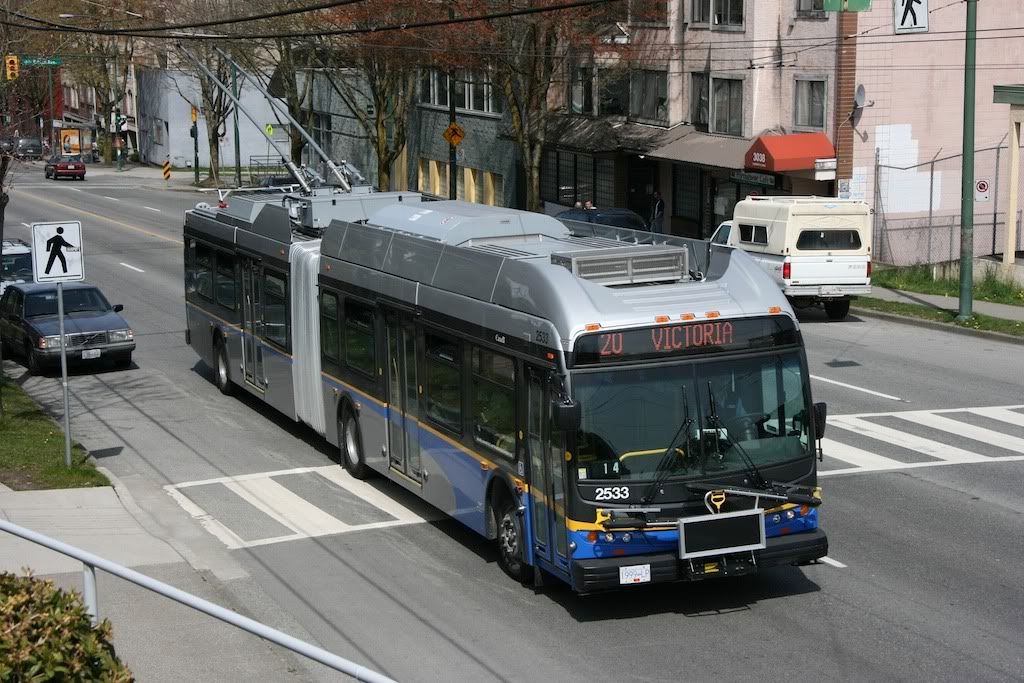 Note that the statement is abbreviated for the title. The full statement is, a common carrier like a train, bus, or plane that running a profit based on passenger revenue while paying its full operating and capital cost is charging too much for its tickets.
The radical abbreviation of the title is in part because of the radical abbreviation of the lie that is commonly used as a frame. The lie is that a common carrier like a train, bus or plane that is paying for its full operating and capital costs out of passenger revenue ought to run a profit, commonly expressed as a charge of, “SERVICE_XYZ is losing money, it needs to be reformed!“, which assumes that Service_XYZ is supposed to be making a profit.
And, of course, in the sense described above, if its a common carrier transport service, of course it shouldn’t be making a profit. And further, if under the above conditions, if its making a profit, you’re doing it wrong. In the sense given above, PROFIT=FAIL.
This is problematic under our economic system, because under our economic system, running a profit on the full cost of production normally means that you are free to continue without substantial outside interference, while not making a profit implies that you have to go cap in hand begging for money to operate. So if the main assertion is correct, we have a situation where you can be doing it wrong, and be free to continue, or be doing it right, and have to constantly beg for permission to continue doing it right.
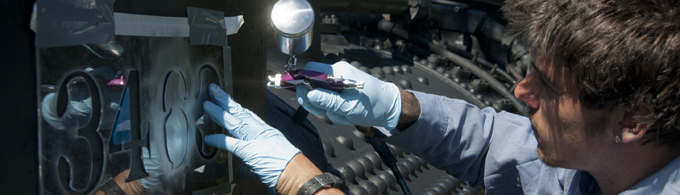 This week’s Sunday Train is a trio of shorter topics. The first is a research development project to develop a modern steam train to run on biocoal. The target is a sustainable steam train that, as a headline grabber, will attempt to run at 130mph and break the world steam train speed record. There’s much to like about this research development project … but I am going to argue that biocoal to operate trains is not it.
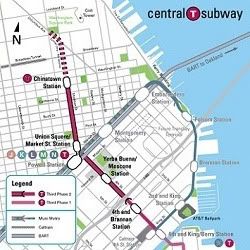 Second, SF’s MUNI transport agency is one of the ten agencies slated to split $760m in Prop1a(2008) bond funds improvements to systems interconnecting with the planned High Speed Rail system. The balance of the $950m goes to the three existing Amtrak California intercity rail services, the Capitol Corridor, the San Joaquin, and the Surfliner.
 And third, a speculative look at an alternative technology that SF MUNI might deploy that money on, that actually would connect with the HSR system at the Transbay Terminal, as well as connecting to BART, the MUNI light rail network, the existing (and proposed alternative) Caltrain terminus at 4th and King, and provide express transit service along Geary Blvd.
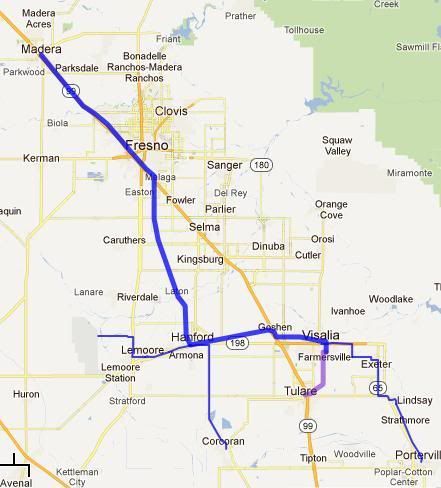 Kings County officials have been
  The headlines out of California indicate that there has been a substantial shift in terms of the California HSR system. In particular, it seems that Gov. Brown has waded into the fray and is reframing the issue from the Only-An-Infrastructure-Geek-Could-Love frame of the Initial Construction Segment and the mythical “Train to Nowhere”, to the “when do I get to ride it?” frame of the Initial Operating Service.
 Nearly a month ago, Yonah Freemark had a post at
Recent Comments